
Christianity is a religion which concerns us as we are here and now, creatures of body and soul. We do not "follow the footsteps of his most holy life" by the exercise of a trained religious imagination, but by treading the firm, rough earth, up hill and down dale.
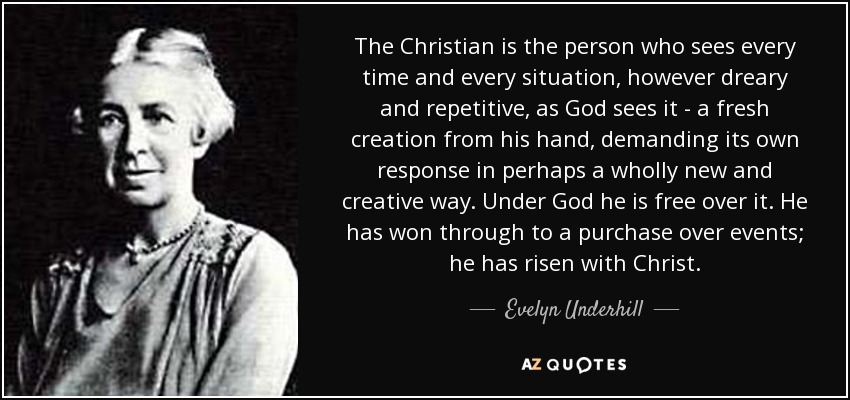
The Christian is the person who sees every time and every situation, however dreary and repetitive, as God sees it - a fresh creation from his hand, demanding its own response in perhaps a wholly new and creative way. Under God he is free over it. He has won through to a purchase over events; he has risen with Christ.
The spiritual life is not a special career, involving abstraction from the world of things. It is a part of every man's life; and until he has realized it, he is not a complete human being, has not entered into possession of all his powers.
The mystic lives and looks; and speaks the disconcerting language of first-hand experience.
Nothing in all nature is so lovely and so vigorous, so perfectly at home in its environment, as a fish in the sea. Its surroundings give to it a beauty, quality, and power which are not its own. We take it out, and at once a poor, limp dull thing, fit for nothing, is gasping away its life. So the soul, sunk in God, living the life of prayer, is supported, filled, transformed in beauty, by a vitality and a power which are not its own.
In mysticism that love of truth which we saw as the beginning of all philosophy leaves the merely intellectual sphere, and takes on the assured aspect of a personal passion. Where the philosopher guesses and argues, the mystic lives and looks; and speaks, consequently, the disconcerting language of first-hand experience, not the neat dialectic of the schools. Hence whilst the Absolute of the metaphysicians remains a diagram —impersonal and unattainable—the Absolute of the mystics is lovable, attainable, alive.
Try to arrange things so that you can have a reasonable bit of quiet every day.
For the most part, of course, the presence of the great spiritual universe surrounding us is no more noticed by us than the pressure of air on our bodies, or the action of light. Our field of attention is not wide enough for that; our spiritual senses are not sufficiently alert. Most people work so hard at developing their correspondence with the visible world, that their power of correspondence with the invisible is left in a rudimentary state.
Mysticism, according to its historical and psychological definitions, is the direct intuition or experience of God; and a mystic is a person who has, to a greater or less degree, such a direct experience -- one whose religion and life are centered, not merely on an accepted belief or practice, but on that which the person regards as first hand personal knowledge.
Mysticism is the art of union with Reality.
The primary declaration of Christianity is not "This do!" but "This happened!
All things are perceived in the light of charity, and hence under the aspect of beauty; for beauty is simply reality seen with the eyes of love.
Grace is God himself, his loving energy at work within his church and within our souls.
The first question here, then, is not "What is best for my soul?" nor is it even "What is most useful to humanity?" But-transcending both these limited aims-what function must this life fulfill in the great and secret economy of God?
Have you ever noticed that Jesus is never recorded as taking a holiday? He retired for the purposes of his mission, not from it. He was never destroyed by his work; he was always on top of it. He moved among people as the master of every situation. He was busier than anyone; the multitudes were always at him, yet he had time, for everything and everyone. He was never hurried, or harassed, or too busy. He had complete supremacy over time; he never let it dictate to him. He talked of my time; my hour. He knew exactly when the moment had come for doing something and when it had not.
A saint is simply a human being whose soul has ... grown up to its full stature, by full and generous response to its environment, God. He has achieved a deeper, bigger life than the rest of us, a more wonderful contact with the mysteries of the Universe; a life of infinite possibility, the term of which he never feels that he has reached.
The mystic cannot wholly do without symbol and image, inadequate to his vision though they must always be: for his experience must be expressed if it is to be communicated, and its actuality is inexpressible except in some hint or parallel which will stimulate the dormant intuition of the reader.
It looks impossible until you do it, and then you find it is possible.
Christian history looks glorious in retrospect; but it is made up of constant hard choices and unattractive tasks, accepted under the pressure of the Will of God.
The life, beauty and meaning of the whole created order, from the tomtit to the Milky Way, refers back to the Absolute Life and Beauty of its Creator: and so lived, every bit has spiritual significance.
All artists are of necessity in some measure contemplative.
A wise man has said: 'Only a Christian can live wholly in the present, for to him the past is pardoned and the future is safe in God.' ...the Christian life must be a life without regrets, without remorse.
The business and method of mysticism is love.
It is important to increase our sense of God's richness and wonder by reading what his great lovers have said about him.
As the social self can only be developed by contact with society, so the spiritual self can only be developed by contact with the spiritual world.
Follow AzQuotes on Facebook, Twitter and Google+. Every day we present the best quotes! Improve yourself, find your inspiration, share with friends
or simply: