Death is not the end, but the beginning of a new life. Yes, it is an end of something that is already dead. It is also a crescendo of what we call life, although very few know what life is. They live, but they live in such ignorance that they never encounter their own life. And it is impossible for these people to know their own death, because death is the ultimate experience of this life, and the beginning experience of another. Death is the door between two lives; one is left behind, one is waiting ahead.
Whatever we say and mean by life is just a journey toward death. If you can understand that your whole life is just a journey and nothing else, then you are less interested in life and more interested in death. And once someone becomes more interested in death, he can go deep into the very depths of life; otherwise, he is just going to remain on the surface.
In life you may be poor or rich, but death is the great equalizer. The greatest communism is in death. Howsoever you live, it makes no difference; death happens equally. In life, equality is impossible; in death, inequality is impossible. Become aware of it, contemplate it.
Death is the greatest illusion of all.
Without zest, what is life? Just waiting for death?
Death is more important than life. Life is just the trivial, just the superficial; death is deeper. Through death you grow to the real life, and through life you only reach death and nothing else.
Paradise is not somewhere else... it is within you. And it is not in some other time, after death... It is in you right now.
The moment you start seeing life as non-serious, a playfulness, all the burden on your heart disappears. All the fear of death, of life, of love - everything disappears.
These are only outer symptoms. Death is the transfer of the soul from one body to another body, or in cases when a man is fully awakened, from one body to the body of the whole universe. It is a great journey, but you cannot know it from the outside. From outside, only symptoms are available; and those symptoms have made people afraid.
The man who has lived his life totally, intensely, passionately, without any fear - without any fear that has been created in you by the priests for centuries and centuries - if a person lives his life without any fear, authentically, spontaneously, death will not create any fear in him, not at all. In fact, death will come as a great rest. Death will come as the ultimate flowering of life. He will be able to enjoy death too; he will be able to celebrate death too.
This is the fear: death will come and we have not lived yet. We are just preparing to live. Nothing is ready; life has not happened. We have not known the ecstasy which life is; we have not known the bliss life is; we have not known anything. We have just been breathing in and out. We have been just existing. Life has been just a hope and death is coming near. And if life has not yet happened and death happens before it, of course, obviously, we will be afraid because we would not like to die.
Those who have known death from inside lose all fear of death.
And remember, that is the criterion. If a person can enjoy and celebrate his death, that shows he has lived rightly; there is no other criterion. Your death will prove how you have lived.
Only those persons who have lived, really lived, are ready, welcoming, receptive, thankful to death. Then death is not the enemy. Then death becomes the fulfillment.
But we are not interested in death at all: rather, we escape the facts, we are continuously escaping the facts. Death is there, and every moment we are dying. Death is not something far away, it is here and now: we are dying. But while we are dying we go on being concerned about life. This concern with life, this over concern with life, is just an escape, just a fear. Death is there, deep inside - growing.
Everybody is afraid of death for the simple reason that we have not tasted of life yet. The man who knows what life is, is never afraid of death; he welcomes death. Whenever death comes he hugs death, he embraces death, he welcomes death, he receives death as a guest. To the man who has not known what life is, death is an enemy; and to the man who knows what life is, death is the ultimate crescendo of life.
The greatest mystery in life is not life itself, but death. Death is the culmination of life, the ultimate blossoming of life. In death the whole life is summed up, in death you arrive. Life is a pilgrimage towards death. From the very beginning, death is coming. From the moment of birth, death has started coming towards you, you have started moving towards death.
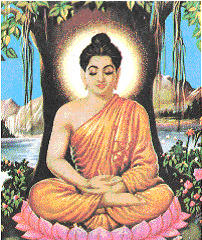
Birth leads to death, death precedes birth. So if you want to see life as it really is, it is rounded on both the sides by death. Death is the beginning and death is again the end, and life is just the illusion in between. You feel alive between two deaths; the passage joining one death to another you call life. Buddha says this is not life. This life is dukkha - misery. This life is death.
Change the emphasis, turn your attention around. If you become concerned with death, your life comes to be revealed to you for the first time, because the moment you become at ease with death you have gained a life that cannot die. The moment you have known death, you have known that life which is eternal.
But everybody is afraid of death; that too is contagious. Your parents are afraid of death, your neighbors are afraid of death. Small children start getting infected by this constant fear all around. Everybody is afraid of death. People don't even want to talk about death.
And the greatest calamity that has happened to the human mind is that he is against death. Being against death means you will miss the greatest mystery. And being against death also means that you will miss life itself - because they are deeply involved into each other; they are not two. Life is growing, death is the flowering of it. The journey and the goal are not separate; the journey ends in the goal.
That is why he appears to us who are deeply life-hypnotized, obsessed about being alive in any way, as life-negating. To us, just to be alive seems to be the end. We are so much afraid of death that Buddha appears in love with death, and that looks abnormal. He seems to be suicidal. This is what many have criticized Buddha for.
Death is the door from the superficial life, the so-called life, the trivial. There is a door. If you pass through the door you reach another life - deeper, eternal, without death, deathless. So from so-called life, which is really nothing but dying, one has to pass through the door of death; only then does one achieve a life that is really existential and active - without death in it.
The religious man, the mystic, tries to explore the mystery of death. In exploring the mystery of death, he inevitably comes to know what life is, what love is. Those are not his goals. His goal is to penetrate death, because there seems to be nothing more mysterious than death. Love has some mystery because of death, and life also has some mystery because of death.
Laughter. Yes, laughter is the Zen attitude towards death and towards life too, because life and death are not separate. Whatsoever is your attitude towards life will be your attitude towards death, because death comes as the ultimate flowering of life. Life exists for death. Life exists through death. Without death there will be no life at all. Death is not the end but the culmination, the crescendo. Death is not the enemy it is the friend. It makes life possible.
Follow AzQuotes on Facebook, Twitter and Google+. Every day we present the best quotes! Improve yourself, find your inspiration, share with friends
or simply: