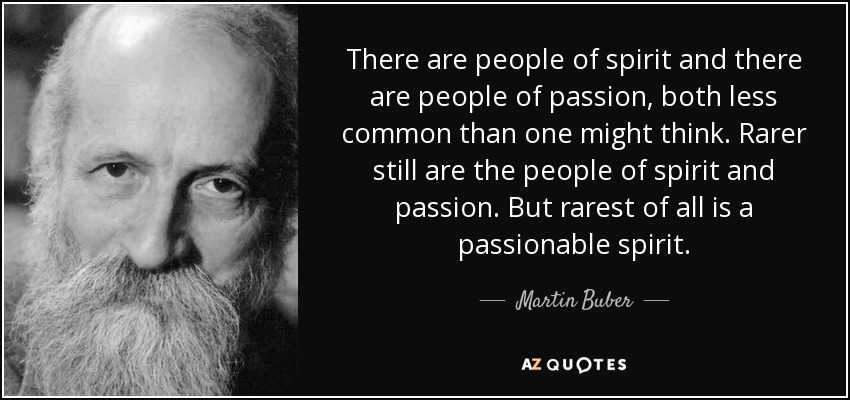
There are people of spirit and there are people of passion, both less common than one might think. Rarer still are the people of spirit and passion. But rarest of all is a passionable spirit.
And if there were a devil it would not be one who decided against God, but one who, in eternity, came to no decision.
Inscrutably involved, we live in the currents of universal reciprocity.
Play is the exultation of the possible.
I have to tell it again and again: I have no doctrine. I only point out something. I point out reality, I point out something in reality which has not or too little been seen. I take him who listens to me at his hand and lead him to the window. I push open the window and point outside. I have no doctrine, I carry on a dialogue.
It is not the nature of the task, but its consecration, that is the vital thing.
So long as you "have" yourself, have yourself as an object, your experience of man is only as of a thing among things.
No limits are set to the ascent of man, and to each and everyone the highest stands open. Here it is only your personal choice that decides.
Through the Thou a person becomes I.
One need ask only 'What for? What am I to unify my being for?' The reply is: Not for my own sake.
This is the eternal origin of art that a human being confronts a form that wants to become a work through him. Not a figment of his soul but something that appears to the soul and demands the soul's creative power. What is required is a deed that a man does with his whole being.
God is the "mysterium tremendum," that appears and overthrows, but he is also the mystery of the self-evident, nearer to me than my I.
Feelings dwell in man; but man dwells in his love. That is no metaphor, but the actual truth. Love does not cling to the I in such a way as to have the Thou only for its " content," its object; but love is between I and Thou. The man who does not know this, with his very being know this, does not know love; even though he ascribes to it the feelings he lives through, experiences, enjoys, and expresses.
You do not attain to knowledge by remaining on the shore and watching the foaming waves, you must make the venture and cast yourself in, you must swim, alert and with all your force, even if a moment comes when you think you are losing consciousness; in this way, and in no other, do you reach anthropological insight.
God said to Abraham: "Get thee out of thy country, and from thy kindred, and from thy father's house, unto the land that I will show thee." God says to man: "First, get you out of your country, that means the dimness you have inflicted on yourself. Then out of your birthplace, that means out of the dimness your mother inflicted on you. After that, out of the house of your father, that means out of the dimness your father inflicted on you. Only then will you be able to go to the land that I will show you"
I shall teach you the best way to say Torah. You must cease to be aware of yourselves. You must be nothing but an ear that hears what the universe of the word is constantly saying within you. The moment you start hearing what you yourself are saying, YOU must stop.
The I of the basic word I-Thou is different from that of the basic word I-It.
If we had the power over the ends of the earth, it would not give us that fulfillment of existence which a quiet devoted relationship to nearby life can give us.
Creation happens to us, burns into us, changes us, we tremble and swoon, we submit. Creation - we participate in it, we encounter the creator, offer ourselves to him, helpers and companions.
All names of God remain hallowed because they have been used not only to speak of God but also to speak to him.
The biblical passage which says of Abraham and the three visiting angels: "And He stood over them under the tree and they did eat" is interpreted by Rabbi Zusya to the effect that man stands above the angels, because he knows something unknown to them, namely, that eating may be hallowed by the eater's intention.... Any natural act, if hallowed, leads to God, and nature needs man for what no angel can perform on it, namely, its hallowing.
When I confront a human being as my Thou and speak the basic word I-Thou to him, then he is no thing among things nor does he consist of things. He is no longer He or She, a dot in the world grid of space and time, nor a condition to be experienced and described, a loose bundle of named qualities. Neighborless and seamless, he is Thou and fills the firmament. Not as if there were nothing but he; but everything else lives in his light.
No purpose intervenes between I and You, no greed and no anticipation; and longing itself is changed as it plunges from the dream into appearance. Every means is an obstacle. Only where all means have disintegrated encounters occur.
It pains me to speak of God in the third person.
Love is responsibility of an I for a You: in this consists what cannot consist in any feeling - the equality of all lovers.
Follow AzQuotes on Facebook, Twitter and Google+. Every day we present the best quotes! Improve yourself, find your inspiration, share with friends
or simply: