
There are times when the mirth of others only saddens us, especially the mirth of children with high spirits, that jar on our own quiet mood.
What men want is not talent, it is purpose; in other words, not the power to achieve, but the will to labor.
More is got from one book on which the thought settles for a definite end in knowledge, than from libraries skimmed over by a wandering eye.
We love the beautiful and serene, but we have a feeling as deep as love for the terrible and dark.
Days are like years in the love of the young, when no bar, no obstacle, is between their hearts,--when the sun shines, and the course runs smooth--when their love is prosperous and confessed.
Rank is a great beautifier.
Life, that ever needs forgiveness, has, for its first duty, to forgive.
I have wrought great use out of evil tools.
Nothing but real love--(how rare it is; has one human heart in a million ever known it?) nothing but real love can repay us for the loss of freedom--the cares and fears of poverty--the cold pity of the world that we both despise and respect.
There is certainly something of exquisite kindness and thoughtful benevolence in that rarest of gifts,--fine breeding.
It is the glorious doom of literature that the evil perishes and the good remains. Even when the original author of some healthy and useful truth is forgotten, the truth survives, transplanted to works more calculated to purify it from error, and perpetuate it to our benefit.
We are not such fools as to pay for reading inferior books, when we can read superior books for nothing.
Though no participator in the joy of more vehement sport, I have a pleasure that I cannot reconcile to my abstract notions of the tenderness due to dumb creatures in the tranquil cruelty of angling. I can only palliate the wanton destructiveness of my amusement by trying to assure myself that my pleasure does not spring from the success of the treachery I practise toward a poor little fish, but rather from that innocent revelry in the luxuriance of summer life which only anglers enjoy to the utmost.
Character is money; and according as the man earns or spends the money, money in turn becomes character. As money is the most evident power in the world's uses, so the use that he makes of money is often all that the world knows about a man.
The curse of the great is ennui.
Man hazards the condition and loses the virtues of a freeman, in proportion as he accustoms his thoughts to view without anguish or shame, his lapse into the bondage of debtor.
A man is already of consequence in the world when it is known that we can implicitly rely upon him. Often I have known a man to be preferred in stations of honor and profit because he had this reputation: When he said he knew a thing, he knew it, and when he said he would do a thing, he did it.
Trees that, like the poplar, lift upward all their boughs, give no shade and no shelter, whatever their height. Trees the most lovingly shelter and shade us, when, like the willow, the higher soar their summits, the lower drop their boughs.
Castles in the air cost a vast deal to keep up.
Fine natures are like fine poems; a glance at the first two lines suffices for a guess into the beauty that waits you if you read on.
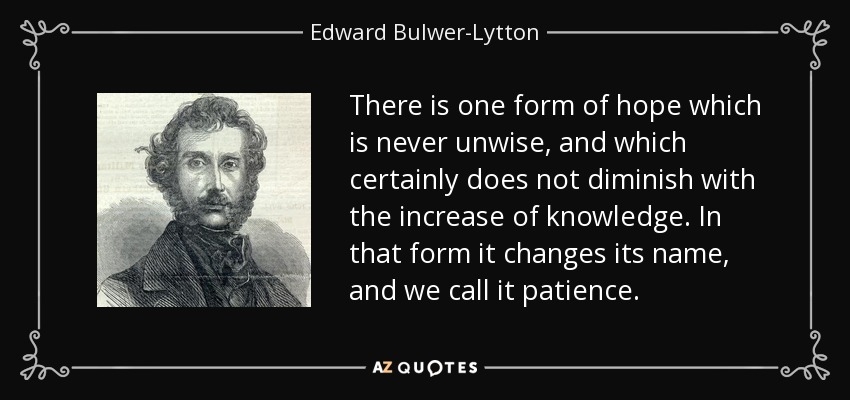
There is one form of hope which is never unwise, and which certainly does not diminish with the increase of knowledge. In that form it changes its name, and we call it patience.
Ask any school-boy up to the age of fifteen where he would spend his holidays. Not one in five hundred will say, "In the streets of London," if you give him the option of green fields and running waters. It is, then, a fair presumption that there must be something of the child still in the character of the men or the women whom the country charms in maturer as in dawning life.
A man's own conscience is his sole tribunal, and he should care no more for that phantom "opinion" than he should fear meeting a ghost if he crossed the churchyard at dark.
It is a very high mind to which gratitude is not a painful sensation. If you wish to please, you will find it wiser to receive, solicit even, favors, than accord them; for the vanity of the obligor is always flattered, that of the obligee rarely.
A man who cannot win fame in big own age will have a very small chance of winning it from posterity. True, there are some half-dozen exceptions to this truth among millions of myriads that attest it; but what man of common sense would invest any large amount of hope in so unpromising a lottery?
Follow AzQuotes on Facebook, Twitter and Google+. Every day we present the best quotes! Improve yourself, find your inspiration, share with friends
or simply: