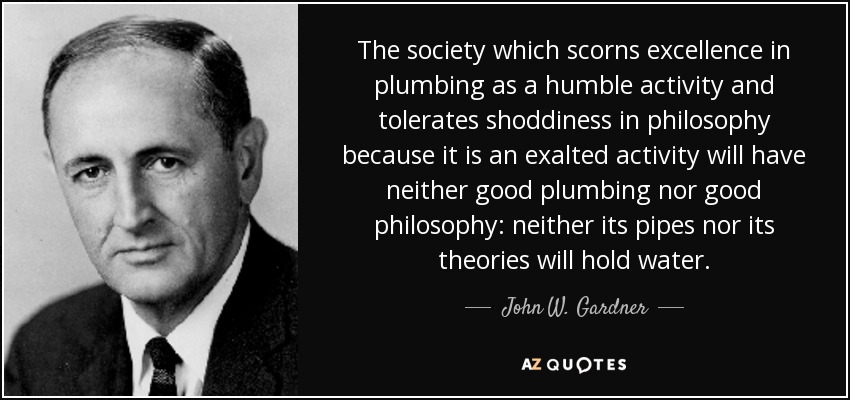

The society which scorns excellence in plumbing as a humble activity and tolerates shoddiness in philosophy because it is an exalted activity will have neither good plumbing nor good philosophy: neither its pipes nor its theories will hold water.
Life is the art of drawing without an eraser.
Excellence is doing ordinary things extraordinarily well.
Much education today is monumentally ineffective. All too often we are giving young people cut flowers when we should be teaching them to grow their own plants.
We pay a heavy price for our fear of failure. It is a powerful obstacle to growth. It assures the progressive narrowing of the personality and prevents exploration and experimentation. There is no learning without some difficulty and fumbling. If you want to keep on learning, you must keep on risking failure-all your life.
Political extremism involves two prime ingredients: an excessively simple diagnosis of the world's ills, and a conviction that there are identifiable villains back of it all.
Some people may have greatness thrust upon them. Very few have excellence thrust upon them. They achieve it. They do not achieve it unwittingly, by “doin' what comes naturally”; and they don't stumble into it in the course of amusing themselves. All excellence involves discipline and tenacity of purpose.
Creativity requires the freedom to consider unthinkable alternatives, to doubt the worth of cherished practices.
True happiness involves the full use of one's power and talents.
Life is an endless process of self-discovery.
A prime function of a leader is to keep hope alive.
Perhaps the most promising trend in our thinking about leadership is the growing conviction that the purposes of the group are best served when the leader helps followers develop their own initiative, strengthens them in the use of their own judgment, enables them to grow, and to become better contributors.
Creativity requires the freedom to consider 'unthinkable' alternatives, to doubt the worth of cherished practices. Every organization, every society is under the spell of assumptions so familiar that they are never questioned, least of all by those most intimately involved.
History never looks like history when you are living through it. It always looks confusing and messy, and it always feels uncomfortable.
The ultimate goal of the educational system is to shift to the individual the burden of pursing his own education. This will not be a widely shared pursuit until we get over our odd conviction that education is what goes on in school buildings and nowhere else.
Tax reduction has an almost irresistible appeal to the politician, and it is no doubt also gratifying to the citizen. It means more dollars in his pocket, dollars that he can spend if inflation doesn't consume them first. But dollars in his pocket won't buy him clean streets or an adequate police force or good schools or clean air and water. Handing money back to the private sector in tax cuts and starving the public sector is a formula for producing richer and richer consumers in filthier and filthier communities. If we stick to that formula we shall end up in affluent misery.
All of us celebrate our values in our behavior.
America's greatness has been the greatness of a free people who shared certain moral commitments. Freedom without moral commitment is aimless and promptly self-destructive.
Some people strengthen the society just by being the kind of people they are.
At home we have lost the capacity to see what is before us. Travel shakes us out of our apathy, and we regain an attentiveness that heightens every experience. The exhilaration of travel has many sources, but surely one of them is that we recapture in some measure the unspoiled awareness of children.
But if we believe what we profess concerning the worth of the individual, then the idea of individual development within a framework of ethical purpose must become our deepest concern, our national preoccupation, our passion, our obsession. We must think of education as relevant for everyone everywhere - at all ages and in all conditions of life.
One of the reasons people stop learning is that they become less and less willing to risk failure.
The cynic says, "One man can't do anything". I say, "Only one man can do anything."
More and more Americans feel threatened by runaway technology, by large-scale organization, by overcrowding. More and more Americans are appalled by the ravages of industrial progress, by the defacement of nature, by man-made ugliness. If our society continues at its present rate to become less livable as it becomes more affluent, we promise all to end up in sumptuous misery.
We pay a heavy price for our fear of failure.
Follow AzQuotes on Facebook, Twitter and Google+. Every day we present the best quotes! Improve yourself, find your inspiration, share with friends
or simply: