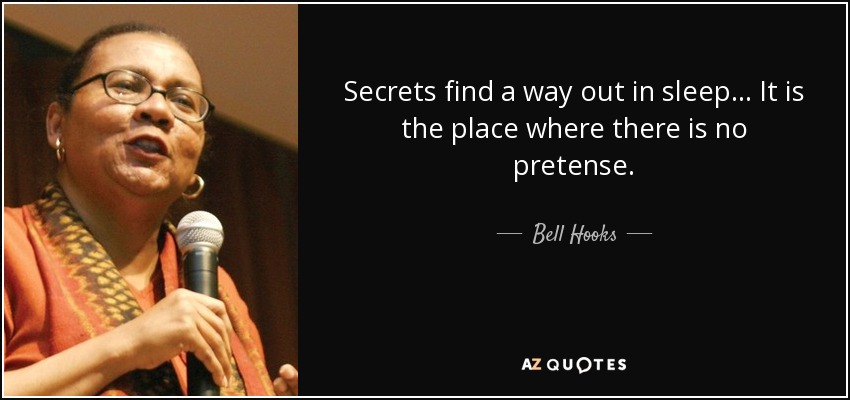








Secrets find a way out in sleep . . . It is the place where there is no pretense.
To love well is the task in all meaningful relationships, not just romantic bonds.
Within a capitalist consumer society, the cult of personality has the power to subsume ideas, to make the person, the personality into the product and not the work itself.
A central theme of all about love is that from childhood into adulthood we are often taught misguided and false assumptions about the nature of love. Perhaps the most common false assumption about love is that love means we will not be challenged or changed.
To indoctrinate boys into the rules of patriarchy, we force them to feel pain and to deny their feelings.
All too often we think of community in terms of being with folks like ourselves: the same class, same race, same ethnicity, same social standing and the like..I think we need to be wary: we need to work against the danger of evoking something that we don’t challenge ourselves to actually practice.
schools for love do not exist. everyone assumes that we will know how to love instinctively. despite overwhelming evidence to the contrary, we still accept that the family is the primary school for love. those of us who do not learn how to love among family are expected to experience love in romantic relationships. however this love often eludes us.
We live in a world with serious class complexes. It is one thing to be a college student with loan debts and another thing to be just dirt poor for your entire life. The challenge is to come up with more complex understandings of where we are, more global awareness of what connects Americans with what is happening with suffering and oppressed people all around the world.
Relationships are treated like Dixie cups. They are the same. They are disposable. If it does not work, drop it, throw it away, get another. Committed bonds (including marriage) cannot last when this is the prevailing logic. Most of us are unclear about what to do to protect and strengthen caring bonds when our self-centered needs are not being met.
While it has become “cool” for white folks to hang out with black people and express pleasure in black culture, most white people do not feel that this pleasure should be linked to unlearning racism.
But love is really more of an interactive process. It's about what we do not just what we feel. It's a verb, not a noun.
In patriarchal culture men are especially inclined to see love as something they should receive without expending effort. More often than not they do not want to do the work that love demands. When the practice of love invites us to enter a place of potential bliss that is at the same time a place of critical awakening and pain, many of us turn our backs on love.
As more people of color raise our consciousness and refuse to be pitted against one another, the forces of neo-colonial white supremacist domination must work harder to divide and conquer.
If you do not know what you feel, then it is difficult to choose love; it is better to fall. Then you do not have to be responsible for your actions.
I think stress is anything going on in our lives that impinges on our capacity to have optimum well being.
If only one party in the relationship is working to create love, to create the space of emotional connection, the dominator model remains in place and the relationship just becomes a site for continuous power struggle.
This rule of silence is upheld when the culture refuses everyone easy access even to the word “patriarchy.” Most children do not learn what to call this system of institutionaliz ed gender roles, so rarely do we name it in everyday speech. This silence promotes denial. And how can we organize to challenge and change a system that cannot be named?
We fear that evaluating our needs and then carefully choosing partners will reveal that there is no one for us to love. Most of us prefer to have a partner who is lacking than no partner at all. What becomes apparent is that we may be more interested in finding a partner than in knowing love.
Feminism is a movement to end sexism, sexist exploitation, and oppression.
I write these words to bear witness to the primacy of resistance struggle in any situation of domination (even within family life); to the strength and power that emerges from sustained resistance and the profound conviction that these forces can be healing, can protect us from dehumanization and despair.
Part of the racialized sexism wants everyone to think that a 15-year old Mexican is not a girl, she’s a woman. We know she’s a girl. We can never emphasize this enough, because this is the fate of colored girls globally right now: the denial of their girlhood, the denial of their childhood, and the constant state of risk and danger they are living in.
Dare I speak ,to oppressed and opressor in the same voice? Dare I speak to you in a language that will move beyond the boundaries of domination- a language, that will not bind you, fence you in, or hold you? Language is also a place of struggle. The oppressed struggle in language to recover ourselves, to reconcile, to reunite, to renew. Our words are not without meaning, they are an action, a resistance. Language is also a place of struggle.
For most people, what is so painful about reading is that you read something and you don't have anybody to share it with. In part what the book club opens up is that people can read a book and then have someone else to talk about it with. Then they see that a book can lead to the pleasure of conversation, that the solitary act of reading can actually be a part of the path to communion and community.
My students tell me, we don't want to love! We're tired of being loving! And I say to them, if you're tired of being loving, then you haven't really been loving, because when you are loving you have more strength.
I would also say that, in practice, many more Americans are anarchists than would ever use that term.
"Dare to look at the intersectionalities."
Follow AzQuotes on Facebook, Twitter and Google+. Every day we present the best quotes! Improve yourself, find your inspiration, share with friends
or simply: