






Even in my side of the world, I've been in publishing for what, 25 or 26 years, and it's gone from being a gentlemen's club to being a few big players, and it's very corporatised.
Most mainstream male fiction is littered with heroines, and female characters are basically so great, you want to fall in love with them.
The combination of modern ordnance and outdated tactics had, as usual, created enormous casualties on both sides.
...[Changers] were a threat to identity, a challenge to the individualism even of those they were never likely to impersonate. It had nothing to do with souls or physical or spiritual possession; it was, as the Idirans well understood, the behavouristic copying of another which revolted. Individuality, the thing which most humans held more precious than anything else about themselves, was somehow cheapened by the ease with which a Changer could ignore it as a limitation and use it as a disguise.
In theory, I work an eight-hour day and a five-day week which means I can socialise with my pals who mostly have normal jobs like teaching and computer programming.
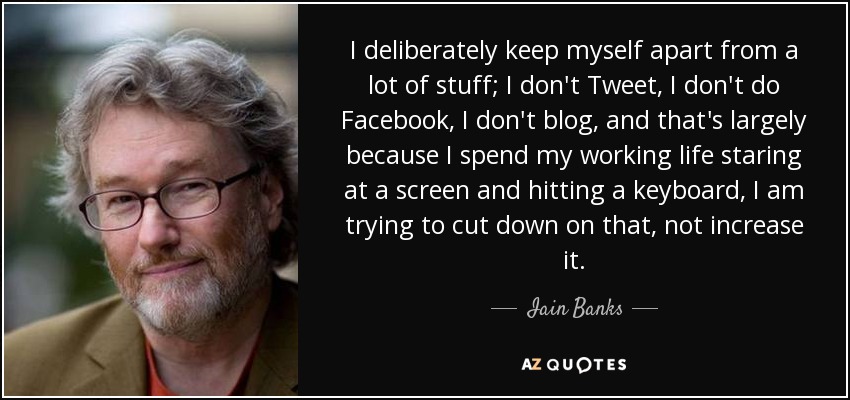
I deliberately keep myself apart from a lot of stuff; I don't Tweet, I don't do Facebook, I don't blog, and that's largely because I spend my working life staring at a screen and hitting a keyboard, I am trying to cut down on that, not increase it.
Science fiction has its own history, its own legacy of what's been done, what's been superseded, what's so much part of the furniture it's practically part of the fabric now, what's become no more than a joke... and so on. It's just plain foolish, as well as comically arrogant, to ignore all this, to fail to do the most basic research.
You get so caught up in what you're writing - action sequences tend to do that more than anything else because you're living it, and feeling for your characters.
Stories set in the Culture in which Things Went Wrong tended to start with humans losing or forgetting or deliberately leaving behind their terminal. It was a conventional opening, the equivalent of straying off the path in the wild woods in one age, or a car breaking down at night on a lonely road in another.
"You like music, Mr. Gurgeh?" Hamin asked, leaning over to the man. Gurgeh nodded. "Well, a little does no harm."
"One of the advantages of having laws is the pleasure one may take in breaking them. We here are not children, Mr. Gurgeh." Hamin waved the pipestem round the tables of people. "Rules and laws exist only because we take pleasure in doing what they forbid, but as long as most of the people obey such proscriptions most of the time, they have done their job; blind obedience would imply we are - ha!" - Hamin chuckled and pointed at the drone with the pipe - "no more than robots!"
Mr Blawke always reminded me of a heron; I'm not sure why. Something to do with a sense of rapacious stillness, perhaps, and also the aura of one who knows time is on his side.
I still have some of my old University essays, and I do still have my drawing book from primary year seven.
But it was pointless, it was stupid; he thought about thoughtless things. If I were a seabird . . . but how could you be a seabird? If you were a seabird your brain would be tiny and stupid and you would love half-rotted fish guts and tweaking the eyes out of little grazing animals; you would know no poetry and you could never appreciate flying as fully as the human on the ground yearning to be you. If you wanted to be a seabird you deserved to be one.
As long as a film stays unmade, the book is entirely yours, it belongs to the writer. As soon as you make it into a film, suddenly more people see it than have ever read the book.
Follow AzQuotes on Facebook, Twitter and Google+. Every day we present the best quotes! Improve yourself, find your inspiration, share with friends
or simply: