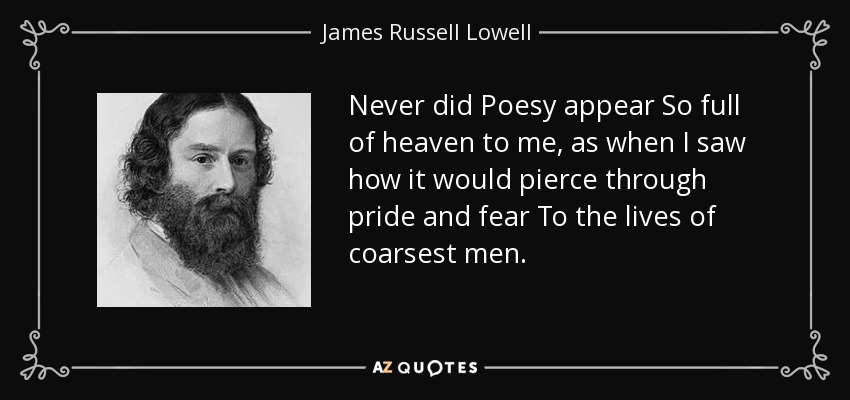
Never did Poesy appear So full of heaven to me, as when I saw how it would pierce through pride and fear To the lives of coarsest men.
A nature wise With finding in itself the types of all, With watching from the dim verge of the time What things to be are visible in the gleams Thrown forward on them from the luminous past, Wise with the history of its own frail heart, With reverence and sorrow, and with love, Broad as the world, for freedom and for man.
The pine is the mother of legends.
The sentimentalist does not think of what he does so much as of what the world will think of what he does.
Not but wut abstract war is horrid, I sign to thet with all my heart, But civilysation doos git forrid Sometimes, upon a powder-cart.
Dear common flower, that grow'st beside the way, Fringing the dusty road with harmless gold, First pledge of blithesome May, Which children pluck, and, full of pride uphold.
It seems to me that the bane of our country is a profession of faith either with no basis of real belief, or with no proper examination of the grounds on which the creed is supposed to rest.
God'll send the bill to you.
A ginooine statesman should be on his guard, if he must hev beliefs, not to b'lieve 'em too hard.
Most long lives resemble those threads of gossamer, the nearest approach to nothing unmeaningly prolonged, scarce visible pathways of some worm from his cradle to his grave.
There is a law of neutralization of forces, which hinders bodies from sinking beyond a certain depth in the sea; but in the ocean of baseness, the deeper we get, the easier the sinking.
O thou, whose days are yet all spring, Faith, blighted once, is past retrieving; Experience is a dumb, dead thing; The victory's in believing.
No sincere desire of doing good need make an enemy of a single human being; that philanthropy has surely a flaw in it which cannot sympathize with the oppressor equally as with the oppressed.
Some kind of pace may be got out of the eeriest jade by the near prospect of oats; but the thoroughbred has the spur in his blood.
It is not a great Xerxes army of words, but a compact Greek ten thousand that march safely down to posterity.
Nature, they say, doth dote, And cannot make a man Save on some worn-out plan Repeating us by rote: For him her Old World moulds aside she threw And, choosing sweet clay from the breast Of the unexhausted West, With stuff untainted shaped a hero new.
A father of the church said that property was theft, many centuries before Proudhon was born. Bourdaloue reaffirmed it. Montesquieu was the inventor of national workshops and of the theory that the state owed every man a living. Nay, was not the church herself the first organized democracy?
The opening of the first grammar school was the opening of the first trench against monopoly in Church and State.
Enthusiasm begets enthusiasm, eloquence produces conviction for the moment; but it is only by truth to Nature and the everlasting institutions of mankind that those abiding influences are won that enlarge from generation to generation.
Faith in God, faith in man, faith in work: this is the short formula in which we may sum up the teachings of the founders of New England,--a creed ample enough for this life and the next.
Fastidiousness is only another word for egotism; and all men who know not where to look for truth save in the narrow well of self will find their own image at the bottom, and mistake it for what they are seeking.
There are two kinds of genius. The first and highest may be said to speak out of the eternal to the present, and must compel its age to understand it; the second understands its age, and tells it what it wishes to be told.
God does not weigh criminality in our scales. We have one absolute, with the seal of authority upon it; and with us an ounce is an ounce, and a pound a pound. God's measure is the heart of the offender,--a balance which varies with every one of us, a balance so delicate that a tear cast in the other side may make the weight of error kick the beam.
It is singular how impatient men are with overpraise of others, how patient of overpraise of themselves; and yet the one does them no injury, while the other may be their ruin.
In the parliament of the present every man represents a constituency of the past.
Follow AzQuotes on Facebook, Twitter and Google+. Every day we present the best quotes! Improve yourself, find your inspiration, share with friends
or simply: