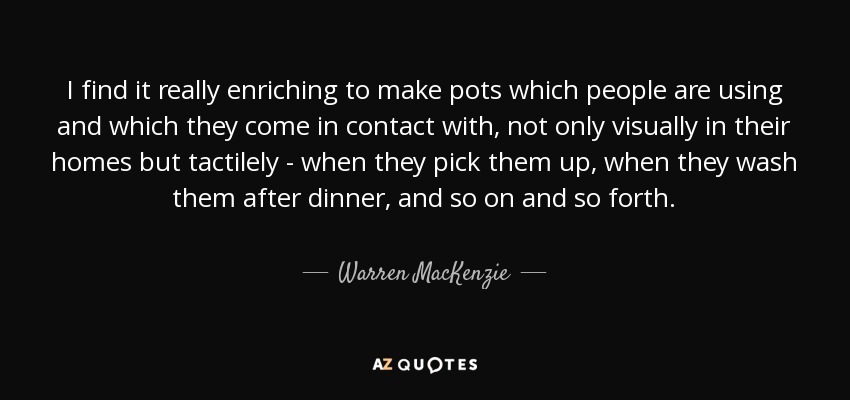
I find it really enriching to make pots which people are using and which they come in contact with, not only visually in their homes but tactilely - when they pick them up, when they wash them after dinner, and so on and so forth.
In working on a drawing or a painting, one can rework and rework and rework and change ideas until you get it the way you think is right at that time. With clay that's not possible. You either succeed the first time, or you should wad it up and start over again, because you can't mess around with the clay and still have it fresh.
Things happen very quickly and they have to happen quickly in order to have vitality, which I think is essentially part of a good pot. But in addition it means that you can explore an idea and change it and then change it and then change it; I don't mean by changing the one pot, but you make one pot then you make another that's related to that; you make another - you can make 50 pots in a day and none of them are going to be carbon copies of any other, but they'll all be related because there's something going through your mind about the form on that particular day.
If you press-mold a pot or if you slab-build a pot, the work has got to take much, much, much longer than if you work on the wheel. And I to this day have the ideal that I want my work to be not too expensive, so that if people buy it and break it, it's not going to be the end of the world. I'm not interested in having things in museums, although some of our work has ended up there, but that's not what I'm striving for.
In fact, I believe to a certain extent a person today who starts with just clay, with no drawing and no painting and no figure drawing, still-life drawing, various things, they miss a great deal.
We'll be potters, we'll be painters, we'll be textile designers, we'll be jewelers, we'll be a little this, a little of that. We were going to be the renaissance people [when we were young].
I make a lot of pots in a year's time and some of them are good and some of them are mediocre and some of them are bad. If they're really bad and I'd be ashamed of them, I throw them out, but if they're mediocre and they'll serve the purpose for which they're designed, that is, a mixing bowl or a soup bowl or a plate or whatever, I sell them. And this income from the sale of these pots permits me to go on and make other pots. It's even more important now that I've quit teaching, because I do not have a teacher's salary to fall back on.
In looking at these pots at the Field Museum, Alix [MacKenzie] and I both came to a conclusion individually but also collectively that the pots that really interested us were the pots that people had used in their everyday life, and we began to think - I mean, whether it was ancient Greece or Africa or Europe or wherever, the pots that people had used in their homes were the ones that excited us.
Here is this ability to explore ideas, but with minute changes, and then look at the results. Often you get so excited about what you're doing that you think, "Oh, wow, this is just great." And you look at it a week later and you realize you'd been excited by the act of creation, but what you've created is not really exciting when you look at it in cold blood. And so that, to me, is a valuable lesson also.
Remember, this is back in the 1940s, and it was sculpture which probably - in my instance probably came out of the European influence, [Alexander] Archipenko and things of that sort, [Jacques] Lipchitz to a certain extent, and I was influenced by those things and attempted to do work that emulated their style.
So I very quickly stopped almost all decoration. I was interested in the three-dimensional form of the pots, but my decoration was nonexistent.
Alix [MacKenzie], on the other hand, found that her painting would translate much more readily into decoration, and she could play with the spacing and the intensity of imagery on the form in a way which I could not. So that when we established our pottery, I was most unhappy with my decoration.
Our main inspiration [with Alix MacKenzie], I think, came from the Field Museum of Natural History, because they had pieces which were selected not for art content but for their relationship to the anthropological history of mankind.
Finally if I had a pot that needed decoration, I would hand it to Alix [MacKenzie] and I would say, "Can you do something with this?" And she'd look at it for a while and then proceed with a brush to embellish the form and enhance the form, and it was wonderful. She could bring the pot to life, whereas if I did it, it was a disaster.
This is something which I think I have been able to communicate to both people I have taught and people that have purchased our work since that time, that they all say, it's so nice to have these pots with us all the time and to eat out of them and be in direct contact with them in our homes.
At the end of that two weeks Bernard [Leach] asked us if we would like to sit with him tending the kiln, the big oil-fired kiln that they had. He was still sitting what we call a kiln watch at that time, and he wondered if we would like to sit the watch with him and talk. So naturally this was our last opportunity to talk with him, so we said yes. We didn't realize Bernard's kiln watch was from 1:00 in the morning until 4:00 AM.
The two teachers that I had in the Art Institute who affected me the most were Kathleen Blackshear and Robert von Neumann; Kathleen Blackshear because she taught a class called design - I can't remember, design something, and in this class - it met once a week - we would do work centered around some theme, word or subject or technique or whatever, and bring it in for a three-hour discussion. And Kathleen was able, in watching and looking at our work, to direct us to all kinds of things which might relate to what we were trying to do, but she never attempted to tell us what to do.
I thought, oh, I'm going to be a painter. And eventually my family had moved near Chicago, and when I graduated from high school, I went to the Chicago Art Institute, and it was there that I thought, well, now I'm going to be a painter.
In searching for further training we turned to England and Bernard Leach. We thought since we had responded to his book so strongly that this would be the sort of training that we would like to have. We saved money, during the summer went to Europe, and the first stop was to go to England, visit the Leach Pottery and ask Leach if he would take us on as apprentices.
I'm striving to make things which are the most exciting things I can make that will fit in people's homes. And in that respect, working on the wheel is economically about the only answer I know, because one can, as Leach said, make 50 pots in a day. You can make 100 pots in a day. A really good potter can make 400 pots in a day.
We were working from very exact models and dimensions and weights of clay to make these pots which had been designed some 10 or 12 years previous to our arriving [at Bernard's Leach studio]. And we, being, I guess you would say young, arrogant Americans, thought that we ought to be able to somehow express ourselves a little bit more in the daily work of the pottery.
Eventually we even got to the point where we could disagree with [Bernard Leach]. I mean, when we first went there, gee, I mean, this was a man who had written a book. He was, in a sense, God, and we for the first couple of weeks called him Mr. Leach.
I thought I was going to be able to use my painting ideas as decoration on pottery, but my painting did not translate into decoration on pottery. I thought it was going to, and in fact I made, while still in school, a plate with one of my paintings on it, and that's exactly what it was, it was a plate with a painting on it. It was not a decorated plate; it was just a painting superimposed over a three-dimensional ceramic form.
The interesting thing was we never talked about pottery. Bernard [Leach] talked about social issues; he talked about the world political situation, he talked about the economy, he talked about all kinds of things.
Friends of Bernard's [Leach] came to visit, and when we went to London, we were given introductions to people like Lucie Rie, Hans Coper, Richard Batram. All these people were, let's say, made available to us by a friendship with Leach. In addition there was a potter's group - what was it called? I think it was called the Cornish Potters Society, but I'm not sure of that. Anyway, they had meetings and we would go with Leach to these meetings and meet other potters, and they would have programs where they would discuss pottery and people would interchange ideas.
"Every pot is not going to be a masterpiece."
Follow AzQuotes on Facebook, Twitter and Google+. Every day we present the best quotes! Improve yourself, find your inspiration, share with friends
or simply: