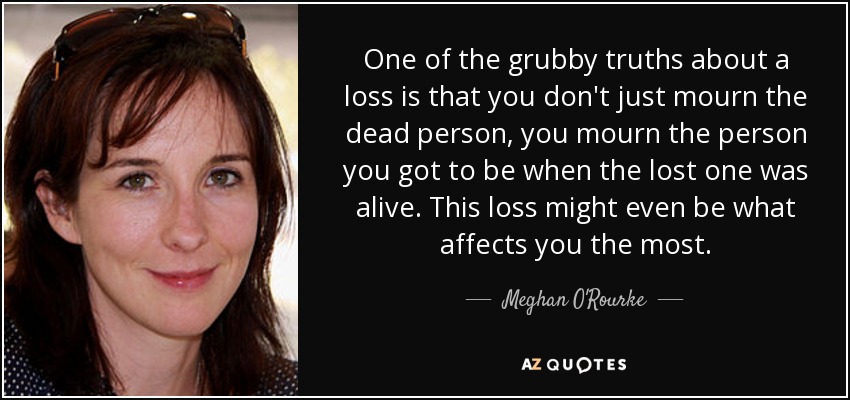





One of the grubby truths about a loss is that you don't just mourn the dead person, you mourn the person you got to be when the lost one was alive. This loss might even be what affects you the most.
There is always tension in women's gymnastics between athleticism, grace, performance, and eros.
Our minds are mysterious; our conscious brain is like a ship on a sea that is obscure to us.
What's endlessly complicated in thinking about women's gymnastics is the way that vulnerability and power are threaded through the sport.
It's all too easy when talking about female gymnasts to fall into the trap of infantilizing them, spending more time worrying more about female vulnerability than we do celebrating female strength.
I live to collect information, and I am also a perfectionist.
One of the ideas I've clung to most of my life is that if I just try hard enough it will work out.
But there is a discomfort that surrounds grief. It makes even the most well-intentioned people unsure of what to say. And so many of the freshly bereaved end up feeling even more alone.
Many Americans don't mourn in public anymore - we don't wear black, we don't beat our chests and wail.
I believe in the importance of individuality, but in the midst of grief I also find myself wanting connection - wanting to be reminded that the sadness I feel is not just mine but ours.
With ferocity and extraordinary craft, Lizzie Harris has made a book of poems that resonates far beyond the personal stories it tells. Stop Wanting reveals, in every lyric, its author's profound metaphorical gifts. In its ironies and intensities, it brings to mind a writer like the young Sylvia Plath, though what is startling about Harris' s work is the way it combines those gifts with a muted, deft self-awareness. Most of all, these are wonderfully shaped, powerful, and surprising poems-a startling debut.
My mother never liked Mother's Day. She thought it was a fake holiday dreamed up by Hallmark to commodify deep sentiments that couldn't be expressed with a card.
Television has never known what to do with grief, which resists narrative: the dramas of grief are largely internal - for the bereaved, it is a chaotic, intense, episodic period, but the chaos is by and large subterranean, and easily appears static to the friendly onlooker who has absorbed the fact of loss and moved on.
And after my mother's death I became more open to and empathetic about other people's struggles and losses.
My mother died of metastatic colorectal cancer shortly before three P.M. on Christmas Day of 2008. I don't know the exact time of her death, because none of us thought to look at a clock for a while after she stopped breathing.
Grief is at once a public and a private experience. One's inner, inexpressible disruption cannot be fully realized in one's public persona.
Much of Hamlet is about the precise kind of slippage the mourner experiences: the difference between being and seeming, the uncertainty about how the inner translates into the outer, the sense that one is expected to perform grief palatably. (If you don’t seem sad, people worry; but if you are grief-stricken, people flinch away from your pain.)
Suddenly it was fall, the season of death, the anniversary of things-going-to-hell.
The people we most love do become a physical part of us, ingrained in our synapses, in the pathways where memories are created.
Relationships take up energy; letting go of them, psychiatrists theorize, entails mental work. When you lose someone you were close to, you have to reassess your picture of the world and your place in it. The more your identity was wrapped up with the deceased, the more difficult the loss.
A mother is beyond any notion of a beginning. That's what makes her a mother.
But when my mother died, I found that I did not believe that she was gone.
'Hamlet' is the best description of grief I've read because it dramatizes grief rather than merely describing it.
To mourn is to wonder at the strangeness that grief is not written all over your face in bruised hieroglyphics. And it's also to feel, quite powerfully, that you're not allowed to descend into the deepest fathom of your grief - that to do so would be taboo somehow.
'Hamlet' is a play about a man whose grief is deemed unseemly.
"A mother is the portal by which you enter the world."
Follow AzQuotes on Facebook, Twitter and Google+. Every day we present the best quotes! Improve yourself, find your inspiration, share with friends
or simply: