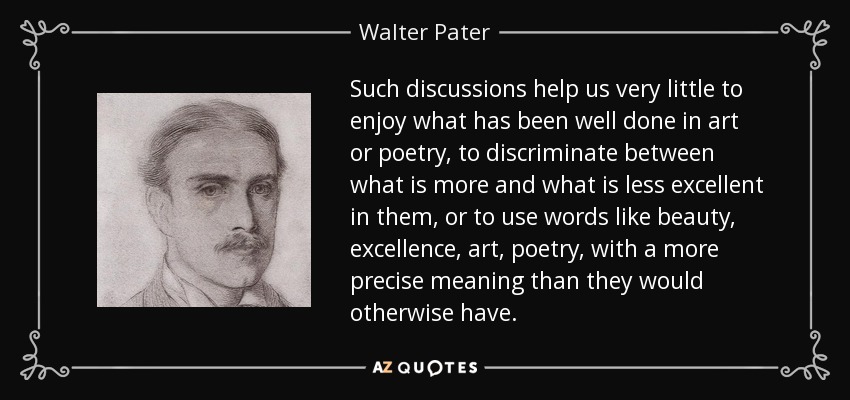
Such discussions help us very little to enjoy what has been well done in art or poetry, to discriminate between what is more and what is less excellent in them, or to use words like beauty, excellence, art, poetry, with a more precise meaning than they would otherwise have.
Poetry, at all times, exercises two distinct functions: it may reveal, it may unveil to every eye, the ideal aspects of common thingsor it may actually add to the number of motives poetic and uncommon in themselves, by the imaginative creation of things that are ideal from their very birth.
A very intimate sense of the expressiveness of outward things, which ponders, listens, penetrates, where the earlier, less developed consciousness passed lightly by, is an important element in the general temper of our modern poetry.
Philosophical theories or ideas, as points of view, instruments of criticism, may help us to gather up what might otherwise pass unregarded by us.
One of the most beautiful passages of Rousseau is that in the sixth book of Confessions, where he describes the awakening in him of the literary sense. Of such wisdom, the poetic passion, the desire of beauty, the love of art for its own sake, has most.
A counted number of pulses only is given to us of a variegated, dramatic life. How may we see in them all that is to to be seen in them by the finest senses?
To regard all things and principles of things as inconstant modes or fashions has more and more become the tendency of modern thought.
No account of the Renaissance can be complete without some notice of the attempt made by certain Italian scholars of the fifteenth century to reconcile Christianity with the religion of ancient Greece.
Every moment some form grows perfect in hand or face; some tone on the hills or the sea is choicer than the rest; some mood of passion or insight or intellectual excitement is irresistibly real and attractive for us - for that moment only.
Great passions may give us a quickened sense of life, ecstasy and sorrow of love, the various forms of enthusiastic activity, disinterested or otherwise, which comes naturally to many of us.
Why do you always write poetry? Why do you not write prose? Prose is so much more difficult.
All art does but consist in the removal of surplusage.
How shall we pass most swiftly from point to point, and be present always at the focus where the greatest number of vital forces unite in their purest energy?
A certain strangeness, something of the blossoming of the aloe, is indeed an element in all true works of art: that they shall excite or surprise us is indispensable.
That the mere matter of a poem, for instance--its subject, its given incidents or situation; that the mere matter of a picture--the actual circumstances of an event, the actual topography of a landscape--should be nothing without the form, the spirit of the handling, that this form, this mode of handling, should become an end in itself, should penetrate every part of the matter;Mthis is what all art constantly strives after, and achieves in different degrees.
The Renaissance of the fifteenth century was, in many things, great rather by what it designed then by what it achieved.
The various forms of intellectual activity which together make up the culture of an age, move for the most part from different starting-points, and by unconnected roads.
A book, like a person, has its fortunes with one; is lucky or unlucky in the precise moment of its falling in our way, and often by some happy accident counts with us for something more than its independent value.
Through the survival of their children, happy parents are able to think calmly, and with a very practical affection, of a world in which they are to have no direct share.
For us necessity is not as of old an image without us, with whom we can do warfare; it is a magic web woven through and through us, like that magnetic system of which modern science speaks, penetrating us with a network subtler than our subtlest nerves, yet bearing in it the central forces of the world.
Experience, already reduced to a group of impressions, is ringed round for each one of us by that thick wall of personality through which no real voice has ever pierced on its way to us, or from us to that which we can only conjecture to be without.
Has nature connected itself together by no bond, allowed itself to be thus crippled, and split into the divine and human elements? Well! there are certain divine powers of a middle nature, through whom our aspirations are conveyed to the gods, and theirs to us. A celestial ladder, a ladder from heaven to earth.
And the fifteenth century was an impassioned age, so ardent and serious in its pursuit of art that it consecrated everything with which art had to ad as a religious object.
It is with a rush of home-sickness that the thought of death presents itself.... Such sentiment is the eternal stock of all religions, modified indeed by changes of time and place, but indestructible, because its root is so deep in the earth of man's nature. The breath of religious initiators passes over them; a few "rise up with wings as eagles" [Isaiah 40:31], but the broad level of religious life is not permanently changed. Religious progress, like all purely spiritual progress, is confined to a few.
In truth, the legitimate contention is, not of one age or school of literary art against another, but of all successive schools alike, against the stupidity which is dead to the substance, and the vulgarity which is dead to form.
Follow AzQuotes on Facebook, Twitter and Google+. Every day we present the best quotes! Improve yourself, find your inspiration, share with friends
or simply: