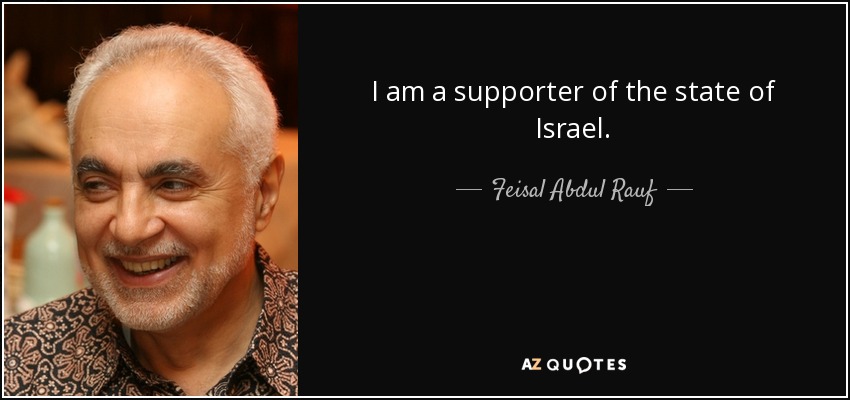


I am a supporter of the state of Israel.
The Islamic method of waging war is not to kill innocent civilians, but it was Christians in World War II who bombed civilians in Dresden and Hiroshima, neither of which were military targets.
If Muslims curse the Christians, then the Christians will curse the Muslims. And people will curse Allah, and Allah will hold us responsible for that.
The ultimate vision is to instate in the Muslim world the notion of multiculturalism, which is part of our heritage and history, part of the fundamental, mainstream ideals of Islam.
Fanaticism and terrorism have no place in Islam.
I condemn everyone and anyone who commits acts of terrorism. And Hamas has committed acts of terrorism.
What's right with America and what's right with Islam have a lot in common. At their highest levels, both worldviews reflect an enlightened recognition that all of humankind shares a common Creator - that we are, indeed, brothers and sisters.
I was completely surrounded by religion from a young time. I was taught by my father. I engaged in discussions with him and many of these scholars who visited and came around the dining table, the lunch table, and attended many lectures with my dad. And so I learned the apprentice way.
I read, read enormously on all different fields of Islamic thought, from philosophy to Islamic literature, poetry, exegeses, knowledge of the Hadith, the teachings of the prophet. That's how I trained myself. And then I was appointed imam by a Sufi master from Istanbul, Turkey.
I am an American citizen born in Kuwait of Egyptian parents. I grew up in Great Britain, Malaysia, and Egypt and have lived in the United States since 1965, when I was seventeen.
We are not going to toy with our religion or any other. Nor are we going to barter. We are here to extend our hands to build peace and harmony.
We tend to forget in the West that the United States has more Muslim blood on its hands than Al Qaeda has on its hands of innocent non-Muslims.
In spite of the polls, the fact is that American Muslims are very happy and they thrive in this country.
In Malaysia, where Western culture was extremely influential, I'd grown up listening to Elvis and the Beatles and watching American movies. People wanted to be like Americans. In contrast, when I got here, I saw prosperous middle-class American college students wanting to somehow join the Third World.
We are Americans. We - we - we are - we are doctors. We are investment bankers. We are taxi drivers. We are store keepers. We are lawyers. We are - we are part of the fabric of America. And the way that America today treats its Muslims is being watched by over a billion Muslims worldwide.
I have never made a threat. I've never made a threat, never expressed a threat, never - I've never - I would never threaten violence ever, because I am a man of peace, dedicated to peace.
I'm not an agent from any government, even if some of you may not believe it. I'm not. I'm a peacemaker.
The battleground has been moderates of all faith traditions in all the countries of the world against the radicals of all faith traditions in all parts of the world.
Yusuf Qaradawi is probably the most well-known legal authority in the whole Muslim world today.
A kind of racism still exists in the United States, and Islamophobia is a more convenient way to express that sentiment. There has also been an attempt to paint Muslims as enemies of the United States.
I've spoken with friends who are rabbis and priests and we've agreed that most people have an emotional attachment to their faith, a desire to fulfill their spiritual longings, but they are not experts in understanding the history of their religion.
It is part of my responsibility as a bridge builder to speak the truth about what's great about America, what we've done right, and what our less glorious moments. And many people feel that the Iraq adventure, for example, has been one of our less glorious moments.
In the 20th century, the Muslim world created a vision of religious nationalism. Turkey, for example, had to be ethnically Turkish. Kurds, Armenians, other minorities didn't have a place in such a vision of a nation-state.
When I arrived in America, I experienced serious culture shock. For someone with a religious upbringing, the 1960s were an extremely difficult time. Even though religion was a big part of the civil rights and peace movements, in my college religion was treated as irrelevant, hopelessly stodgy, and behind the times.
Follow AzQuotes on Facebook, Twitter and Google+. Every day we present the best quotes! Improve yourself, find your inspiration, share with friends
or simply: