
Across the sea of space, the stars are other suns.
Where did God come from? If we decide this is an unanswerable question why not save a step and conclude that the origin of the universe is an unanswerable question.
I also wish that the Pledge of Allegiance were directed at the Constitution and the Bill of Rights, as it is when the President takes his oath of office, rather than to the flag and the nation
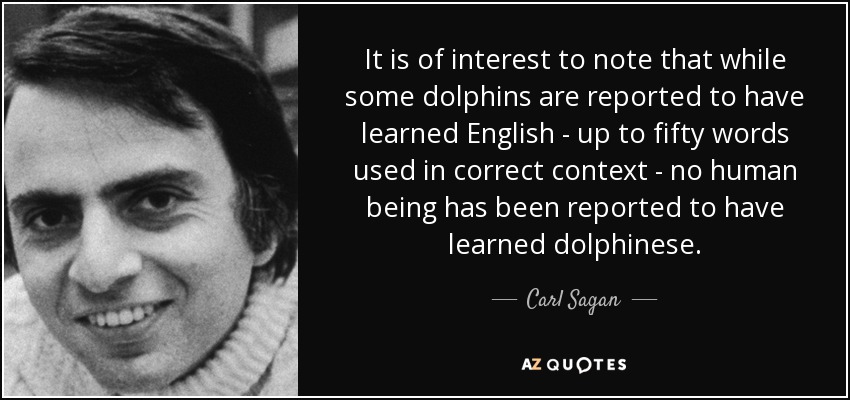
It is of interest to note that while some dolphins are reported to have learned English - up to fifty words used in correct context - no human being has been reported to have learned dolphinese.
And you are made of a hundred trillion cells. We are, each of us, a multitude.
Science is an attempt, largely successful, to understand the world, to get a grip on things, to get hold of ourselves, to steer a safe course. Microbiology and meteorology now explain what only a few centuries ago was considered sufficient cause to burn women to death.
There are lots of ways to communicate what we know, but few ways to communicate what we feel. Music is one way to communicate emotions.
But I try not to think with my gut. If I'm serious about understanding the world, thinking with anything besides my brain, as tempting as that might be, is likely to get me into trouble.
We are a way of the universe knowing itself.
I believe that the extraordinary should be pursued. But extraordinary claims require extraordinary evidence.
All inquiries carry with them some element of risk.
Writing is perhaps the greatest of human inventions, binding together people who never knew each other, citizens of distant epochs. Books break the shackles of time. A book is proof that humans are capable of magic.
Science is not perfect. It's often misused; it's only a tool, but it's the best tool we have. Self-correcting , ever changing, applicable to everything: with this tool, we vanquish the impossible.
A book is made from a tree. It is an assemblage of flat, flexible parts (still called "leaves") imprinted with dark pigmented squiggles. One glance at it and you hear the voice of another person, perhaps someone dead for thousands of years. Across the millennia, the author is speaking, clearly and silently, inside your head, directly to you. Writing is perhaps the greatest of human inventions, binding together people, citizens of distant epochs, who never knew one another. Books break the shackles of time ― proof that humans can work magic.
We humans look rather different from a tree. Without a doubt we perceive the world differently than a tree does. But down deep, at the molecular heart of life, the trees and we are essentially identical.
What distinguishes our species is thought. The cerebral cortex is in a way a liberation. We need no longer be trapped in the genetically inherited behavior patterns of lizards and baboons: territoriality and aggression and dominance hierarchies. We are each of us largely responsible for what gets put in to our brains. For what as adults we wind up caring for and knowing about. No longer at the mercy of the reptile brain we can change ourselves. Think of the possibilities.
The vast distances that separate the stars are providential. Beings and worlds are quarantined from one another. The quarantine is lifted only for those with sufficient self-knowledge and judgment to have safely traveled from star to star.
We are made of star-stuff. Our bodies are made of star-stuff. There are pieces of star within us all.
In the way that scepticism is sometimes applied to issues of public concern, there is a tendency to belittle, to condescend, to ignore the fact that, deluded or not, supporters of superstition and pseudoscience are human beings with real feelings, who, like the sceptics, are trying to figure out how the world works and what our role in it might be. Their motives are in many cases consonant with science. If their culture has not given them all the tools they need to pursue this great quest, let us temper our criticism with kindness. None of us comes fully equipped.
Think of how many religions attempt to validate themselves with prophecy. Think of how many people rely on these prophecies, however vague, however unfulfilled, to support or prop up their beliefs. Yet has there ever been a religion with the prophetic accuracy and reliability of science? ... No other human institution comes close.
The library connects us with the insight and knowledge, painfully extracted from Nature, of the greatest minds that ever were, with the best teachers, drawn from the entire planet and from all our history, to instruct us without tiring, and to inspire us to make our own contribution to the collective knowledge of the human species.
In many cultures it is customary to answer that God created the universe out of nothing. But this is mere temporizing. If we wish courageously to pursue the question, we must, of course ask next where God comes from? And if we decide this to be unanswerable, why not save a step and conclude that the universe has always existed?
It is clear that the nations of the world now can only rise and fall together. It is not a question of one nation winning at the expense of another. We must all help one another or all perish together.
Our perceptions are fallible. We sometimes see what isn't there. We are prey to optical illusions. Occasionally we hallucinate. We are error-prone.
The Cosmos is all that is or was or ever will be. Our feeblest contemplations of the Cosmos stir us -- there is a tingling in the spine, a catch in the voice, a faint sensation, as if a distant memory, of falling from a height. We know we are approaching the greatest of mysteries.
Follow AzQuotes on Facebook, Twitter and Google+. Every day we present the best quotes! Improve yourself, find your inspiration, share with friends
or simply: