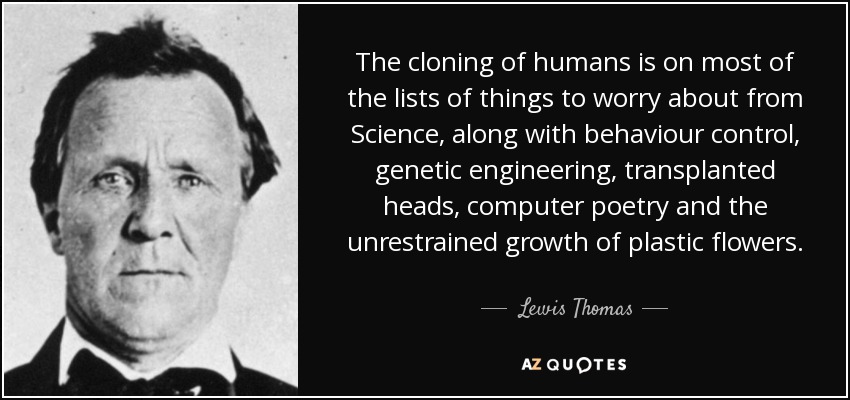



The cloning of humans is on most of the lists of things to worry about from Science, along with behaviour control, genetic engineering, transplanted heads, computer poetry and the unrestrained growth of plastic flowers.
My mitochondria comprise a very large proportion of me. I cannot do the calculation, but I suppose there is almost as much of them in sheer dry bulk as there is the rest of me. Looked at in this way, I could be taken for a very large, motile colony of respiring bacteria, operating a complex system of nuclei, microtubules, and neurons for the pleasure and sustenance of their families, and running, at the moment, a typewriter.
We are not made up, as we had always supposed, of successively enriched packets of our own parts. We are shared, rented, occupied. At the interior of our cells, driving them, providing the oxidative energy that sends us out for the improvement of each shining day, are the mitochondria, and in a strict sense they are not ours.
Good applied science in medicine, as in physics, requires a high degree of certainty about the basic facts at hand, and especially about their meaning, and we have not yet reached this point for most of medicine.
We are a spectacular, splendid manifestation of life. We have language. . . . We have affection. We have genes for usefulness, and usefulness is about as close to a 'common goal' of nature as I can guess at.
Good science is done by being curious in general, by asking questions all around, by acknowledging the likelihood of being wrong and taking this in good humor for granted, by having a deep fondness for nature, and by being made jumpy and nervous by ignorance.
Well, biology today as I see it has an amiable look - quite different from the 19th-century view that the whole arrangement of nature is hostile, 'red in tooth and claw.' That came about because people misread Darwin's 'survival of the fittest.'
We are told that the trouble with modern man is that he has been trying to detach himself from nature... In this scenario, Man comes on as a stupendous lethal force, and the Earth is pictured as something delicate, like rising bubbles at the surface of a country pond, or flights of fragile birds.
We are built to make mistakes, coded for error.
The whole dear notion of one's own Self-marvelous old free-willed, free- enterprising, autonomous, independent, isolated island of a Self- is a myth.
We spend our time sending messages to each other, talking and trying to listen at the same time, exchanging information. This seems to be our most urgent biological function; it is what we do with our lives.
I will confess that I have no more sense of what goes on in the mind of mankind than I have for the mind of an ant.
I don't want to be reincarnated, that's for sure. When you've had rewarding experiences in your life - a loving family, friends - you don't need additional reassurances that you're going to do something with a new cast of characters. I'd just as soon pass.
Society evolves not by shouting each other down, but by the unique capacity of unique, individual human beings to comprehend each other.
The greatest of all the accomplishments of 20th century science has been the discovery of human ignorance
It's just plain learning something that you didn't know. There is a real aesthetic experience in being dumbfounded.
Medical knowledge and technical savvy are biodegradable. The sort of medicine that was practiced in Boston or New York or Atlanta fifty years ago would be as strange to a medical student or intern today as the ceremonial dance of a !Kung San tribe would seem to a rock festival audience in Hackensack.
Selfness is an essential fact of life. The thought of nonselfness, precise sameness is terrifying.
Exclamation points are the most irritating of all. Look! they say, look at what I just said! How amazing is my thought! It is like being forced to watch someone else's small child jumping up and down crazily in the center of the living room shouting to attract attention. If a sentence really has something of importance to say, something quite remarkable, it doesn't need a mark to point it out. And if it is really, after all, a banal sentence needing more zing, the exclamation point simply emphasizes its banality!
The greatest achievements in the science of this [twentieth] century are themselves the sources of more puzzlement than human beings have ever experienced. Indeed, it is likely that the twentieth century will be looked back at as the time when science provided the first close glimpse of the profundity of human ignorance. We have not reached solutions; we have only begun to discover how to ask questions.
We are educated to be amazed by the infinite variety of life forms in nature. We are, I believe, only at the beginning of being flabbergasted by its unity.
As a species, taking all in all, we are still too young, too juvenile, to be trusted. We have spread across the face of the earth in just a few thousand years, no time at all as evolution clocks time, covering all livable parts of the planet, endangering other forms of life, and now threatening ourselves.
On any Tuesday morning, if asked, a good working scientist will tell you with some self-satisfaction that the affairs of his field are nicely in order, that things are finally looking clear and making sense, and all is well. But come back again on another Tuesday, and the roof may have just fallen in on his life's work.
I have always had a bad memory, as far back as I can remember.
The only solid piece of scientific truth about which I feel totally confident is that we are profoundly ignorant about nature... It is this sudden confrontation with the depth and scope of ignorance that represents the most significant contribution of twentieth-century science to the human intellect.
Follow AzQuotes on Facebook, Twitter and Google+. Every day we present the best quotes! Improve yourself, find your inspiration, share with friends
or simply: