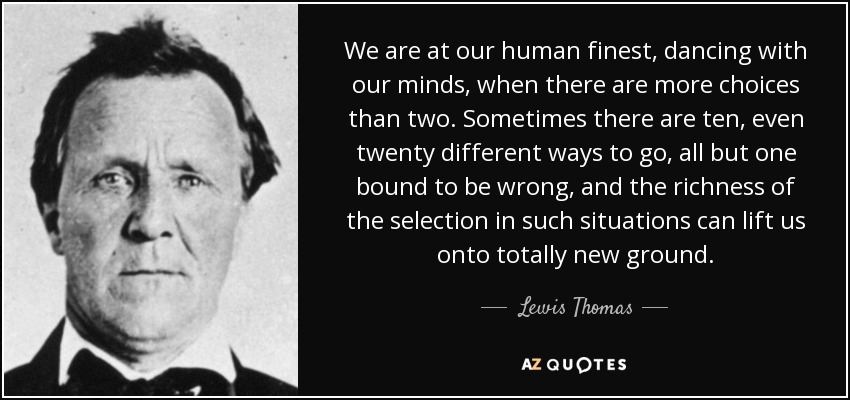

We are at our human finest, dancing with our minds, when there are more choices than two. Sometimes there are ten, even twenty different ways to go, all but one bound to be wrong, and the richness of the selection in such situations can lift us onto totally new ground.
We have dominated and overruled nature, and from now on the earth is ours, a kitchen garden until we learn to make our own chlorophyll and float it out in the sun inside plastic mebranes. We will build Scarsdale on Mount Everest.
Although I usually think I know what I'm going to be writing about, what I'm going to say, most of the time it doesn't happen that way at all. At some point I get misled down a garden path, I get surprised by an idea that I hadn't anticipated getting, which is a little bit like being in a laboratory.
Left to ourselves, mechanistic and autonomic, we hanker for friends.
Everything here is alive thanks to the living of everything else.
If we have learned anything at all in this century, it is that all new technologies will be put to use, sooner or later, for better or worse, as it is in our nature to do.
Altruism has always been one of biology's deep mysteries. Why should any animal, off on its own, specified and labeled by all sorts of signals as its individual self, choose to give up its life in aid of someone else?
It is a distortion, with something profoundly disloyal about it, to picture the human being as a teetering, fallible contraption, always needing, watching and patching, always on the verge of flapping to pieces.
Man is embedded in nature.
We still think of human disease as the work of an organized, modernized kind of demonology, in which the bacteria are the most visible and centrally placed of our adversaries. We assume that they must somehow relish what they do.
If we are to be destroyed we will do it ourselves by warfare with thermonuclear weaponry.
We hanker to go on, even in the face of plain evidence that long, long lives are not necessarily pleasurable in the kind of society we have arranged thus far. We will be lucky if we can postpone the search for new technologies for a while, until we have discovered some satisfactory things to do with the extra time.
The drive to be useful is encoded in our genes. But when we gather in very large numbers, as in the modern nation-state, we seem capable of levels of folly and self-destruction to be found nowhere else in all of nature. But if we keep at it and keep alive, we are in for one surprise after another. We can build structures for human society never seen before, thoughts never heard before, music never heard before.
Maybe there is a single spot, just one, where living organisms are holed up. Maybe so, but if so this would be the strangest thing of all, absolutely incomprehensible. For we are not familiar with this kind of living. We do not have solitary, isolated creatures. It is beyond our imagination to conceive of a single form of life that exists alone and independent, unattached to other forms.
Most things get better by themselves. Most things, in fact, are better by morning.
We have yet to learn how to retain our humaneness when assembled in masses.
Follow AzQuotes on Facebook, Twitter and Google+. Every day we present the best quotes! Improve yourself, find your inspiration, share with friends
or simply: