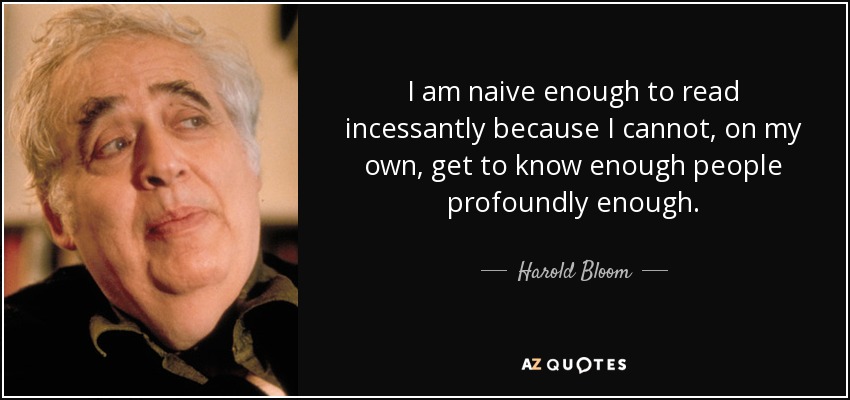






I am naive enough to read incessantly because I cannot, on my own, get to know enough people profoundly enough.
Shakespeare is universal.
No one yet has managed to be post-Shakespearean.
Hamlet, Kierkegaard, Kafka are ironists in the wake of Jesus. All Western irony is a repetition of Jesus' enigmas/riddles, in amalgam with the ironies of Socrates.
Dark influences from the American past congregate among us still. If we are a democracy, what are we to make of the palpable elements of plutocracy, oligarchy, and mounting theocracy that rule our state? How do we address the self-inflicted catastrophes that devastated our natural environment? So large is our malaise that no single writer can encompass it. We have no Emerson or Whitman among us. An institutionalized counterculture condemns individuality as archaic and depreciates intellectual values, even in the universities. (The Anatomy of Influence)
Literature is achieved anxiety.
I don't believe in myths of decline or myths of progress, even as regards the literary scene.
No poem, not even Shakespeare or Milton or Chaucer, is ever strong enough to totally exclude every crucial precursor text or poem.
We can be reluctant to recognize how much of our culture was literary, particularly now that so many of the institutional purveyors of literature happily have joined in proclaiming its death. A substantial number of Americans who believe they worship God actually worship three major literary characters: the Yahweh of the J Writer (earliest author of Genesis, Exodus, Numbers), the Jesus of the Gospel of Mark, and Allah of the Koran.
Sometimes one succeeds, sometimes one fails.
What is supposed to be the very essence of Judaism - which is the notion that it is by study that you make yourself a holy people - is nowhere present in Hebrew tradition before the end of the first or the beginning of the second century of the Common Era.
One measures oncoming old age by its deepening of Proust, and its deepening by Proust. How to read a novel? Lovingly, if it shows itself capable of accomodating one's love; and jealously, because it can become the image of one's limitations in time and space, and yet can give the Proustian blessing of more life.
Personality, in our sense, is a Shakespearean invention.
The world gets older, without getting either better or worse and so does literature. But I do think that the drab current phenomenon that passes for literary studies in the university will finally provide its own corrective.
I would say that there is no future for literary studies as such in the United States.
The very best of all Merwin: I have been reading William since 1952, and always with joy.
Not a moment passes these days without fresh rushes of academic lemmings off the cliffs they proclaim the political responsibilities of the critic, but eventually all this moralizing will subside.
What I think I have in common with the school of deconstruction is the mode of negative thinking or negative awareness, in the technical, philosophical sense of the negative, but which comes to me through negative theology.
The morality of scholarship, as currently practiced, is to encourage everyone to replace difficult pleasures by pleasures universally accessible precisely because they are easier.
In the finest critics one hears the full cry of the human. They tell one why it matters to read.
To be a poet did not occur to me. It was indeed a threshold guarded by demons.
More even than Southern Presbyterians and Southern Methodists, the Baptists provided the great mass of Confederate enlisted men.
I take it that a successful therapy is an oxymoron.
I think the Greek New Testament is the strongest and most successful misreading of a great prior text in the entire history of influence.
At our present bad moment, we need above all to recover our sense of literary individuality and of poetic autonomy.
Follow AzQuotes on Facebook, Twitter and Google+. Every day we present the best quotes! Improve yourself, find your inspiration, share with friends
or simply: