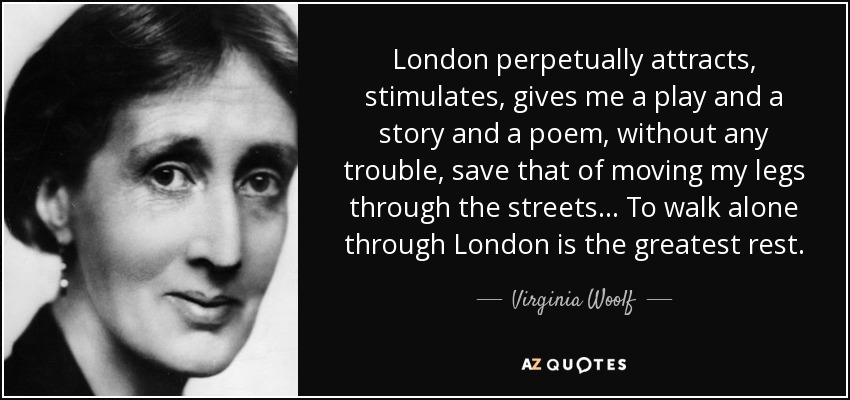
London perpetually attracts, stimulates, gives me a play and a story and a poem, without any trouble, save that of moving my legs through the streets... To walk alone through London is the greatest rest.
for it was not knowledge but unity that she desired, not inscriptions on tablets, nothing that could be written in any language known to men, but intimacy itself, which is knowledge
The roar of the traffic, the passage of undifferentiated faces, this way and that way, drugs me into dreams; rubs the features from faces. People might walk through me. And what is this moment of time, this particular day in which I have found myself caught? The growl of traffic might be any uproar - forest trees or the roar of wild beasts. Time has whizzed back an inch or two on its reel; our short progress has been cancelled. I think also that our bodies are in truth naked. We are only lightly covered with buttoned cloth; and beneath these pavements are shells, bones and silence.
The weight of the world is on our shoulders, its vision is through our eyes; if we blink or look aside, or turn back to finger what Plato said or remember Napoleon and his conquests, we inflict on the world the injury of some obliquity. This is life.
The world has raised its whip; where will it descend?
Her life was a tissue of vanity and deceit.
Lord, how tired one gets of one's own writing.
No passion is stronger in the breast of man than the desire to make others believe as he believes
Rhoda comes now, having slipped in while we were not looking. She must have made a tortuous course, taking cover now behind a waiter, now behind some ornamental pillar, so as to put off as long as possible the shock of recognition, so as to be secure for one more moment to rock her petals in her basin. We wake her. We torture her. She dreads us, she despises us, yet she comes cringing to our sides because for al our cruelty there is always some name, some face which sheds a radiance, which lights up her pavements and makes it possible for her to replenish her dreams.
The future is dark, which is the best thing the future can be, I think.
There is no doubt in my mind, that I have found out how to begin (at 40) to say something in my own voice.
Let a man get up and say, Behold, this is the truth, and instantly I perceive a sandy cat filching a piece of fish in the background. Look, you have forgotten the cat, I say.
Oh, I am in love with life!
Here was a woman about the year 1800 writing without hate, without bitterness, without fear, without protest, without preaching. That was how Shakespeare wrote, I thought, looking at Antony and Cleopatra; and when people compare Shakespeare and Jane Austen, they may mean that the minds of both had consumed all impediments; and for that reason we do not know Jane Austen and we do not know Shakespeare, and for that reason Jane Austen pervades every word that she wrote, and so does Shakespeare.
Reading [poetry], you know, is rather like opening the door to a horde of rebels who swarm out attacking one in twenty places at once - hit, roused, scraped, bared, swung through the air, so that life seems to flash by; then again blinded, knocked on the head - all of which are agreeable sensations for a reader (since nothing is more dismal than to open the door and get no response).
scarcely a human being in the course of history has fallen to a woman's rifle; the vast majority of birds and beasts have been killed by you, not by us. Obviously there is for you some glory, some necessity, some satisfaction in fighting which we have never felt or enjoyed.
She had the perpetual sense, as she watched the taxi cabs, of being out, out, far out to sea and alone; she always had the feeling that it was very, very, dangerous to live even one day.
Words, English words, are full of echoes, of memories, of associations. They have been out and about, on people's lips, in their houses, in the streets, in the fields, for so many centuries. And that is one of the chief difficulties in writing them today -- that they are stored with other meanings, with other memories, and they have contracted so many famous marriages in the past.
Mr. Beerbohm in his way is perfect ... He has brought personality into literature, not unconsciously and impurely, but so consciously and purely that we do not know whether there is any relation between Max the essayist and Mr. Beerbohm the man. We only know that the spirit of personality permeates every word that he writes ... He is without doubt the prince of his profession.
But I think I’m coloured by my own wishes, & experimental mood.
I was in a queer mood, thinking myself very old: but now I am a woman again - as I always am when I write.
Fear no more, says the heart, committing its burden to some sea, which sighs collectively for all sorrows, and renews, begins, collects, lets fall
Besides, in this random miscellaneous company we may rub against some complete stranger who will, with luck, turn into the best friend we have in the world.
So long as you write what you wish to write, that is all that matters; and whether it matters for ages or only for hours, nobody can say. But to sacrifice a hair of the head of your vision, a shade of its colour, in deference to some Headmaster with a silver pot in his hand or to some professor with a measuring-rod up his sleeve, is the most abject treachery, and the sacrifice of wealth and chastity which used to be said to be the greatest of human disasters, a mere flea-bite in comparison.
Green in nature is one thing, green in literature another. Nature and letters seem to have a natural antipathy; bring them together and they tear each other to pieces.
Follow AzQuotes on Facebook, Twitter and Google+. Every day we present the best quotes! Improve yourself, find your inspiration, share with friends
or simply: