
. . . to walk alone in London is the greatest rest.
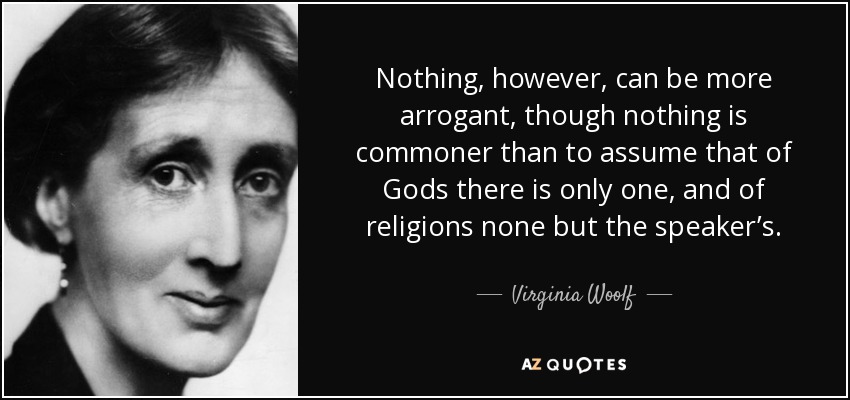
Nothing, however, can be more arrogant, though nothing is commoner than to assume that of Gods there is only one, and of religions none but the speaker’s.
O friendship, I too will press flowers between the pages of Shakespeare's sonnets!
women have always been poor, not for two hundred years merely, but from the beginning of time. ... Women, then, have not had a dog's chance of writing poetry. That is why I have laid so much stress on money and a room of one's own.
Use words that soak up life.
There is a sadness at the back of life which some people do not attempt to mitigate. Entirely aware of their own standing in the shadow, and yet alive to every tremor and gleam of existence, there they endure.
The poet is always our contemporary.
I think writing, my writing, is a species of mediumship. I become the person.
every secret of a writer's soul, every experience of his life, every quality of his mind is written large in his works, yet we require critics to explain the one and biographers to expound the other. That time hangs heavy on people's hands is the only explanation of the monstrous growth.
Like a ghostly roll of drums remorselessly beat the measure of life.
I ride rough waters, and shall sink with no one to save me.
Novels so often provide an anodyne and not an antidote, glide one into torpid slumbers instead of rousing one with a burning brand.
There is much to support the view that it is clothes that wear us, and not we, them; we may make them take the mould of arm or breast, but they mould our hearts, our brains, our tongues to their liking.
Lines slip easily down the accustomed grooves. The old designs are copied so glibly that we are half inclined to think them original, save for that very glibness.
That perhaps is your task--to find the relation between things that seem incompatible yet have a mysterious affinity, to absorb every experience that comes your way fearlessly and saturate it completely so that your poem is a whole, not a fragment; to re-think human life into poetry and so give us tragedy again and comedy by means of characters not spun out at length in the novelist's way, but condensed and synthesized in the poet's way--that is what we look to you to do now.
What a lark! What a plunge!
I feel certain that I'm going mad again, I feel we can't go thru another of those terrible times. And I shan't recover this time. I begin to hear voices
It was odd, she thought, how if one was alone, one leant to inanimate things; trees, streams, flowers; felt they expressed one; felt they became one; felt they knew one, in a sense were one; felt an irrational tenderness thus (she looked at that long steady light) as for oneself.
If one is to deal with people on a large scale and say what one thinks, how can one avoid melancholy? I don’t admit to being hopeless, though: only the spectacle is a profoundly strange one; and as the current answers don’t do, one has to grope for a new one, and the process of discarding the old, when one is by no means certain what to put in their place, is a sad one.
It is the duty of the writer to describe.
We scarcely wish to analyse what we feel to be so large and deeply human.
The poet gives us his essence, but prose takes the mould of the body and mind entire.
So the days pass, and I ask myself whether one is not hypnotized, as a child by a silver globe, by life, and whether this is living.
It was a silly, silly dream, being unhappy.
With her foot on the threshold she waited a moment longer in a scene which was vanishing even as she looked, and then, as she moved and took Minta's arm and left the room, it changed, it shaped itself differently; it had become, she knew, giving one last look at it over her shoulder, already the past.
Follow AzQuotes on Facebook, Twitter and Google+. Every day we present the best quotes! Improve yourself, find your inspiration, share with friends
or simply: