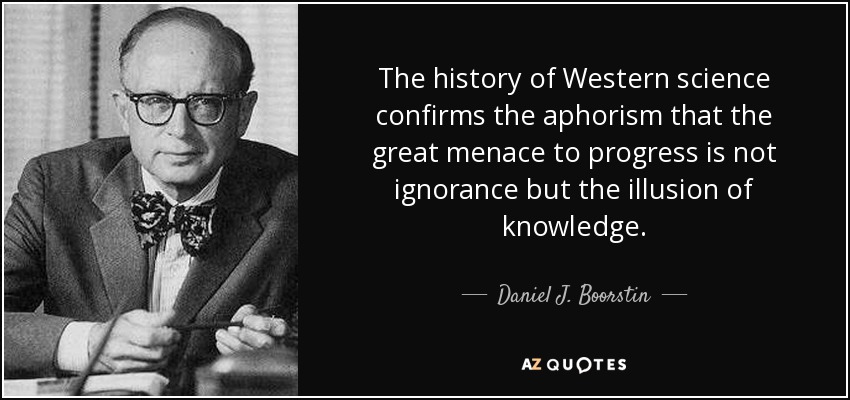
The history of Western science confirms the aphorism that the great menace to progress is not ignorance but the illusion of knowledge.
The traveler was active; he went strenuously in search of people, of adventure, of experience. The tourist is passive; he expects interesting things to happen to him. He goes 'sight-seeing.'
By reading we discover our world, our history, and ourselves.
Beware of charisma . . . Representative Men; was Ralph Waldo Emerson's 1850 phrase for the great men in a democracy . . . Is there some common quality among these Representative Men who have been most successful as our leaders? I call it the need to be authentic-or, as our dictionaries tell us, conforming to fact and therefore worthy of trust, reliance or belief. While the charismatic has an uncanny outside source of strength, the authentic is strong because he is what he seems to be.
In America, communities existed before governments. There were many groups of people with a common sense of purpose and a feeling of duty to one another before there were political institutions.
Never have people been more the masters of their environment. Yet never has a people felt more deceived and disappointed. For never has a people expected so much more than the world could offer.
The problem for us is less to discover the way it really is than to see the meaning of the way.
As individuals and as a nation, we now suffer from social narcissism. The beloved Echo of our ancestors, the virgin America, has been abandoned. We have fallen in love with our own image, with images of our making, which turn out to be images of ourselves.
Disagreement produces debate but dissent produces dissension.
The traveler used to go about the world to encounter the natives. A function of travel agencies now is to prevent this encounter.
Each living art object, taken out of its native habitat so we can conveniently gaze at it, is like an animal in a zoo. Something about it has died in the removal.
We read advertisements... to discover and enlarge our desires. We are always ready - even eager - to discover, from the announcement of a new product, what we have all along wanted without really knowing it.
Throught human history, illusions of knowledge, not ignorance, have proven to be the principal obstacles to discovery
No agnostic ever burned anyone at the stake or tortured a pagan, a heretic, or an unbeliever.
More appealing than knowledge itself is the feeling of knowledge.
The hero created himself; the celebrity is created by the media.
Knowledge is not simply another commodity. On the contrary. Knowledge is never used up. It increases by diffusion and grows by dispersion.
Being known primarily for their well-knownness, celebrities intensify their celebrity images simply by becoming widely known for relations among themselves. By a kind of symbiosis, celebrities live off one another.
Time makes heroes but dissolves celebrities.
A pseudo-event ... comes about because someone has planned it, planted, or incited it. Typically, it is not a train wreck or an earthquake, but an interview.
The modern American tourist now fills his experience with pseudo-events. He has come to expect both more strangeness and more familiarity than the world naturally offers. He has come to believe that he can have a lifetime of adventure in two weeks and all the thrills of risking his life without any real risk at all.
The celebrity is a person who is known for his well-knownness.
The most promising words ever written on the maps of human knowledge are terra incognita, unknown territory.
What preoccupies us, then, is not God as a fact of nature, but as a fabrication useful for a God-fearing society. God himself becomes not a power but an image.
I write to discover what I think. After all, the bars aren't open that early.
Follow AzQuotes on Facebook, Twitter and Google+. Every day we present the best quotes! Improve yourself, find your inspiration, share with friends
or simply: