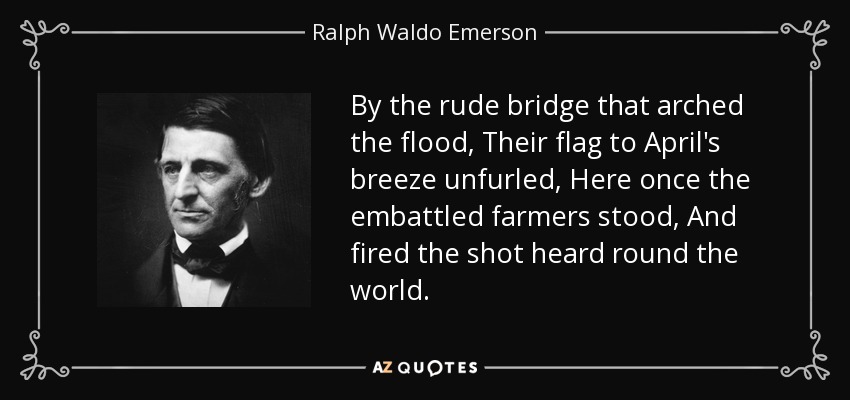
By the rude bridge that arched the flood, Their flag to April's breeze unfurled, Here once the embattled farmers stood, And fired the shot heard round the world.
Genius detects through the fly, through the caterpillar, through the grub, through the egg, the constant individual; through countless individuals the fixed species; through many species the genus; through all genera the steadfast type; through all the kingdoms of organized life the eternal unity. Nature is a mutable cloud which is always and never the same.
But genius is religious. It is a larger imbibing of the common heart.
No rent-roll nor army-list can dignify skulking and dissimulation: and the first point of courtesy must always be truth, as really all the forms of good-breeding point that way.
Every man who would do anything well, must come to it from a higher ground.
A man must be clothed with society, or we shall feel a certain bareness and poverty, as of a displaced and unfurnished member. He is to be dressed in arts and institutions, as well as in body garments. Now and then a man exquisitely made can live alone, and must; but coop up most men and you undo them.
The power men possess to annoy me I give them by a weak curiosity
Some men's words I remember so well that I must often use them to express my thought. Yes, because I perceive that we have heard the same truth, but they have heard it better.
One thing is forever good; That one thing is Success.
The senses collect the surface facts of matter... It was sensation; when memory came, it was experience; when mind acted, it was knowledge; when mind acted on it as knowledge, it was thought.
The hues of the opal, the light of the diamond, are not to be seen if the eye is too near.
If you cannot be free be as free as you can.
Circumstance does not make the man. Circumstance reveals man to himself.
Man is the will, and woman the sentiment. In this ship of humanity, Will is the rudder, and Sentiment the sail; when woman affects to steer, the rudder is only a masked sail.
It is long ere we discover how rich we are. Our history, we are sure, is quite tame: we have nothing to write, nothing to infer. But our wiser years still run back to the despised recollections of childhood, and always we are fishing up some wonderful article out of that pond; until, by and by, we begin to suspect that the biography of the one foolish person we know is, in reality, nothing less than the miniature paraphrase of the hundred volumes of the Universal History.
Another sort of false prayers are our regrets. Discontent is the way of self-reliance: it is infirmity of will. Regret calamities, if you can thereby help the sufferer; if not, attend your own work, and already the evil begins to be repaired.
Man is endogenous, and education is his unfolding. The aid we have from others is mechanical, compared with the discoveries of nature in us. What is thus learned is delightful in the doing, and the effect remains.
Right is more beautiful than private affection, and is compatible with universal wisdom.
The kingdom of man over nature, which cometh not with observation,--a dominion such as now is beyond his dream of God,--he shall enter without more wonder than the blind man feels who is gradually restored to perfect sight.
Every rational creature has all nature for his dowry and estate. It is his, if he will. He may divest himself of it; he may creepinto a corner, and abdicate his kingdom, as most men do, but he is entitled to the world by his constitution.
Nature always wears the colors of the spirit. To a man laboring under calamity, the heat of his own fire hath sadness in it.
The visible heavens and earth sympathize with Jesus.
In a cabinet of natural history, we become sensible of a certain occult recognition and sympathy in regard to the most unwieldy and eccentric forms of beast, fish, and insect.
The use of natural history is to give us aid in supernatural history: the use of the outer creation, to give us language for the beings and changes of the inward creation.
Nature will not let us fret and fume. She does not like our benevolence or our learning much better than she likes our frauds andwars. When we come out of the caucus, or the bank, or the abolition-convention, or the temperance-meeting, or the transcendental club, into the fields and woods, she says to us, "so hot? my little Sir.
Follow AzQuotes on Facebook, Twitter and Google+. Every day we present the best quotes! Improve yourself, find your inspiration, share with friends
or simply: