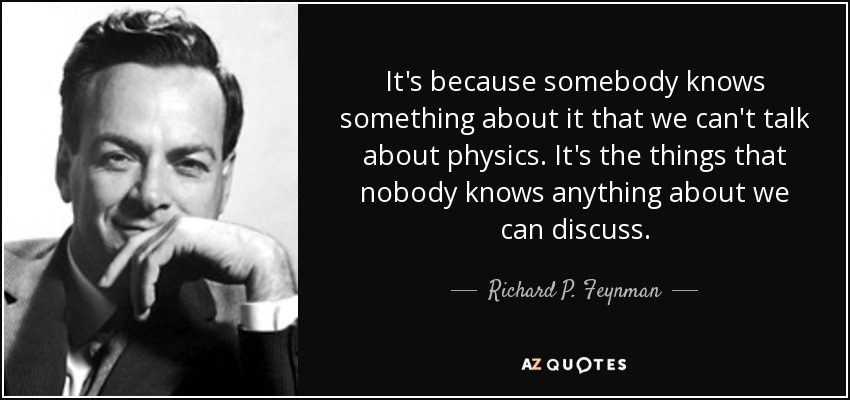

It's because somebody knows something about it that we can't talk about physics. It's the things that nobody knows anything about we can discuss.
I am a successful lecturer in physics for popular audiences. The real entertainment gimmick is the excitement, drama and mystery of the subject matter. People love to learn something, they are 'entertained' enormously by being allowed to understand a little bit of something they never understood before. One must have faith in the subject and in people's interest in it.
I couldn't claim that I was smarter than sixty-five other guys--but the average of sixty-five other guys, certainly!
Some things that satisfy the rules of algebra can be interesting to mathematicians even though they don't always represent a real situation.
Physicists like to think that all you have to do is say, these are the conditions, now what happens next?
In a way, the Nobel Prize has been something of a pain in the neck, though there was at least one time that I got some fun out of it, Shortly after I won the Prize, Gweneth and I received an invitation from the Brazilian government to be the guests of honor at the Carnaval celebrations in Rio.
What would happen if we could arrange the atoms one by one the way we want them?
There is one simplification at least. Electrons behave ... in exactly the same way as photons; they are both screwy, but in exactly in the same way.
We are very lucky to be living in an age in which we are still making discoveries. It is like the discovery of America-you only discover it once. The age in which we live is the age in which we are discovering the fundamental laws of nature, and that day will never come again. It is very exciting, it is marvelous, but this excitement will have to go.
Any schemes - such as 'think of symmetry laws', or 'put the information in mathematical form', or 'guess equations'- are known to everybody now, and they are all tried all the time. When you are stuck, the answer cannot be one of these, because you will have tried these right away...The next scheme, the new discovery, is going to be made in a completely different way.
From a long view of the history of mankind, seen from, say, ten thousand years from now, there can be little doubt that the most significant event of the 19th century will be judged as Maxwell's discovery of the laws of electrodynamics. The American Civil War will pale into provincial insignificance in comparison with this important scientific event of the same decade.
A poet once said, "The whole universe is in a glass of wine." We will probably never know in what sense he meant that, for poets do not write to be understood. But it is true that if we look at a glass of wine closely enough we see the entire universe.
The present situation in physics is as if we know chess, but we don't know one or two rules.
Some people think Wheeler's gotten crazy in his later years, but he's always been crazy.
We scientists are clever — too clever — are you not satisfied? Is four square miles in one bomb not enough? Men are still thinking. Just tell us how big you want it!
People are always asking for the latest developments in the unification of this theory with that theory, and they don't give us a chance to tell them anything about what we know pretty well. They always want to know the things we don't know.
One does not, by knowing all the physical laws as we know them today, immediately obtain an understanding of anything much. I love only nature, and I hate mathematicians.
We can deduce, often, from one part of physics like the law of gravitation, a principle which turns out to be much more valid than the derivation.
When the problem [quantum chromodynamics] is finally solved, it will all be by imagination. Then there will be some big thing about the great way it was done. But it's simple -it will all be by imagination, and persistence.
I am going to tell you what nature behaves like. If you will simply admit that maybe she does behave like this, you will find her a delightful, entrancing thing. Do not keep saying to yourself, if you can possibly avoid it, 'But how can it be like that?' ...Nobody knows how it can be like that.
On the contrary, it's because somebody knows something about it that we can't talk about physics . It's the things that nobody knows anything about that we can discuss. We can talk about the weather; we can talk about social problems; we can talk about psychology; we can talk about international finance gold transfers we can't talk about, because those are understood so it's the subject that nobody knows anything about that we can all talk about!
Phenomena complex-laws simple....Know what to leave out.
I don't think that the laws can be considered to be like God because they have been figured out.
Everybody who reasons carefully about anything is making a contribution ... and if you abstract it away and send it to the Department of Mathematics they put it in books.
It is to be emphasized that no matter how many [amplitude] arrows we draw, add, or multiply, our objective is to calculate a single final arrow for the event . Mistakes are often made by physics students at first because they do not keep this important point in mind. They work for so long analyzing events involving a single photon that they begin to think that the arrow is somehow associated with the photon [rather than with the event].
Follow AzQuotes on Facebook, Twitter and Google+. Every day we present the best quotes! Improve yourself, find your inspiration, share with friends
or simply: