If I were making paintings of a bowl of fruit it would still be viewed through some sort of political lens, because the viewer wants to create a type of narrative around the political theme when they look at work depicting black and brown models.
My paintings at their best take that vocabulary and attempt to transpose that into a form that gives respect not only to the history of painting but also to those people who look and sound like me.
I use those expectations as a color on my palette, a certain temperature in the room. You can use those expectations for the great punchline, but also for a great painting, in society.
You know, I'm incredibly blessed to be able to have this level of choice as an artist today. In this economy, it's something that I, you know, pinch myself at constantly, just thinking about how I could wake up tomorrow and decide I'm going to start painting this or that. So it's good.
Going back to that idea that painting sits still and that we give ourselves over to it over time. There's a difference between living with - imagine if this were sitting in your living room for 15 years. You'd probably understand the contours of it.
Feudal Europe is over, but it found its way into film culture. It found its way into postmodern painting culture, and we're all here talking about it today. It still lives. I don't believe in ghosts, but these are contemporary ghosts.
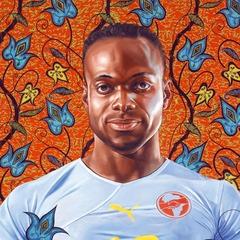
Unlike the background in many of the paintings that I was inspired by or paintings that I borrowed poses from - the great European paintings of the past - the background in my work does not play a passive role.
There's nothing shocking inherently about that, given that so much of the way that artists are taught is by copying old master paintings.
Painting is situational. And my particular situation exists within gender, race, class, sexuality, nation.
While it may seem a little mundane, the material realities of realizing the painting actually have a lot to do with how you should read the painting. For example, we assume that what the model is wearing is what we found him in in the streets. No; in fact, a lot of what happens is that in Photoshop certain aspects are being heightened or diminished. There is no actual material truth in these paintings.
That should be something that an artist can respond to as well in terms of a painting.
I like to play with the conventions around what we expect of paintings historically. But I also like to play with the conventions that you expect from a Kehinde Wiley painting, too.
Almost as though the painting itself becomes the embodiment of a type of struggle for visibility, and this might be considered the main subject of the painting.
I suppose in the end what shift occurred - is that at Yale I began to become more materially and conceptually aware of the mechanisms that gave rise to those types of patterns and paintings. And so the copying that happened in the childhood was a much more conscious type of copying in later years.
Can I - do I have to be obsessed with it and proceed from that? Not always. But when I'm on top of my game, I definitely think about the way that the world sees me and the way that the world thinks about painting. You must.
Most people say, "Hell, no. I don't know who you are. This scares me. Like, I'm not interested in this."Another way of looking at these paintings is, these are the guys who said yes.
So much of my work is defined by the difference between the figure in the foreground and the background. Very early in my career, I asked myself, "What is that difference?" I started looking at the way that a figure in the foreground works in eighteenth- and nineteenth-century European paintings and saw how much has to do with what the figure owns or possesses. I wanted to break away from that sense in which there's the house, the wife, and the cattle, all depicted in equal measure behind the sitter.
When I look back at my paintings, they don't give me a sense of where I was when I first met that guy. They don't give me a sense of what I felt like when I first saw that original source material. They give me a sense of the world that I'm trying to create. And we all just have to deal with that.
I have been painting white people for much longer in my life than I have done for colored people.
I was trying. I was crawling. I was coming into myself. I was trying to in some ways get beyond - what is the word that I'm looking for? - metaphorical language in painting, and to create something that was more indexical. And what I mean by that is that when you go to the library there's an index card that refers to a book that's actual and real in the world. So that index relates to something real.
There's quite obviously the desire to open the rule sets that allow for inclusion or disclusion. I think that my hope would be that my work set up certain type of precedent, that allowed for great institutions, museums and viewers to see the possibilities of painting culture to be a bit more inclusive.
I pay my models to work with me, so there becomes this weird sort of economic bartering thing, which made me feel really sort of uncomfortable, almost as though you were buying into a situation - which, again, is another way of looking at those paintings. The body language in those paintings is a lot more stiff.
In my work, I want to create an understanding, not about what a painting looks like but about what a painting says.
I studied shades, textures by painting after the Old Masters, the classical European paintings, as part of my educational process.
I think that gave rise to the type of practice that I - that I do now. I think it was informed by a very Marxist almost "use-value"-driven investigation of painting as agent. These are high-priced luxury goods for wealthy consumers, which are designed to deliver certain communicative effects.
Follow AzQuotes on Facebook, Twitter and Google+. Every day we present the best quotes! Improve yourself, find your inspiration, share with friends
or simply: