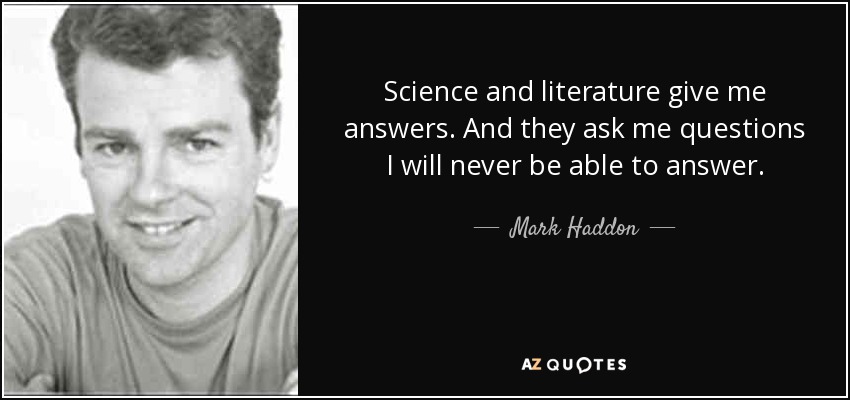




Science and literature give me answers. And they ask me questions I will never be able to answer.
If you enjoy math and you write novels, it's very rare that you'll get a chance to put your math into a novel. I leapt at the chance.
Children simply don't make the distinction; a book is either good or bad. And some of the books they think are good are very, very bad indeed.
I read very, very little fiction as a kid. All the books I can remember are junior science books.
I started writing books for children because I could illustrate them myself and because, in my innocence, I thought they'd be easier.
Jane Austen was writing about boring people with desperately limited lives. We forget this because we've seen too many of her books on screen.
The way of creating believable characters is not by conforming to a set of PC rules.
Use your imagination and you'll see that even the most narrow, humdrum lives are infinite in scope if you examine them with enough care.
A lot of roles for people with disabilities are quite patronising. It's a real pity when they are just used to give dull PC kudos to a drama, or when they're wheeled on in a tokenistic way without any real involvement in the plot.
As a teenager, I was always this strange mixture of kind of vice-captain of the rugby team and sensitive artist type the rest of the time. I was sent away to this public school in the middle of nowhere, and I think we managed to completely miss out on normal youth culture.
Humour and high seriousness... Perfect bedfellows, I think. Though I usually phrase it in terms of comedy and darkness. Comedy without darkness rapidly becomes trivial. And darkness without comedy rapidly becomes unbearable.
I am really interested in eccentric minds. It's rather like being fascinated by how cars work. It's really boring if your car works all the time. But as soon as something happens, you get the bonnet up. If someone has an abnormal or dysfunctional state of mind, you get the bonnet up.
I better make the plot good. I wanted to make it grip people on the first page and have a big turning point in the middle, as there is, and construct the whole thing like a bit of a roller coaster ride...
I have very fond memories of swimming in Walden Pond when we lived in Boston. You'd swim past a log and see all these turtles sunning themselves. Slightly disturbing if you thought about how many more were swimming around your toes, but also rather wonderful.
I suffer depression only in the sense that I am a writer. We don't have proper jobs to go to. We are on our own all day. Show me a writer who doesn't get depressed: who has a completely stable mood. They'd be a garage mechanic or something.
I went to boarding school and then I went to Oxford, and I know how easy it is for certain groups of people to become wholly insulated from ordinary life.
Indeed, I am repeatedly astonished by the number of really good writers who understand human beings so well on paper but don't know how to deal with them in real life.
The most difficult book I wrote was the fourth in a series of linked children's books. It was like pulling teeth because the publisher wanted exactly the same but completely different. I'd much rather just do something completely different even if there's a risk of it going wrong.
There's something rather wonderful about the fact that Oxford is a very small city that contains most of the cultural and metropolitan facilities you could want, in terms of bookshops, theatre, cinema, conversation. But it's near enough to London to get here in an hour, and it's near enough to huge open spaces without which I would go insane.
And I know I can do this because I went to London on my own, and because I solved the mystery…and I was brave and I wrote a book and that means I can do anything.
... He had always rather liked emergencies. Other people's at any rate. They put your own problems into perspective. It was like being on a ferry. You didn't have to think about what you had to do or where you had to go for the next few hours. It was all laid out for you.
At twenty life was like wrestling an octopus. Every moment mattered. At thirty it was a walk in the country. Most of the time your mind was somewhere else. By the time you got to seventy, it was probably like watching snooker on the telly.
It exasperated her sometimes. The way men could be so sure of themselves. They put words together like sheds or shelves and you could stand on them they were so solid. And those feelings which overwhelmed you in the small hours turned to smoke.
You love someone, you've got to let something go.
Siobhan also says that if you close your mouth and breathe out loudly through your nose it can mean that you are relaxed, or that you are bored, or that you are angry and it all depends on how much air comes out of your nose and how fast and what shape your mouth is when you do it and how you are sitting and what you just said before and hundreds of other things which are too complicated to work out in a few seconds.
Follow AzQuotes on Facebook, Twitter and Google+. Every day we present the best quotes! Improve yourself, find your inspiration, share with friends
or simply: