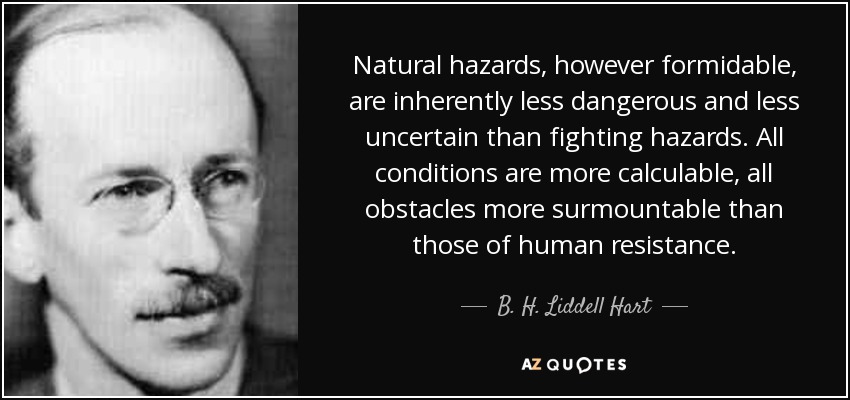

Natural hazards, however formidable, are inherently less dangerous and less uncertain than fighting hazards. All conditions are more calculable, all obstacles more surmountable than those of human resistance.
While hitting one must guard ... In order to hit with effect, the enemy must be taken off his guard.
If we clear the air of the fog of catchwords which surround the conduct of war, and grasp that in the human will lies the source and mainspring of all conflict, as of all other activities of man's life, it becomes clear that our object in war can only be attained by the subjugation of the opposing will. All acts, such as defeat in the field, propaganda, blockade, diplomacy, or attack on the centres of government and population, are seen to be but means to that end.
While there are many causes for which a state goes to war, its fundamental object can be epitomized as that of ensuring the continuance of its policy - in face of the determination of the opposing state to pursue a contrary policy. In the human will lies the source and mainspring of conflict.
This high proportion of history's decisive campaigns, the significance of which is enhanced by the comparative rarity of the direct approach, enforces the conclusion that the indirect is by far the most hopeful and economic form of strategy.
While the nominal strength of a country is represented by its numbers and resources, this muscular development is dependent on the state of its internal organs and nerve-system - upon its stability of control, morale, and supply.
If you wish for peace, understand war.
The blurring of the line between policy and strategy] encouraged soldiers to make the preposterous claim that policy should be subservient to their conduct of operations, and (especially in democratic countries) it drew the statesman on to overstep the definite border of his sphere and interfere with his military employees in the actual use of their tools.
[The] aim is not so much to seek battle as to seek a strategic situation so advantageous that if it does not of itself produce the decision, its continuation by a battle is sure to achieve this. In other words, dislocation is the aim of strategy.
As has happened so often in history, victory had bred a complacency and fostered an orthodoxy which led to defeat in the next war.
The urge to gain release from tension by action is a precipitating cause of war.
An army should always be so distributed that its parts can aid each other and combine to produce the maximum possible concentration of force at one place, while the minimum force necessary is used elsewhere to prepare the success of the concentration.
The principle of compulsory service, embodied in the system of conscription, lias been the means by which modem dictators and military gangs have shackled their people after a coup d'état, and bound them to their own aggressive purposes. In view of the great service that conscription has rendered to tyranny and war, it is fundamentally shortsighted for any liberty-loving and peace-desiring peoples to maintain it as an imagined safeguard, lest they become the victims of the monster they have helped to preserve.
The hydrogen bomb is not the answer to the Western peoples' dream of full and final insurance of their security ... While it has increased their striking power it has sharpened their anxiety and deepened their sense of insecurity.
In reality, it si more fruitful to wound than to kill. While the dead man lies still, counting only one man less, the wounded man is a progressive drain upon his side.
The more closely [the German army] converged on [Stalingrad], the narrower became their scope for tactical manoeuvre as a lever in loosening resistance. By contrast, the narrowing of the frontage made it easier for the defender to switch his local reserves to any threatened point on the defensive arc.
The predominance of moral factors in all military decisions. On them constantly turns the issue of war and battle. In the history of war they form the more constant factors, changing only in degree, whereas the physical factors are different in almost every war and every military situation.
It is folly to imagine that the aggressive types, whether individuals or nations, can be bought off ... since the payment of danegeld stimulates a demand for more danegeld. But they can be curbed. Their very belief in force makes them more susceptible to the deterrent effect of a formidable opposing force.
The nearer the cutting off point lies to the main force of the enemy, the more immediate the effect; whereas the closer to the strategic base it takes place, the greater the effect.
It is only to clear from history that states rarely keep faith with each other, save in so far (and so long) as their promises seem to them to combine with their interests.
For even the best of peace training is more theoretical than practical experience ... indirect practical experience may be the more valuable because infinitely wider.
In should be the duty of every soldier to reflect on the experiences of the past, in the endeavor to discover improvements, in his particular sphere of action, which are practicable in the immediate future.
For if we merely take what obviously appears the line of least resistance, its obviousness will appeal to the opponent also; and this line may no longer be that of least resistance. In studying the physical aspect, we must never lose sight of the psychological, and only when both are combined is the strategy truly an indirect approach, calculated to dislocate the opponent's balance.
A modern state is such a complex and interdependent fabric that it offers a target highly sensitive to a sudden and overwhelming blow from the air.
Follow AzQuotes on Facebook, Twitter and Google+. Every day we present the best quotes! Improve yourself, find your inspiration, share with friends
or simply: