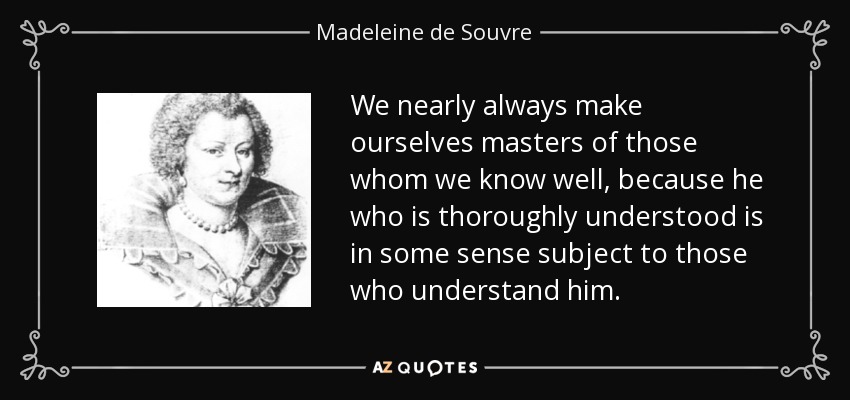






We nearly always make ourselves masters of those whom we know well, because he who is thoroughly understood is in some sense subject to those who understand him.
There is as much wisdom in soliciting good counsel as in giving it. The most sensible people are not reluctant to consider the feelings of other people; and to know how to submit to the wise guidance of others is a kind of wisdom in itself.
Even the best-natured people, if uninstructed, are always blind and uncertain. We must take pains to instruct ourselves so that ignorance makes us neither too timid nor too bold.
There is always enough self-love hidden beneath the greatest devoutness to set limits on charity.
It is such a great fault to talk too much that, in business and conversation, if what is good is also brief, it is doubly good, and one gains by brevity what one often loses by an excess of words.
This imperiousness which aids us in all things is merely a fitting authority which comes from superior spirit.
Wealth does not teach us to transcend the desire for wealth. The possession of many goods does not bring the repose of not desiring them.
The loftiness of understanding embraces all. It requires as much spirit to suffer the failings of others as it does to appreciate their good qualities.
There is nothing that does not have something perfect in it; and it is the happiness of good taste to be able to find this perfection in all things. But there is a natural malignity that often discovers a vice in the midst of several virtues, in order to reveal and proclaim the discovery to all the world - a quality that is more the mark of a naturally evil temperament than a superior sense of discrimination. And it is truly an evil lot, to pass one's life always feeding off the imperfections of others.
It is a very trying task for deceitful people, always to have to cover up their lack of sincerity and to repair the breaking of their word.
There is no more reason to accuse ourselves excessively of our failings than to excuse them overmuch. He who goes overboard in self-criticism often does so in order not to suffer others' criticisms, or else does so out of a kind of vanity that wishes to make others believe that he knows how to confess his faults.
It is sometimes useful to pretend we are deceived, because when we show a deceiving man that we see through his artifices, we only encourage him to increase his deceptions.
It is base to take advantage of our rank or greatness by making fun of those placed beneath us in life.
We would often rather seem dutiful to others than to succeed in our duties; and often we would rather tell our friends that we have done them good than to do good in actuality.
When High and Mighty people want to make us believe that they possess some good quality which they in fact do not have, it is dangerous to show that you doubt them; because, by removing their hope of deceiving the world, you also remove their desire to perform the good acts that might have arisen from their very pretensions.
The maxims of Christian life, which should draw upon the truths of the Gospel, are always partially symbolic of the mind and temperament of those who teach them to us. The former, by their natural sweetness, show us the quality of God's mercy; the latter, by their harshness, show us God's justice.
Although most friendships that exist do not merit the name, we can nevertheless make use of them in accordance with our needs, as a kind of commercial venture based on uncertain foundations and in which we are very often deceived.
The shame that comes to us as we see ourselves praised when we are unworthy of it often gives us the occasion to accomplish things that we might never have achieved without such undeserved praise.
There is a certain imperiousness, in the manner of speaking and in actions, which makes itself felt everywhere, and soon wins attention and respect. This commanding quality is useful in all affairs, and even for obtaining what we ask for.
Just as there is no action weaker or more unreasonable than to submit one's judgment to another's, where there is no advantage to oneself, so also there is nothing greater or wiser than to place oneself unquestioningly under God's judgment by believing in every word He speaks.
Often our good deeds make enemies for us, and the ungrateful person despises us on two counts; for he is not only unwilling to acknowledge the gratitude he owes us: he does not want to have his benefactor as witness to his thankless behavior.
One cannot always bestow all manner of things upon everybody. To refuse a request for just cause is as praiseworthy as to grant a request that is worthy. It is for this reason that the "no" of some people pleases more than the "yes" of others. A refusal accompanied by sweet words and a civil manner gives more satisfaction to a true heart than a favor given with bad grace.
When people reproach us, they only increase their own failings even as they are disclaiming them.
Those who foolishly pride themselves on their nobility mistake that which makes them noble, for it is only the virtue of their ancestors that gives them noble blood.
It is neither a great praise nor a great blame when people say a tendency is in or out of fashion. If a tendency is as it should be at one time, it is always as it should be.
Follow AzQuotes on Facebook, Twitter and Google+. Every day we present the best quotes! Improve yourself, find your inspiration, share with friends
or simply: