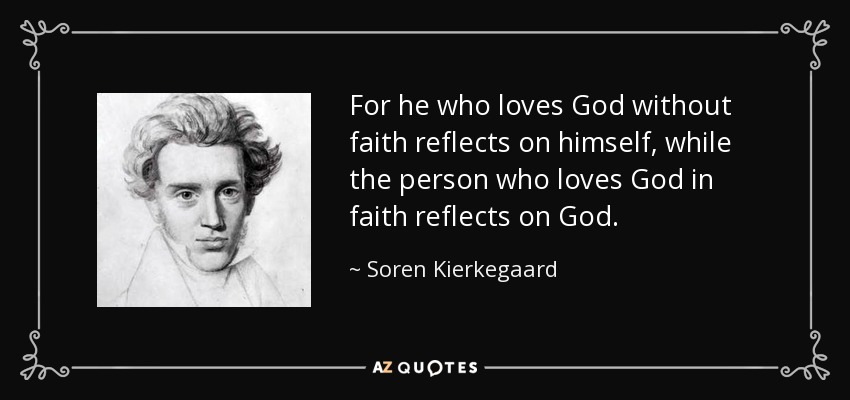



For he who loves God without faith reflects on himself, while the person who loves God in faith reflects on God.
It is the normal state of the human heart to try to build its identity around something besides God.
Whoever thou art, whatever in other respects thy life may be, my friend, by ceasing to take part (if ordinarily thou doest) in the public worship of God, as it now is (with the claim that it is the Christianity of the New Testament), thou hast constantly one guilt the less, and that a great one: thou dost not take part in treating God as a fool by calling that the Christianity of the New Testament which is not the Christianity of the New Testament.
You wanted God's ideas about what was best for you to coincide with your ideas, but you also wanted him to be the almighty Creator of heaven and earth so that he could properly fulfill your wish. And yet, if he were to share your ideas, he would cease to be the almighty Father.
All moral elevation consists first and foremost of being weaned from the momentary.
... all comparisons injure.
To defend something is always to discredit it. Let a man have a warehouse full of gold, let him be willing to give away a ducat to every one of the poor - but let him also be stupid enough to begin this charitable undertaking of his with a defense in which he offers three good reasons in justification; and it will almost come to the point of people finding it doubtful whether indeed he is doing something good. But now for Christianity. Yes, the person who defends that has never believed in it.
In the end, therefore, money will be the one thing people will desire, which is moreover only representative, an abstraction. Nowadays a young man hardly envies anyone his gifts, his art, the love of a beautiful girl, or his fame; he only envies him his money. Give me money, he will say, and I am saved...He would die with nothing to reproach himself with, and under the impression that if only he had had the money he might really have lived and might even have achieved something great.
When you say 'Yes' or promise something, you can very easily deceive yourself and others also, as if you had already done what you promised. It is easy to think that by making a promise you have at least done part of what you promised to do, as if the promise itself were something of value. Not at all! In fact, when you do not do what you promise, it is a long way back to the truth.
If I had a humble spirit in my service who, when I asked for a glass of water, brought me the world's costliest wines blended in a chalice, I should dismiss him, in order to teach him that my pleasure consists, not in what I enjoy, but in having my own way.
I believe that there is a longing in my soul that searches the whole world.
The idea of demonstrating that this unknown something [God] exists, could scarcely suggest itself to Reason. For if God does not exist it would of course be impossible to prove it, and if he does exist it would be folly to attempt it.
In order to swim one takes off all one's clothes--in order to aspire to the truth one must undress in a far more inward sense, divest oneself of all one's inward clothes, of thoughts, conceptions, selfishness etc., before one is sufficiently naked.
Boredom rests upon the nothingness that winds its way through existence; its giddiness, like that which comes from gazing down into an infinite abyss, is infinite.
If anyone on the verge of action should judge himself according to the outcome, he would never begin. Even though the result may gladden the whole world, that cannot help the hero; for he knows the result only when the whole thing is over, and that is not how he became a hero, but by virtue of the fact that he began.
To stand on one leg and prove God's existence is a very different thing from going on one's knees and thanking him.
It is tragic-comic to see that all this knowledge and understanding exercises no power at all over men's lives, that their lives do not express in the remotest way what they have understood, but rather the opposite.
Worldly wisdom thinks that love is a relationship between man and man. Christianity teaches that love is a relationship between man-God-man, that is, that God is the middle term.
Genius, like a thunderstorm, comes up against the wind.
All essential knowledge relates to existence, or only such knowledge as has an essential relationship to existence is essential knowledge.
However much one generation learns from another, it can never learn from its predecessor the genuinely human factor. In this respect every generation begins afresh. Thus no generation has learned from another how to love, no generation can begin other than at the beginning.
One must not think slightingly of the paradoxical…for the paradox is the source of the thinker’s passion, and the thinker without a paradox is like a lover without feeling: a paltry mediocrity.
This age will die not as a result of some evil, but from a lack of passion.
Christians remind me of schoolboys who want to look up the answers to their math problems in the back of the book rather than work them through.
Thus our own age is essentially one of understanding, and on the average, perhaps, more knowledgeable than any former generation, but it is without passion. Every one knows a great deal, we all know which way we ought to go and all the different ways we can go, but nobody is willing to move.
Follow AzQuotes on Facebook, Twitter and Google+. Every day we present the best quotes! Improve yourself, find your inspiration, share with friends
or simply: