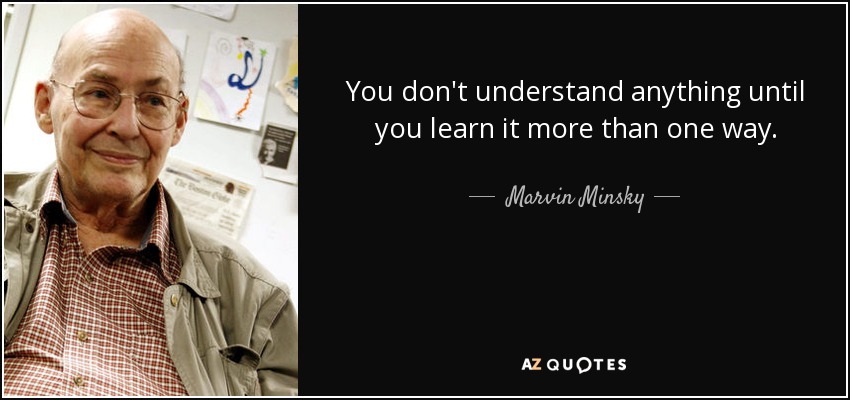



You don't understand anything until you learn it more than one way.
Artificial intelligence is the science of making machines do things that would require intelligence if done by men.
No computer has ever been designed that is ever aware of what it's doing; but most of the time, we aren't either.
If you understand something in only one way, then you don't really understand it at all. The secret of what anything means to us depends on how we've connected it to all other things we know. Well-connected representations let you turn ideas around in your mind, to envision things from many perspectives until you find one that works for you. And that's what we mean by thinking!
Once the computers got control, we might never get it back. We would survive at their sufferance. If we're lucky, they might decide to keep us as pets.
Will robots inherit the earth? Yes, but they will be our children.
One can acquire certainty only by amputating inquiry.
But the big feature of human-level intelligence is not what it does when it is works but what it does when it's stuck.
What is intelligence, anyway It is only a word that people use to name those unknown processes with which our brains solve problems we call hard. But whenever you learn a skill yourself, you're less impressed or mystified when other people do the same. This is why the meaning of 'intelligence' seems so elusive: It describes not some definite thing but only the momentary horizon of our ignorance about how minds might work.
I bet the human brain is a kludge
Common sense is not a simple thing. Instead, it is an immense society of hard-earned practical ideas - of multitudes of life-learned rules and exceptions, dispositions and tendencies, balances and checks.
Logic doesn't apply to the real world.
We'll show you that you can build a mind from many little parts, each mindless by itself.
Within 10 years computers won't even keep us as pets.
Everything is similar if you're willing to look far out of focus.
The secret of what anything means to us depends on how we've connected it to all the other things we know. That's why it's almost always wrong to seek the "real meaning" of anything. A thing with just one meaning has scarcely any meaning at all.
What magical trick makes us intelligent? The trick is that there is no trick. The power of intelligence stems from our vast diversity, not from any single, perfect principle.
In general, we’re least aware of what our minds do best.
How hard is it to build an intelligent machine? I don't think it's so hard, but that's my opinion, and I've written two books on how I think one should do it. The basic idea I promote is that you mustn't look for a magic bullet. You mustn't look for one wonderful way to solve all problems. Instead you want to look for 20 or 30 ways to solve different kinds of problems. And to build some kind of higher administrative device that figures out what kind of problem you have and what method to use.
Experience has shown that science frequently develops most fruitfully once we learn to examine the things that seem the simplest, instead of those that seem the most mysterious.
Anyone could learn Lisp in one day, except that if they already knew Fortran, it would take three days.
All intelligent problem solvers are subject to the same ultimate constraints - limitations on space, time, and materials.
Our present culture may be largely shaped by this strange idea of isolating children's thought from adult thought. Perhaps the way our culture educates its children better explains why most of us come out as dumb as they do, than it explains how some of us come out as smart as they do.
You don't understand anything unless you understand there are at least 3 ways.
Minds are simply what brains do.
Follow AzQuotes on Facebook, Twitter and Google+. Every day we present the best quotes! Improve yourself, find your inspiration, share with friends
or simply: