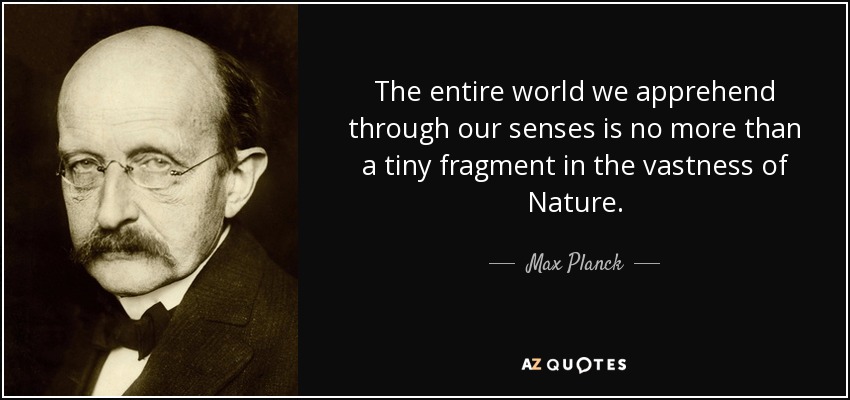
The entire world we apprehend through our senses is no more than a tiny fragment in the vastness of Nature.
Insight must precede application.
The man who cannot occasionally imagine events and conditions of existence that are contrary to the causal principle as he knows it will never enrich his science by the addition of a new idea.
The pioneer scientist must have "a vivid intuitive imagination, for new ideas are not generated by deduction, but by artistically creative imagination."
Thus, the photons which constitute a ray of light behave like intelligent human beings: out of all possible curves they always select the one which will take them most quickly to their goal.
An experiment is a question which science poses to Nature and a measurement is the recording of Nature's answer.
There is a real world independent of our senses; the laws of nature were not invented by man, but forced on him by the natural world. They are the expression of a natural world order.
No burden is so heavy for a man to bear as a succession of happy days.
Both religion and natural science require a belief in God for their activities, to the former He is the starting point, and to the latter the goal of every thought process. To the former He is the foundation, to the latter, the crown of the edifice of every generalized world view.
Ego is the immediate dictate of human consciousness.
Science enhances the moral value of life, because it furthers a love of truth and reverence-love of truth displaying itself in the constant endeavor to arrive at a more exact knowledge of the world of mind and matter around us, and reverence, because every advance in knowledge brings us face to face with the mystery of our own being.
A scientist is happy, not in resting on his attainments but in the steady acquisition of fresh knowledge.
A new scientific truth is usually not propagated in such a way that opponents become convinced and discard their previous views. No, the adversaries eventually die off, and the upcoming generation is familiarised anew with the truth.
This is one of man's oldest riddles. How can the independence of human volition be harmonized with the fact that we are integral parts of a universe which is subject to the rigid order of nature's laws?
Those [scientists] who dislike entertaining contradictory thoughts are unlikely to enrich their science with new ideas.
Religion and natural science are fighting a joint battle in an incessant, never-relaxing crusade against skepticism and dogmatism, against disbelief and against superstition, and the rallying cry in this crusade has always been, and will always be, 'On to God.'
We are in a position similar to that of a mountaineer who is wandering over uncharted spaces, and never knows whether behind the peak which he sees in front of him and which he tries to scale there may not be another peak still beyond and higher up.
Science progresses not by convincing the adherents of old theories that they are wrong, but by allowing enough time to pass so that a new generation can arise unencumbered by the old errors.
All matter originates and exists only by virtue of a force.
Science advances funeral by funeral
The assumption of an absolute determinism is the essential foundation of every scientific enquiry.
We have no right to assume that any physical laws exist, or if they have existed up until now, that they will continue to exist in a similar manner in the future.
When I began my physical studies [in Munich in 1874] and sought advice from my venerable teacher Philipp von Jolly...he portrayed to me physics as a highly developed, almost fully matured science...Possibly in one or another nook there would perhaps be a dust particle or a small bubble to be examined and classified, but the system as a whole stood there fairly secured, and theoretical physics approached visibly that degree of perfection which, for example, geometry has had already for centuries.
Physical changes take place continuously, while chemical changes take place discontinuously. Physics deals chiefly with continuous varying quantities, while chemistry deals chiefly with whole numbers.
It is impossible to make a clear cut between science, religion, and art. The whole is never equal simply to the sum of its various parts.
Follow AzQuotes on Facebook, Twitter and Google+. Every day we present the best quotes! Improve yourself, find your inspiration, share with friends
or simply: