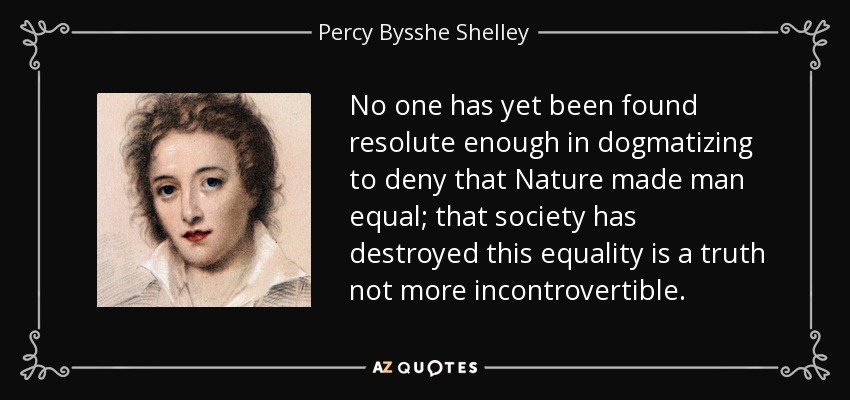
No one has yet been found resolute enough in dogmatizing to deny that Nature made man equal; that society has destroyed this equality is a truth not more incontrovertible.
The moon of Mahomet Arose, and it shall set; While, blazoned as on heaven's immortal noon, The cross leads generations on.
Those who inflict must suffer, for they see The work of their own hearts, and this must be Our chastisement or recompense.
The awful shadow of some unseen Power Floats, tho' unseen, amongst us.
Mild is the slow necessity of death; The tranquil spirit fails beneath its grasp, Without a groan, almost without a fear, Resigned in peace to the necessity; Calm as a voyager to some distant land, And full of wonder, full of hope as he.
The breath Of accusation kills an innocent name, And leaves for lame acquittal the poor life, Which is a mask without it.
Dar'st thou amid the varied multitude To live alone, an isolated thing?
In each human heart terror survives The ravin it has gorged: the loftiest fear All that they would disdain to think were true: Hypocrisy and custom make their minds The fanes of many a worship, now outworn. They dare not devise good for man's estate, And yet they know not that they do not dare.
The quick Dreams, The passion-winged Ministers of thought.
Less oft peace in Shelley's mind, Than calm in waters seen.
You would not easily guess All the modes of distress Which torture the tenants of earth; And the various evils, Which like so many devils, Attend the poor souls from their birth.
And many an ante-natal tomb Where butterflies dream of the life to come.
Mont Blanc yet gleams on high: the power is there, The still and solemn power of many sights And many sounds, and much of life and death. In the long glare of day, the snows descend Upon that Mountain; none beholds them there, Nor when the flakes burn in the sinking sun, Or the sunbeams dart through them.
Spirit of BEAUTY, that dost consecrate With thine own hues all thou dost shine upon Of human thought or form, where art thou gone? Why dost thou pass away and leave our state, This dim vast vale of tears, vacant and desolate? Ask why the sunlight not for ever Weaves rainbows o'er yon mountain-river, Why aught should fail and fade that once is shown, Why fear and dream and death and birth Cast on the daylight of this earth Such gloom, why man has such a scope For love and hate, despondency and hope?
This, and no other, is justice: to consider, under all the circumstances and consequences of a particular case, how the greatest quantity and purest quality of happiness will ensue from any action ... there is no other justice.
The most refined abstractions of logic conduct to a view of life, which, though startling to the apprehension, is, in fact, that which the habitual sense of its repeated combinations has extinguished in us. It strips, as it were, the painted curtain from this scene of things. I confess that I am one of those who are unable to refuse my assent to the conclusions of those philosophers who assert that nothing exists but as it is perceived.
In proportion as a man is selfish, so far has he receded from the motive which constitutes virtue.
Thou shoreless flood, which in thy ebb and flow claspest the limits of mortality.
Where art thou, beloved To-morrow? When young and old, and strong and weak, Rich and poor, through joy and sorrow, Thy sweet smiles we ever seek,-- In thy place--ah! well-a-day! We find the thing we fled--To-day!
Near that a dusty paint-box, some odd hooks, A half-burnt match, an ivory block, three books, Where conic sections, spherics, logarithms, To great Laplace, from Saunderson and Sims, Lie heaped in their harmonious disarray Of figures,-disentangle them who may.
Had this author [Sir W Drummond Academical Questions, chap. iii.], instead of inveighing against the guilt and absurdity of atheism, demonstrated its falsehood, his conduct would have, been more suited to the modesty of the skeptic and the toleration of the philosopher.
It is thus that the generality of mankind, whose lot is ignorance, attributes to the Divinity, not only the unusual effects which strike them, but moreover the most simple events, of which the causes are the most simple to understand by whomever is able to study them. In a word, man has always respected unknown causes, surprising effects that his ignorance kept him from unraveling. It was on this debris of nature that man raised the imaginary colossus of the Divinity.
I am convinced that there can be no regeneration of mankind until laughter is put down.
Music, when soft voices die, Vibrates in the memory; Odors, when sweet violets sicken, Live within the sense they quicken.
In a drama of the highest order there is little food for censure or hatred; it teaches rather self-knowledge and self-respect.
Follow AzQuotes on Facebook, Twitter and Google+. Every day we present the best quotes! Improve yourself, find your inspiration, share with friends
or simply: