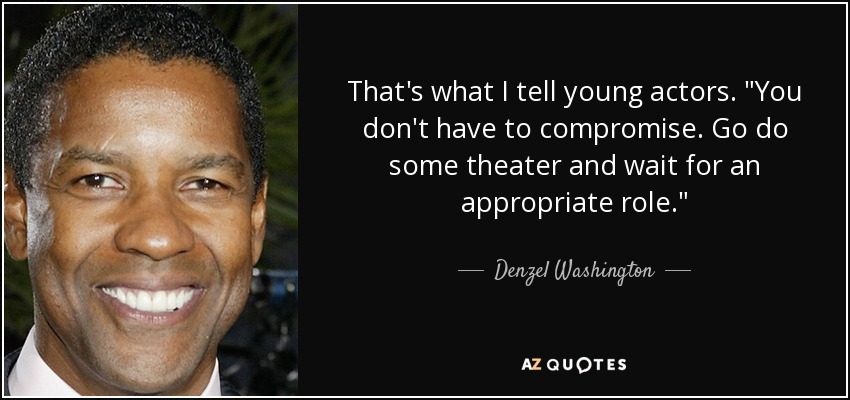


That's what I tell young actors. "You don't have to compromise. Go do some theater and wait for an appropriate role."
I'm a positive person, so I don't get bogged down with it. If you're expecting that, if you wall in that, if you practice that, then you'll attract what you fear.
I didn't want to audition the kids so much; I just wanted to talk to them because I like seeing how they are because their mothers usually mess them up with practice. So, I'd rather talk to them and see how they respond. I just throw things at them and see how they can hit the ball back, and Saniyya Sidney was good.
One good thing about acting in film is that it's good therapy.
As an actor, you're a color of paint on someone else's palette. But as a director, it's your canvas and you make the painting you want to make.
It's simple: You get a part. You play a part. You play it well. You do your work and you go home. And what is wonderful about movies is that once they're done, they belong to the people. Once you make it, it's what they see. That's where my head is at.
The last few years I've been saying I was ready to quit. It wasn't that interesting to me. Now that I'm directing, it's all new again.
When you make a movie it's always interesting, because you end up in places you never would as a normal visitor or tourist.
People tend to relax when they're off camera. That's when they should be working the hardest.
Growing up I didn't watch movies.
When you look in one direction where Troy's chair was, you could see out through the yard across the street, there was an old cork bar advertisement for five cents. We wanted it to feel like this was real life [in Fences] and that it extended blocks and blocks.
I had the kid [on "Fences" ] who understudied me so I could stand back and think about shots so he had to learn the blocking and everything. I'd come in early sometimes, and they 'd be in there rehearsing and working on their stuff. I didn't want them to feel like, "Oh these are people who can't be touched." We're all working actors; we're all trying to get better.
A film is just like a muffin. You make it. You put it on the table. One person might say, 'Oh, I don't like it.' One might say it's the best muffin ever made. One might say it's an awful muffin. It's hard for me to say. It's for me to make the muffin.
I try to encourage actors to work harder off screen because that's where you find things.
I'm older and wiser. So and now having segued into filmmaking I'm looking at [Ridley Scott ] and what he does in an entirely different way and I have respect for what he does and how he composes shots. So that was what was completely fascinating.
I don't look back, no. Maybe when I'm older; people say, 'What's your favorite film?' I say, 'My next one.' I'm not interested in sitting around; I just don't, never have.
We know what hair smells like when a hot comb hits it. That's a cultural thing. We know what that smells like on Sunday mornings, usually church-related or something. In my house, it was getting ready for church and your sister was getting her hair fried.
You don't have to kill somebody to play a murderer. You have to read the script and interpret the character.
I try not to think about that [getting Oscar] ahead of time. You just try to do the best work you can, and then you get the movie out there, and we've been hearing good things. But you never know, you don't want to get too high, and you don't want to get too low.
Even though the story [Fences] is set during the 1950s, some contemporary women might have trouble understanding her decision.
I talked to my mother about it a lot. I asked her what it was like to grow up in New York and Harlem in the 1920s and 1930s, and I asked her about a woman leaving her husband. I asked her about how she would feel about that woman, and my mother grew up in the Church Of God In Christ, and she told me that the woman might be isolated because the other women thought she might go and come after their husbands. That's how they thought then.
I remember my father telling me that just like Troy, he could get me in with the water department where he worked in New York. He talked about how he could get me on the job, and if I stayed 25 years, I could probably work my way up to be a supervisor and how it was a good union and all of the benefits and that I was going to make $20,000 in 50 years or whatever it was. He couldn't see that far.
It's tricky with monologues, and I never like to use that word. Like I told the actors, you are talking to somebody; there is no such thing as a monologue.
We'll all retire from life at some point. The great thing about acting is you don't necessarily have to retire.
I've just directed a film called The Great Debaters, which is inspired by a true story about a young college debating team in the thirties and two of those people are still alive and we put them on tape on the film and I'm sure that will be added to the DVD, and to get the opportunity to do that is very cool.
"It's important for us to tell our stories."
Follow AzQuotes on Facebook, Twitter and Google+. Every day we present the best quotes! Improve yourself, find your inspiration, share with friends
or simply: