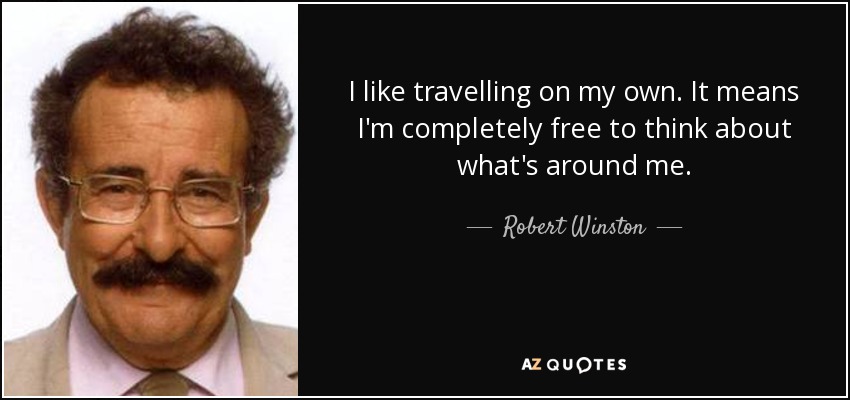


I like travelling on my own. It means I'm completely free to think about what's around me.
I don't know whether it is important to study science at a young age, though current thinking emphasises the need.
However pragmatic you are, it is very demanding being a new parent.
Ethics is not routinely taught to science students except in medicine, and I think it should be.
I remember eating in school in the years after the Second World War. Most of my friends had miserable portions of Spam with an inedible, glutinous pudding served in containers we called 'coffins.' As a vegetarian, I had a lump of loathsome cheese and some bread.
It's extraordinary to think that if you walked into a room and said you had never heard of Hamlet, you would be regarded as a Philistine. But you could walk into the same room and say, 'I don't know what a proton is,' and people would just laugh and say, 'Why should you know?'
It is time my colleagues got real. All British universities doing worthwhile research use animals, and, instead of hiding, they should be boasting of their achievements.
I've been all over the world on my own because, as a scientist, you travel a great deal if your work is reasonably successful or published. I get invitations to go to all sorts of strange countries where I would mostly be by myself and just meet other people there, instead of having travelling companions.
I'm a traditional Jew with an orthodox background, and it informs much of my approach to science. Of course I think it's very important that if you have those sorts of backgrounds you don't impose them on other people as a clinician, of course.
I used to work for the World Health Organisation in poor countries all over the world - Bangladesh, Korea, the Philippines and India. You learn a whole range of things about how other people are living and try to connect with them to gain an understanding of where they're coming from.
I do not know of any credible evidence that suggests Dr Zavos can clone a human being. This seems to be yet another one of his claims to get repeated publicity.
I did not study science at school until I was 13, when I was totally turned on by a seemingly dreary old teacher who suddenly, unannounced, manufactured a huge explosion in the middle of a totally boring monologue. From then on, all of his class wanted to make explosions.
Following 25 children for the TV series 'Child of Our Time' has been extraordinary. The BBC's original plan was to commemorate the new millennium. What better way than to film a number of expectant mums from across the U.K.? Coming from widely different backgrounds, all were due to give birth on January 1, 2000.
Childhood is not dead. Children were worse off when we were hunter-gatherers; they were threatened in medieval times and exploited during the Industrial Revolution. Was it any better in the time of Charles Kingsley or Charles Dickens?
Carbon dioxide is unusual because it doesn't go through the usual three phases of matter, from solid to liquid to gas, but it goes straight from solid to gas. The volume of the gas is much greater than the volume of the solid. When a solid turns into a gas, we say it sublimes. The process is sublimation.
Both in Britain and America, huge publicity has been given to stem cells, particularly embryonic stem cells, and the potential they offer. Of course, the study of stem cells is one of the most exciting areas in biology, but I think it is unlikely that embryonic stem cells are likely to be useful in healthcare for a long time.
My own field, the prevention of genetic disorders in babies, has been possible only because of humane work on animals.
Whether you're religious or not, there is a real need for other people's religious positions to be treated with the upmost respect.
Follow AzQuotes on Facebook, Twitter and Google+. Every day we present the best quotes! Improve yourself, find your inspiration, share with friends
or simply: