


When people in organizations feel too secure, it's because there aren't any significant outcomes as a result of what they do. Whatever you do, nothing much different happens. This also means there are no important pay-offs if you risk by innovating. As there are no rewards for taking risks, then there's no sense of push in that institution's culture.
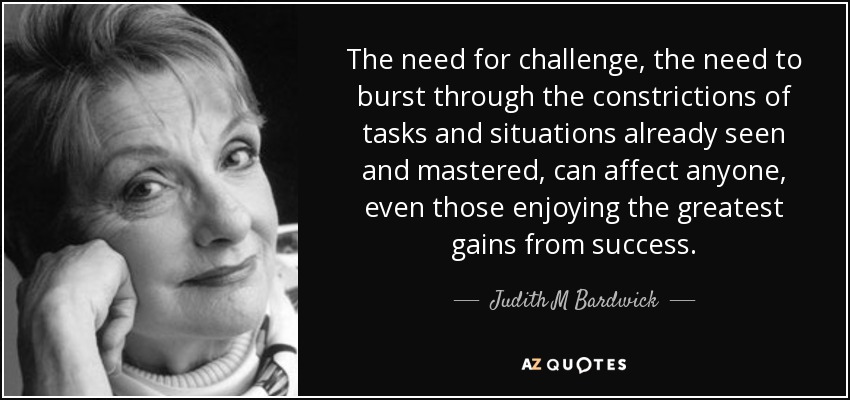
The need for challenge, the need to burst through the constrictions of tasks and situations already seen and mastered, can affect anyone, even those enjoying the greatest gains from success.
Leaders evoke emotional connections in followers only to the extent that the followers are emotionally needy.
I think the characteristics of really effective leaders when people are frightened and depressed are the same qualities that leaders need when people are optimistic. The difference is when people are frightened the need for these few qualities becomes much stronger because frightened people are desperate to have someone they can trust and believe in and who seems to be able to create a better future.
I am impressed and distressed at how passive hierarchical organizations make people. There's often a lot of overt activity, but it's not going anywhere, it's game-playing. It's play-acting at work.
... there's a large core of powerlessness which is balanced against the unwritten contract that says that if you behave, you'll be okay. No wonder people pay so much attention to knowing the rules, to knowing the right people, to not making waves, to never making errors -- to not risking, trying, innovating.
For most women being other-directed, focused on how other people feel and nurturing them, was (and can still be) a quality that girls were (are) heavily pressured to become. The unselfish or Self-less woman was (is) seen as ideal. The realization and articulation that the cultural ideal of the perfect woman was someone who had no sense of Self and was a key part of the angry energy that drove Feminism to its swift success.
Women's self didn't die; it had never been born. And when women insisted on their right to have a self, they weren't understood even by their husbands who cried, Haven't I given you enough? And by their parents who joined the crowd who deemed them selfish and responsible for all the problems in their marriage. I remember it all too well.
Self is a construct, a feeling, an identity that is internal and can neither be given nor taken away by others. We develop and nurture that identity by embracing inter-dependence.
The Psychological Recession is the cluster of feelings that the present is really scary and the future will likely be worse. It comes from the sense you have no control over what's happening to you and you don't see a way to get your life back under control. It's the feeling that life is unfair; you paid your dues, you worked hard, and you ended up naked and vulnerable. There is no comfort to be found in the dismissal of the Psychological Recession as being just an idea; it is a real phenomenon with real consequences, all of them bad.
The sense of loss of control over what happens to you at work (and thus in your life is vital). This further involves a sense of fairness as in, I did my part and look where it got me! "The deal," the contract between employee and employer has eroded and been replaced with unilateral power by the organization over the employee.
The balanced life is a goal, but for us it is mostly a myth.
"The balanced life is a goal, but for us it is mostly a myth."
Follow AzQuotes on Facebook, Twitter and Google+. Every day we present the best quotes! Improve yourself, find your inspiration, share with friends
or simply: