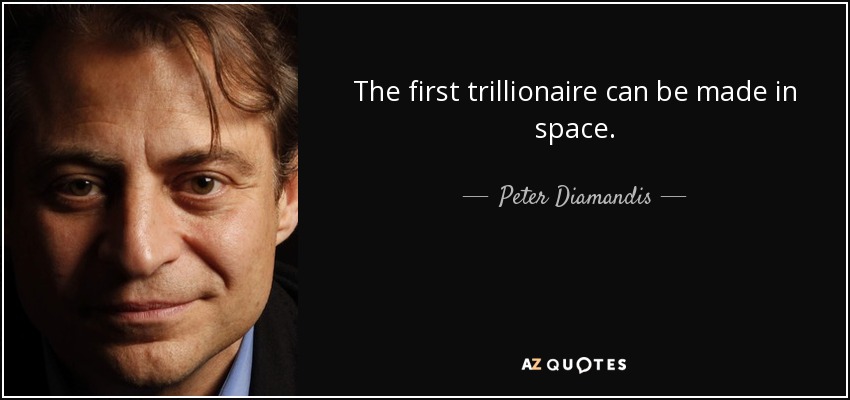

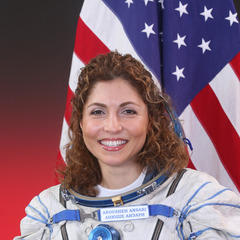



The first trillionaire can be made in space.
I'm not saying we don't have our set of problems - climate crisis, species extinction, water and energy shortage - we surely do. But ultimately we knock them down.
During the next 50 years, in countless cycles, in countless entrepreneurial companies, this let's just go and do it mentality will help us finally get off the planet and irreversibly open the space frontier. The capital and tools are finally being placed into the hands of those willing to risk, willing to fail, willing to follow the dreams.
If you believe that the developing world deserves the same standards of living that we do in the developed world, then to achieve that, they need resources. They need the metals and the minerals to build the industries and the buildings and so forth, and the energy.
Super-ambitious goals tend to be unifying and energizing to people; but only if they believe there's a chance of success.
I founded a launch company called International Microspace when I graduated medical school in 1989. We were trying to build a microsatellite launcher.
In 1980, during my sophomore year at MIT, I realized that the school didn't have a student space organization. I made posters for a group I called Students for the Exploration and Development of Space and put them up all over campus. Thirty-five people showed up. It was the first thing I ever organized, and it took off!
Eight billion people will have Internet access by 2020.
NASA calls stuff nominal instead of phenomenal, like it really is. So I have given up that there is going to be a balance and NASA is going to do certain things and we are finally in a state of existence where small groups of individuals can do extraordinary things, funded by single people.
One of my goals is to reinvent philanthropy.
Today, philanthropy is a very unsophisticated, old world process where people who make a shitload of money go and give it away and when they're making their money, they're focused on 10x, 100x returns on the dollar.
You should command and demand the tenfold leverage on your dollars when you give it away as well.
In the space business, space had gotten very much to be the aerospace industry. This is something that governments only do and it's where the Boeings and the Lockheed's and the Northrop's and so forth. And there's no way these small companies could do it.
You have to ask yourself the question, do you have the smartest people in the world working for your company? And if you do, you're lucky. But if you don't, put up the incentive. And have someone who is absolutely brilliant who's a 22-year old in India who says what about this way? And who revolutionizes the way you do business.
It's sad that the U.S. government doesn't fund risky research anymore.
I think people are dreaming big because they have the tools to dream big. I hope that people are dreaming big because it makes them feel good about their lives.
Back in 2007, I had the opportunity to meet Professor Stephen Hawking through the X PRIZE Foundation. In my first conversation with him I learned that he was passionate about flying into space someday.
I ended up realizing that NASA was unlikely to get me into space, or get me to the moon or beyond, and I needed some other way to drive this.
My father, who grew up picking olives on the Greek island of Lesbos, was a doctor. So my family expected me to become a physician.
My childhood dreams were focused on being part of the effort to make humanity a multiplanetary species.
We are not going to stop here on planet Earth. We're going to move out to other planetary bodies.
The thing about frontiers, it allows the individuals who are best, whether they're men or women or minorities or whatever, to step to the top. So in traditional societies, old world societies, in the United Kingdom if you would; if you were born into the right stratus, the right class, you had the ability to succeed.
Go and try to start your own government in the United States today and you'll be squashed very quickly.
I became very much, if I have to describe myself, I'm sort of a Libertarian Capitalist, and I was looking for, what's the economic engine that's going to drive us into space?
I don't think the space station is innovative. Going to the moon was innovative because we had no idea how to do it.
"The first trillionaire can be made in space."
Follow AzQuotes on Facebook, Twitter and Google+. Every day we present the best quotes! Improve yourself, find your inspiration, share with friends
or simply: