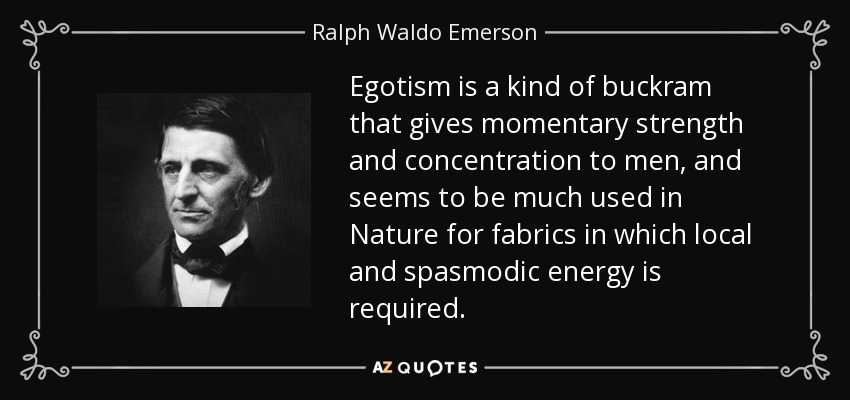


Egotism is a kind of buckram that gives momentary strength and concentration to men, and seems to be much used in Nature for fabrics in which local and spasmodic energy is required.
The public values the invention more than the inventor does. The inventor knows there is much more and better where this came from.
These arts open great gates of a future, promising to make the world plastic and to lift human life out of its beggary to a god- like ease and power.
Whilst we want cities as the centres where the best things are found, cities degrade us by magnifying trifles.
New York is a sucked orange. All conversation is at an end, when we have discharged ourselves of a dozen personalities, domestic or imported, which make up our American existence.
The city is always recruited from the country. The men in cities who are the centres of energy, the driving-wheels of trade, politics or practical arts, and the women of beauty and genius, are the children or grandchildren of farmers, and are spending the energies which their fathers' hardy, silent life accumulated in frosty furrows in poverty, necessity and darkness.
This one fact the world hates; that the soul becomes; for that forever degrades the past, turns all riches to poverty, all reputation to a shame, confounds the saint with the rogue, shoves Jesus and Judas equally aside.
Besides, our action on each other, good as well as evil, is so incidental and at random, that we can seldom hear the acknowledgments of any person who would thank us for a benefit, without some shame and humiliation. We can rarely strike a direct stroke, but must be content with an oblique one; we seldom have the satisfaction of yielding a direct benefit, which is directly received.
How shall a man escape from his ancestors, or draw off from his veins the black drop which he drew from his father's or mother's life?
Every ship is a romantic object, except that we sail in. Embark, and the romance quits our vessel, and hangs on every other sail in the horizon.
For, truly speaking, whoever provokes me to a good act or thought has given me a pledge of his fidelity to virtue,--he has come under the bonds to adhere to that cause to which we are jointly attached.
Again, the great number of cultivated men keep each other up to a high standard. The habit of meeting well-read and knowing men teaches the art of omission and selection.
Fashion which affects to be honor, is often, in all men's experience, only a ballroom-code.
The poor and the low have their way of expressing the last facts of philosophy as well as you. "Blessed be nothing," and "The worse things are, the better they are," are proverbs which express the transcendentalism of common life.
A great licentiousness treads on the heels of a reformation.
The history of reform is always identical; it is the comparison of the idea with the fact. Our modes of living are not agreeable to our imagination. We suspect they are unworthy. We arraign our daily employments.
Many a reformer perishes in his removal of rubbish,--and that makes the offensiveness of the class. They are partial; they are notequal to the work they pretend. They lose their way; in the assault on the kingdom of darkness, they expend all their energy on some accidental evil, and lose their sanity and power of benefit.
It is handsomer to remain in the establishment better than the establishment, and conduct that in the best manner, than to make asally against evil by some single improvement, without supporting it by a total regeneration.
The new statement is always hated by the old, and, to those dwelling in the old, comes like an abyss of skepticism.
In the actual world--the painful kingdom of time and place--dwell care, and canker, and fear. With thought, with the ideal, is immortal hilarity, the rose of joy.
As thinkers, mankind has ever divided into two sects, Materialists and Idealists; the first class founding on experience, the second on consciousness; the first class beginning to think from the data of the senses, the second class perceive that the senses are not final and say, The senses give us representations of things, but what are the things themselves, they cannot tell. The materialist insists on facts, on history, on the force of circumstances and the animal wants of man; the idealists on the power of Thought and Will, on inspiration, on miracle, on individual culture.
Society is frivolous, and shreds its day into scraps, its conversation into ceremonies and escapes.
If you meet a sectary, or a hostile partisan, never recognize the dividing lines; but meet on what common ground remains,--if onlythat the sun shines, and the rain rains for both; the area will widen very fast, and ere you know it the boundary mountains, on which the eye had fastened, have melted into air.
A man is a beggar who only lives to the useful, and, however he may serve as a pin or rivet in the social machine, cannot be saidto have arrived at self-possession.
When private men shall act with original views, the lustre will be transferred from the actions of kings to those of gentlemen.
Follow AzQuotes on Facebook, Twitter and Google+. Every day we present the best quotes! Improve yourself, find your inspiration, share with friends
or simply: