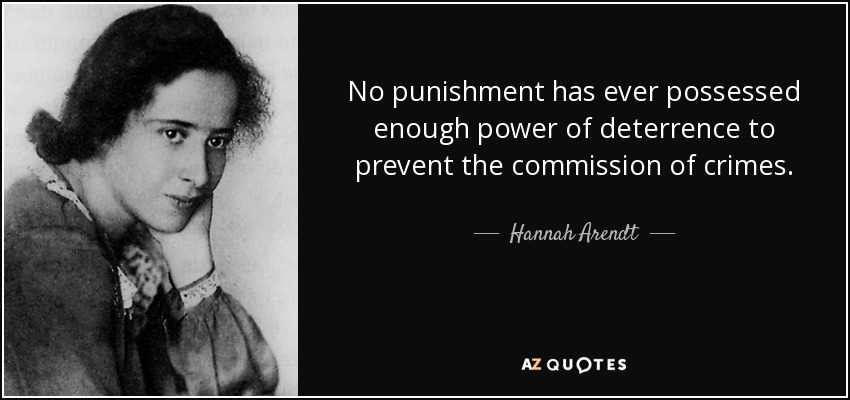



No punishment has ever possessed enough power of deterrence to prevent the commission of crimes.
No punishment has ever possessed enough power of deterrence to prevent the commission of crimes. On the contrary, whatever the punishment, once a specific crime has appeared for the first time, its reappearance is more likely than its initial emergence could ever have been.
Caution in handling generally accepted opinions that claim to explain whole trends of history is especially important for the historian of modern times, because the last century has produced an abundance of ideologies that pretend to be keys to history but are actually nothing but desperate efforts to escape responsibility.
Manipulations of opinion, insofar as they are inspired by well-defined interests, have limited goals; their effect, however, if they happen to touch upon an issue of authentic concern, is no longer subject to their control and may easily produce consequences they never foresaw or intended.
When we were told that by freedom we understood free enterprise, we did very little to dispel this monstrous falsehood. Wealth and economic well-being, we have asserted, are the fruits of freedom, while we should have been the first to know that this kind of happiness has been an unmixed blessing only in this country, and it is a minor blessing compared with the truly political freedoms, such as freedom of speech and thought, of assembly and association, even under the best conditions.
That Hegelian dialectics should provide a wonderful instrument for always being right, because they permit the interpretations of all defeats as the beginning of victory, is obvious. One of the most beautiful examples of this kind of sophistry occurred after 1933 when the German Communists for nearly two years refused to recognize that Hitler's victory had been a defeat for the German Communist Party.
You think that you can judge what's good or evil from whether you enjoy doing it or not. You think that evil is what always appears in the form of a temptation, while good is what you never spontaneously want to do. I think this is all total rubbish, if you don't mind my saying so.
Men who no longer can make sure of the reality which they feel and experience through talking about it and sharing it with their fellow-men, live in the same nightmare of loneliness and uncertainty which, in a normal world, is the terrible fate of insanity.
Men always want to be terribly influential, but I see that as somewhat external. Do I imagine myself being influential? No. I want to understand. And if others understand--in the same sense that I have understood--that gives me a sense of satisfaction, like feeling at home.
Economic growth may one day turn out to be a curse rather than a good, and under no conditions can it either lead into freedom or constitute a proof for its existence.
Luck serves ... as rationalization for every people that is not master of its own destiny.
The conviction that everything that happens on earth must be comprehensible to man can lead to interpreting history by commonplaces.
Opinions are formed in a process of open discussion and public debate, and where no opportunity for the forming of opinions exists, there may be moods -moods of the masses and moods of individuals, the latter no less fickle and unreliable than the former -but no opinion.
Psychologically speaking, one may say that the hypocrite is too ambitious; not only does he want to appear virtuous before others, he wants to convince himself.
If a given science accidentally reached its goal, this would by no means stop the workers in the field, who would be driven past their goal by the sheer momentum of the illusion of unlimited progress.
By its very nature the beautiful is isolated from everything else. From beauty no road leads to reality.
Entirely new concepts are very rare in politics.
As witnesses not of our intentions but of our conduct, we can be true or false, and the hypocrite's crime is that he bears false witness against himself. What makes it so plausible to assume that hypocrisy is the vice of vices is that integrity can indeed exist under the cover of all other vices except this one. Only crime and the criminal, it is true, confront us with the perplexity of radical evil; but only the hypocrite is really rotten to the core.
thinking beings have an urge to speak, speaking beings have an urge to think.
Only crime and the criminal, it is true, confront us with the perplexity of radical evil; but only the hypocrite is really rotten to the core.
What really distinguishes this generation in all countries from earlier generations ... is its determination to act, its joy in action, the assurance of being able to change things by one's own efforts.
If men were ever to lose the appetite for meaning we call thinking, they would lose the capacity for asking all the unanswerable questions upon which every civilization is founded.
It is obvious: if you do not accept something that assumes the form of ‘destiny,’ you not only change its ‘natural laws’ but also the laws of the enemy playing the role of fate.
The monstrous sameness and pervasive ugliness so highly characteristic of the findings of modern psychology, and contrasting so obviously with the enormous variety and richness of overt human conduct, witness to the radical difference between the inside and the outside of the human body.
When an old truth ceases to be applicable, it does not become any truer by being stood on its head.
Follow AzQuotes on Facebook, Twitter and Google+. Every day we present the best quotes! Improve yourself, find your inspiration, share with friends
or simply: