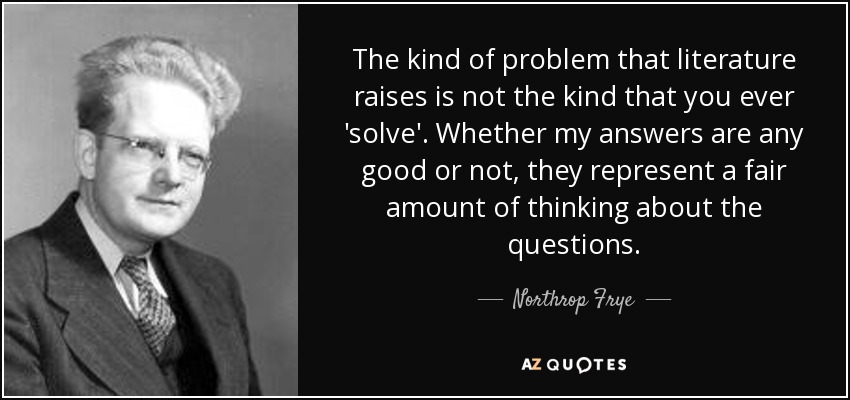
The kind of problem that literature raises is not the kind that you ever 'solve'. Whether my answers are any good or not, they represent a fair amount of thinking about the questions.
My subject is the educated imagination, and education is something that affects the whole person, not bits and pieces of him .
The bedrock of doubt is the total nothingness of death. Death is a leveler, not because everybody dies, but because nobody understands what death means.
The pursuit of beauty is much more dangerous nonsense than the pursuit of truth or goodness, because it affords a stronger temptation to the ego.
Science begins with the world we have to live in, accepting its data and trying to explain its laws. From there, it moves toward the imagination: it becomes a mental construct, a model of a possible way of interpreting experience. The further it goes in this direction, the more it tends to speak the language of mathematics, which is really one of the languages of the imagination, along with literature and music. Art, on the other hand, begins with the world we construct, not with the world we see. It starts with the imagination, and then works toward ordinary experience.
In the world of the imagination, anything goes that's imaginatively possible, but nothing really happens.
Every human society possesses a mythology which is inherited, transmitted and diversified by literature.
Literature is a human apocalypse, man's revelation to man, and criticism is not a body of adjudications, but the awareness of that revelation, the last judgement of mankind.
The Bible should be taught so early and so thoroughly that it sinks straight to the bottom of the mind where everything that comes along can settle on it.
Beauty and truth may be attributes of good writing, but if the writer deliberately aims at truth, he is likely to find that what he has hit is the didactic.
Man is constantly building anxiety-structures, like geodesic domes, around his social and religious institutions.
The poet, however, uses these two crude, primitive, archaic forms of thought (simile and metaphor) in the most uninhibited way, because his job is not to describe nature, but to show you a world completely absorbed and possessed by the human mind.
It seems clear that the Bible belongs to an area of language in which metaphor is functional, and were we have to surrender precision for flexibility.
The human landscape of the New World shows a conquest of nature by an intelligence that does not love it.
Metaphors of unity and integration take us only so far, because they are derived from the finiteness of the human mind.
The simple point is that literature belongs to the world man constructs, not to the world he sees; to his home, not his environment.
Work, as we usually think of it, is energy expended for a further end in view; play is energy expended for its own sake, as with children's play, or as manifestation of the end or goal of work, as in "playing" chess or the piano. Play in this sense, then, is the fulfillment of work, the exhibition of what the work has been done for.
Literature is conscious mythology: as society develops, its mythical stories become structural principles of story-telling, its mythical concepts, sun-gods and the like, become habits of metaphoric thought. In a fully mature literary tradition the writerenters intoa structure of traditional stories and images.
War appeals to young men because it is fundamentally auto-eroticism.
A snowflake is probably quite unconscious of forming a crystal, but what it does may be worth study even if we are willing to leave its inner mental processes alone.
Teaching literature is impossible; that is why it is difficult.
Poetry is the most direct and simple means of expressing oneself in words: the most primitive nations have poetry, but only quitewell developed civilizations can produce good prose. So don't think of poetry as a perverse and unnatural way of distorting ordinary prose statements: prose is a much less natural way of speaking than poetry is. If you listen to small children, and to the amount of chanting and singsong in their speech, you'll see what I mean.
Popular art is normally decried as vulgar by the cultivated people of its time; then it loses favor with its original audience as a new generation grows up; then it begins to merge into the softer lighting of
Historically, a Canadian is an American who rejects the Revolution.
No matter how much experience we may gather in life, we can never in life get the dimension of experience that the imagination gives us. Only the arts and sciences can do that, and of these, only literature gives us the whole sweep and range of human imagination as it sees itself
Follow AzQuotes on Facebook, Twitter and Google+. Every day we present the best quotes! Improve yourself, find your inspiration, share with friends
or simply: