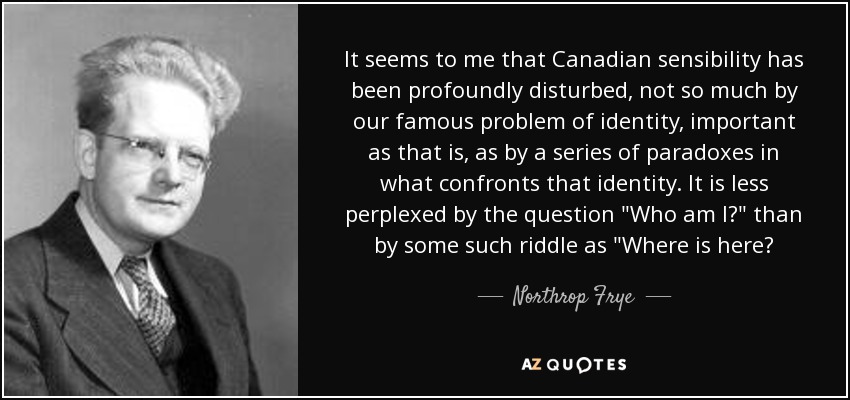



It seems to me that Canadian sensibility has been profoundly disturbed, not so much by our famous problem of identity, important as that is, as by a series of paradoxes in what confronts that identity. It is less perplexed by the question "Who am I?" than by some such riddle as "Where is here?
Man creates what he calls history as a screen to conceal the workings of the apocalypse from himself.
Most of my writing consists of an attempt to translate aphorisms into continuous prose.
Everything that happens in the Old Testament is a "type" or adumbration of something that happens in the New Testament, and the whole subject is therefore called typology, though it is a typology in a special sense.
I see a sequence of seven main phases: creation,revolution or exodus (Israel in Egypt), law, wisdom, prophecy, gospel, and apocalypse.
There is a curious law of art... that even the attempt to reproduce the act of seeing, when carried out with sufficient energy, tends to lose its realism and take on the unnatural glittering intensity of hallucination.
The objective world is the order of nature, thinking or reflection follows the suggestions of sense experience, and words are the servomechanisms of reflection.
We do not live in a centred space any more, but have to create our own centres.
Failure to grasp centrifugal meaning is incomplete reading; failure to grasp centripetal meaning is incompetent reading.
I don't see how the study of language and literature can be separated from the question of free speech, which we all know is fundamental to our society.
We have revolutionary thought whenever the feeling "life is a dream" becomes geared to an impulse to awaken from it.
The tricky or boastful gods of ancient myths and primitive folk tales are characters of the same kind that turn up in Faulkner or Tennessee Williams.
A public that tries to do without criticism, and asserts that it knows what it wants or likes, brutalizes the arts and loses its cultural memory. Art for art's sake is a retreat from criticism which ends in an impoverishment of civilized life itself.
Writing: I certainly do rewrite my central myth in every book, and would never read or trust any writer who did not also do so.
For the serious mediocre writer convention makes him sound like a lot of other people; for the popular writer it gives him a formula he can exploit; for the serious good writer it releases his experiences or emotions from himself and incorporates them into literature, where they belong.
Horace, in a particularly boastful mood, once said his verse would last as long as the vestal virgins kept going up the Capitoline Hill to worship at the temple of Jupiter. But Horace's poetry has lasted longer than Jupiter's religion, and Jupiter himself has only survived because he disappeared into literature.
The Bible is not interested in arguing, because if you state a thesis of belief you have already stated it's opposite; if you say, I believe in God, you have already suggested the possibility of not believing in him. [p.250]
The metaphor of the king as the shepherd of his people goes back to ancient Egypt. Perhaps the use of this particular convention is due to the fact that, being stupid, affectionate, gregarious, and easily stampeded, the societies formed by sheep are most like human ones.
To bring anything really to life in literature we can't be lifelike: we have to be literature-like
We find rhetorical situations everywhere in life, and only our imaginations can get us out of them.
Poetry can only be made out of other poems; novels out of other novels.
Writers don't seem to benefit much by the advance of science, although they thrive on superstitions of all kinds.
Culture's essential service to a religion is to destroy intellectual idolatry, the recurrent tendency in religion to replace the object of its worship with its present understanding and forms of approach to that object.
Literature is not a subject of study, but an object of study.
It is of the essence of imaginative culture that it transcends the limits both of the naturally possible and of the morally acceptable.
Follow AzQuotes on Facebook, Twitter and Google+. Every day we present the best quotes! Improve yourself, find your inspiration, share with friends
or simply: