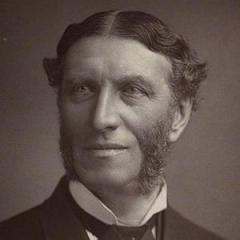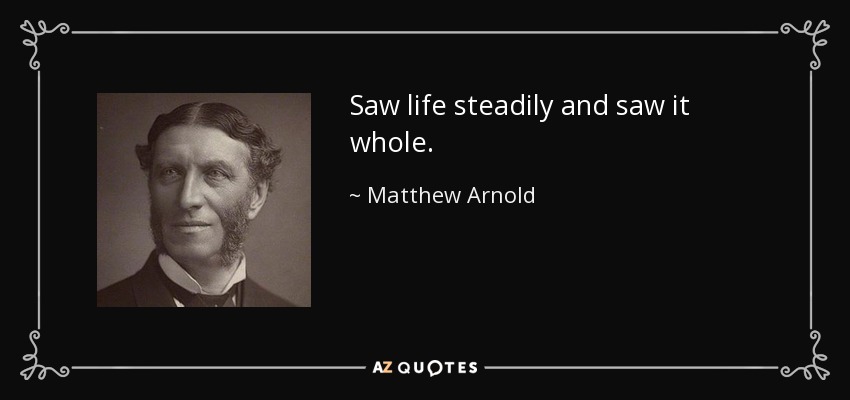

Saw life steadily and saw it whole.
Alas! is even love too weak To unlock the heart, and let it speak? Are even lovers powerless to reveal To one another what indeed they feel? I knew the mass of men conceal'd Their thoughts, for fear that if reveal'd They would by other men be met With blank indifference, or with blame reproved; I knew they lived and moved Trick'd in disguises, alien to the rest Of men, and alien to themselves - and yet The same heart beats in every human breast!
Inequality has the natural and necessary effect, under the present circumstances, of materializing our upper class, vulgarizing our middle class, and brutalizing our lower class.
Our society distributes itself into Barbarians, Philistines and Populace; and America is just ourselves with the Barbarians quite left out, and the Populace nearly.
The kings of modern thought are dumb.
Calm soul of all things! make it mine To feel, amid the city's jar, That there abides a peace of thine, Man did not make, and cannot mar! The will to neither strive nor cry, The power to feel what others give! Calm, calm me more! nor let me die Before I have begun to live.
But the idea of science and systematic knowledge is wanting to our whole instruction alike, and not only to that of our business class ... In nothing do England and the Continent at the present moment more strikingly differ than in the prominence which is now given to the idea of science there, and the neglect in which this idea still lies here; a neglect so great that we hardly even know the use of the word science in its strict sense, and only employ it in a secondary and incorrect sense.
What is it to grow old? Is it to lose the glory of the form, The lustre of the eye? Is it for Beauty to forego her wreath? Yes; but not this alone.
Goethe in Weimar sleeps, and Greece, Long since, saw Byron 's struggle cease.
Creep into thy narrow bed, Creep, and let no more be said!
Hither and thither spins The wind-borne mirroring soul, A thousand glimpses wins, And never sees a whole.
And amongst us one, Who most has suffer'd, takes dejectedly His seat upon the intellectual throne.
Where great whales come sailing by, Sail and sail, with unshut eye, Round the world for ever and aye.
The nice sense of measure is certainly not one of Nature's gifts to her English children ... we have all of us yielded to infatuation at some moment of our lives.
Culture looks beyond machinery, culture hates hatred; culture has one great passion--the passion for sweetness and light. It has one even yet greater, the passion for making them all prevail. It is not satisfied till we all come to a perfect man; it knows that the sweetness and light of the few must be imperfect until the raw and unkindly masses of humanity are touched with sweetness and light.
Poetry interprets in two ways: it interprets by expressing, with magical felicity, the physiognomy and movements of the outward world; and it interprets by expressing, with inspired conviction, the ideas and laws of the inward world of man's moral and spiritual nature. In other words, poetry is interpretative both by having natural magic in it, and by having moral profundity.
Because thou must not dream, thou need not despair.
In our English popular religion the common conception of a future state of bliss is that of ... a kind of perfected middle-class home, with labour ended, the table spread, goodness all around, the lost ones restored, hymnody incessant.
Thou waitest for the spark from heaven! and we, Light half-believers in our casual deeds . . . Who hesitate and falter life away, And lose tomorrow the ground won today- Ah, do not we, Wanderer, await it too?
One has often wondered whether upon the whole earth there is anything so unintelligent, so unapt to perceive how the world is really going, as an ordinary young Englishman of our upper class.
Beautiful city! . . . spreading her gardens to the moonlight, and whispering from her towers the last enchantments of the Middle Age . . . her ineffable charm. . . . Adorable dreamer, whose heart has been so romantic!
The working-class is now issuing from its hiding-place to assert an Englishman's heaven-born privilege of doing as he likes, and is beginning to perplex us by marching where it likes, meeting where it likes, bawling what it likes, breaking what it likes.
For what wears out the life of mortal men? 'Tis that from change to change their being rolls; Tis that repeated shocks, again, again, Exhaust the energy of strongest souls And numb the elastic powers.
Most men in a brazen prison live, Where, in the sun's hot eye, With heads bent o'er their toil, they languidly Their lives to some unmeaning taskwork give, Dreaming of nought beyond their prison-wall.
The love of science, and the energy and honesty in the pursuit of science, in the best of the Aryan races do seem to correspond in a remarkable way to the love of conduct, and the energy and honesty in the pursuit of conduct, in the best of the Semitic.
Follow AzQuotes on Facebook, Twitter and Google+. Every day we present the best quotes! Improve yourself, find your inspiration, share with friends
or simply: