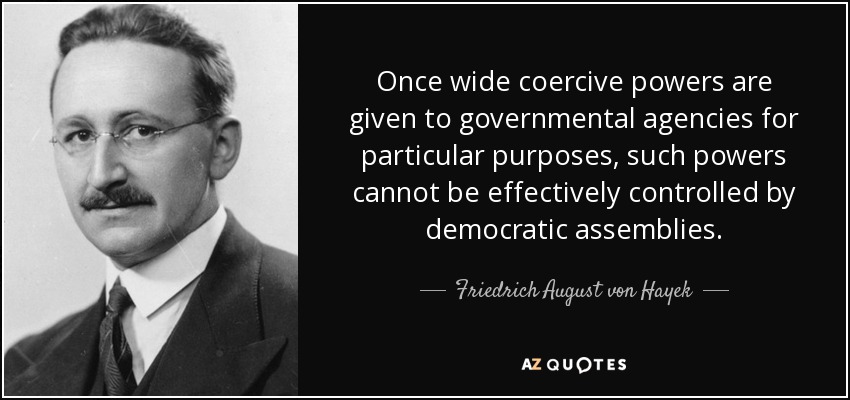
Once wide coercive powers are given to governmental agencies for particular purposes, such powers cannot be effectively controlled by democratic assemblies.
We must shed the illusion that we can deliberately 'create the future of mankind'
Democracy is essentially a means, a utilitarian device for safeguarding internal peace and individual freedom. As such it is by no means infallible or certain. Nor must we forget that there has often been much more cultural and spiritual freedom under an autocratic rule than under some democracies and it is at least conceivable that under the government of a very homogeneous and doctrinaire majority democratic government might be as oppressive as the worst dictatorship.
To create conditions in which competition will be as effective as possible, to prevent fraud and deception, to break up monopolies- these tasks provide a wide and unquestioned field for state activity.
I use throughout the term 'liberal' in the original, nineteenth-century sense in which it is still current in Britain. In current American usage it often means very nearly the opposite of this. It has been part of the camouflage of leftish movements in this country, helped by muddleheadedness of many who really believe in liberty, that 'liberal' has come to mean the advocacy of almost every kind of government control.
It is one of the most fatal illusions that, by substituting negotiations between states or organized groups for competition for markets or for raw materials, international friction would be reduced. This would merely put a contest of force in the place of what can only metaphorically be called the "struggle" of competition and would transfer to powerful and armed states, subject to no superior law, the rivalries which between individuals had to be decided without recourse to force.
If democracy is a means rather than an end, its limits must be determined in the light of the purpose we want it to serve.
Without a theory the facts are silent.
Socialism has never and nowhere been at first a working-class movement.
Nowhere has democracy ever worked well without a great measure of local self-government, providing a school of political training for the people at large as much as for their future leaders.
It is possible for a dictator to govern in a liberal way. And it is also possible for a democracy to govern with a total lack of liberalism. Personally I prefer a liberal dictator to democratic government lacking liberalism.
It is also true that the less possible it becomes for a man to acquire a new fortune, the more must the existing fortunes appear as privileges for which there is no justification. Policy is then certain to aim at taking these fortunes out of private hands, either by the slow process of heavy taxation of inheritance or by the quicker one of outright confiscation. A system based on private property and control of the means of production presupposes that such property and control can be acquired by any successful man.
Never will man penetrate deeper into error than when he is continuing on a road which has led him to great success
Wherever liberty as we understand it has been destroyed, this has almost always been done in the name of some new freedom promised to the people
It is not the source but the limitation of power which prevents it from being arbitrary.
It is because freedom means the renunciation of direct control of individual efforts that a free society can make use of so much more knowledge than the mind of the wisest ruler could comprehend.
Capitalism created the possibility of employment.
Competition means decentralized planning by many separate persons.
As is true with respect to other great evils, the measures by which war might be made altogether impossible for the future may well be worse than even war itself.
It is when it is contended that "in a democracy right is what the majority makes it to be" that democracy degenerates into demagoguery.
We must not forget that … monetary policy all over the world has followed the advice of the stabilizers. It is high time that their influence, which has already done harm enough, should be overthrown.
... that order generated without design can far outstrip plans men consciously contrive
... I prefer true but imperfect knowledge, even if it leaves much undetermined and unpredictable, to a pretense of exact knowledge that is likely to be false.
Freedom granted only when it is known beforehand that its effects will be beneficial is not freedom.
The confidence in the unlimited power of science is only too often based on a false belief that the scientific method consists in the application of a ready-made technique, or in imitating the form rather than the substance of scientific procedure, as if one needed only to follow some cooking recipes to solve all social problems. It sometimes almost seems as if the techniques of science were more easily learnt than the thinking that shows us what the problems are and how to approach them.
Follow AzQuotes on Facebook, Twitter and Google+. Every day we present the best quotes! Improve yourself, find your inspiration, share with friends
or simply: