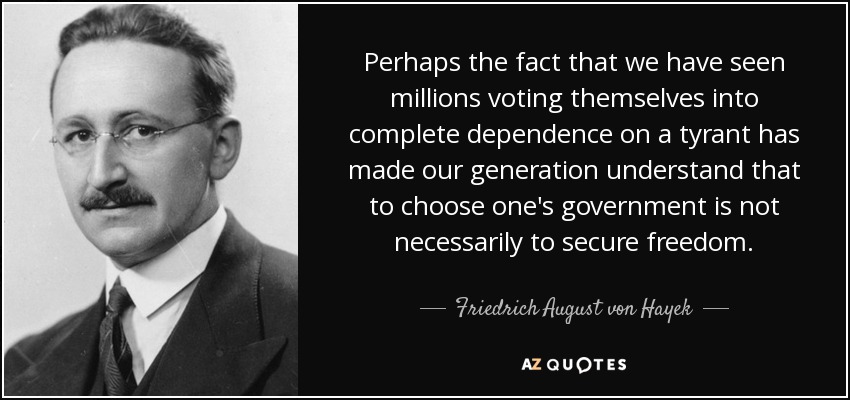
Perhaps the fact that we have seen millions voting themselves into complete dependence on a tyrant has made our generation understand that to choose one's government is not necessarily to secure freedom.
A claim for equality of material position can be met only by a government with totalitarian powers.
Economic control is not merely control of a sector of human life which can be separated from the rest; it is the control of the means for all our ends. And whoever has sole control of the means must also determine which ends are to be served, which values are to be rates higher and which lower, in short, what men should believe and strive for.
When we ask what ought to be the relative remunerations of a nurse or a butcher, or a coal miner and a judge at a high court, of the deep sea diver of the cleaner of sewers, of the organiser of a new industry and a jockey, of the inspector of taxes and the inventor of a life-saving drug, of the jet-pilot or the professor of mathematics, the appeal to 'social justice' does not give us the slightest help in deciding.
While an equality of rights under a limited government is possible and an essential condition of individual freedom, a claim for equality of material position can be met only by a government with totalitarian powers.
The system of private property is the most important guaranty of freedom, not only for those who own property, but scarcely less for those who do not.
By the time any view becomes a majority view, it is no longer the best view: somebody will already have advanced beyond the point which the majority have reached.
Liberty is an opportunity for doing good, but this is only so when it is also an opportunity for doing wrong.
We must face the fact that the preservation of individual freedom is incompatible with a full satisfaction of our views of distributive justice.
If we wish to preserve a free society, it is essential that we recognize that the desirability of a particular object is not sufficient justification for the use of coercion.
And who will deny that a world in which the wealthy are powerful is still a better world than one in which only the already powerful can acquire wealth?
To combat the depression by a forced credit expansion is to attempt to cure the evil by the very means which brought it about.
Everything which might cause doubt about the wisdom of the government or create discontent will be kept from the people. The basis of unfavorable comparisons with elsewhere, the knowledge of possible alternatives to the course actually taken, information which might suggest failure on the part of the government to live up to its promises or to take advantage of opportunities to improve conditions--all will be suppressed. There is consequently no field where the systematic control of information will not be practiced and uniformity of views not enforced.
Socialist thought owes its appeal to the young largely to its visionary character; the very courage to indulge in Utopian thought is in this respect a source of strength for socialism which traditional liberalism sadly lacks. Speculation about general principles provides an opportunity for the play of the imagination of those who are unencumbered by much knowledge of the facts of present-day life. Their ideas suffer from inherent contradictions, and any attempt to put them into practice must produce something utterly different from what they expect.
We shall never prevent the abuse of power if we are not prepared to limit power in a way which occasionally may prevent its use for desirable purposes.
Liberty and responsibility are inseparable.
It is tempting to believe that social evils arise from the activities of evil men and that if only good men (like ourselves, naturally) wielded power, all would be well. That view requires only emotion and self-praise - easy to come by and satisfying as well. To understand why it is that 'good' men in positions of power will produce evil, while the ordinary man without power but able to engage in voluntary cooperation with his neighbors will produce good, requires analysis and thought, subordinating emotions to the rational.
The conception that government should be guided by majority opinion makes sense only if that opinion is independent of government. The ideal of democracy rests on the belief that the view which will direct government emerges from an independent and spontaneous process. It requires, therefore, the existence of a large sphere independent of majority control in which the opinions of the individuals are formed.
The mischievous idea that all public needs should be satisfied by compulsory organization and that all the means that individuals are willing to devote to pubic purposes should be under the control of government, is wholly alien to the basic principles of a free society.
Human reason can neither predict nor deliberately shape its own future. Its advances consist in finding out where it has been wrong.
You can have economic freedom without political freedom, but you cannot have political freedom without economic freedom.
Unlike liberalism, with its fundamental belief in the long-range power of ideas, conservatism is bound by the stock of ideas inherited at a given time. And since it does not really believe in the power of argument, its last resort is generally a claim to superior wisdom, based on some self-arrogated superior quality.
The argument for liberty is not an argument against organization, which is one of the most powerful tools human reason can employ, but an argument against all exclusive, privileged, monopolistic organization, against the use of coercion to prevent others from doing better.
The [classical] liberal, of course, does not deny that there are some superior people -- he is not an egalitarian -- but he denies that anyone has authority to decide who these superior people are.
The Socratic maxim that the recognition of our ignorance is the beginning of wisdom has profound significance for our understanding of society. Most of the advantages of social life, especially in the more advanced forms that we call "civilization" rest on the fact that the individual benefits from more knowledge than he is aware of. It might be said that civilization begins when the individual in the pursuit of his ends can make use of more knowledge than he has himself acquired and when he can transcend the boundaries of his ignorance by profiting from knowledge he does not himself possess.
Follow AzQuotes on Facebook, Twitter and Google+. Every day we present the best quotes! Improve yourself, find your inspiration, share with friends
or simply: