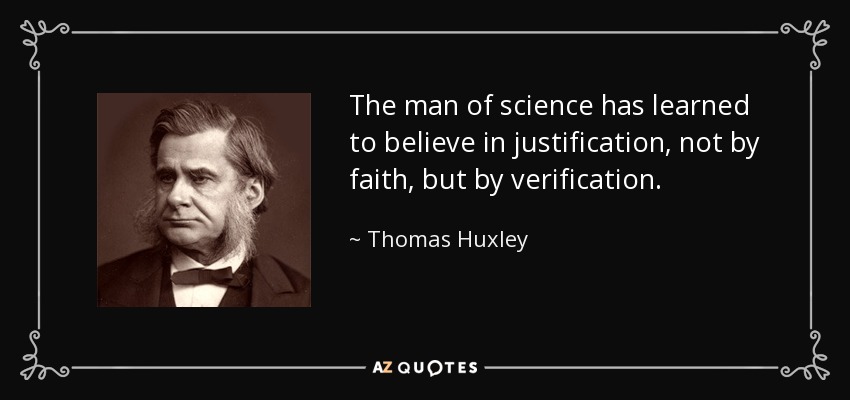



The man of science has learned to believe in justification, not by faith, but by verification.
The rung of a ladder was never meant to rest upon, but only to hold a man's foot long enough to enable him to put the other somewhat higher.
Agnosticism, in fact, is not a creed, but a method, the essence of which lies in the rigorous application of a single principle. ... Positively the principle may be expressed: In matters of the intellect, follow your reason as far as it will take you, without regard to any other consideration. And negatively: In matters of the intellect, do not pretend that conclusions are certain which are not demonstrated or demonstrable.
The rules of the game are what we call the laws of nature.
It is not what we believe, but why we believe it. Moral responsibility lies in diligently weighing the evidence. We must actively doubt; we have to scrutinize our views, not take them on trust. No virtue attached to blindly accepting orthodoxy, however 'venerable'.
A man who speaks out honestly and fearlessly that which he knows, and that which he believes, will always enlist the good will and the respect, however much he may fail in winning the assent, of his fellow men.
The birth of science was the death of superstition.
Teach a child what is wise, that is morality. Teach him what is wise and beautiful, that is religion!
What would become of the garden if the gardener treated all the weeds and slugs and birds and trespassers as he would like to be treated, if he were in their place?
Science is simply common sense at its best.
Extinguished theologians lie about the cradle of every science as the strangled snakes beside that of Hercules; and history records that whenever science and orthodoxy have been fairly opposed, the latter has been forced to retire from the lists, bleeding and crushed if not annihilated; scotched, if not slain.
The Bible account of the creation of Eve is a preposterous fable.
. . . I fail to find a trace [in Protestantism] of any desire to set reason free. The most that can be discovered is a proposal to change masters. From being a slave of the papacy, the intellect was to become the serf of the Bible.
Science is simply common sense at its best, that is, rigidly accurate in observation, and merciless to fallacy in logic.
There is assuredly no more effectual method of clearing up one's own mind on any subject than by talking it over, so to speak, with men of real power and grasp, who have considered it from a totally different point of view.
In matters of intellect, follow your reason as far as it will take you, without regard for any other consideration.
All truth, in the long run, is only common sense clarified.
The thief and the murderer follow nature just as much as the philanthropist.
I can assure you that there is the greatest practical benefit in making a few failures early in life. You learn that which is of inestimable importance that there are a great many people in the world who are just as clever as you are. You learn to put your trust, by and by, in an economy and frugality of the exercise of your powers, both moral and intellectual; and you very soon find out, if you have not found it out before, that patience and tenacity of purpose are worth more than twice their weight of cleverness.
The doctrine that all men are, in any sense, or have been, at any time, free and equal, is an utterly baseless fiction.
Sit down before fact as a little child, be prepared to give up every conceived notion, follow humbly wherever and whatever abysses nature leads, or you will learn nothing.
A world of facts lies outside and beyond the world of words.
In scientific work, those who refuse to go beyond fact rarely get as far as fact.
History warns us that it is the customary fate of new truths to begin as heresies and to end as superstitions.
Science and literature are not two things, but two sides of one thing.
Follow AzQuotes on Facebook, Twitter and Google+. Every day we present the best quotes! Improve yourself, find your inspiration, share with friends
or simply: