

War is a profession by which a man cannot live honorably; an employment by which the soldier, if he would reap any profit, is obliged to be false, rapacious, and cruel.
A return to first principles in a republic is sometimes caused by the simple virtues of one man. His good example has such an influence that the good men strive to imitate him, and the wicked are ashamed to lead a life so contrary to his example.
A wise ruler ought never to keep faith when by doing so it would be against his interests.
For without invention, no one was ever a great man in his own trade.
To know in war how to recognize an opportunity and seize it is better than anything else.
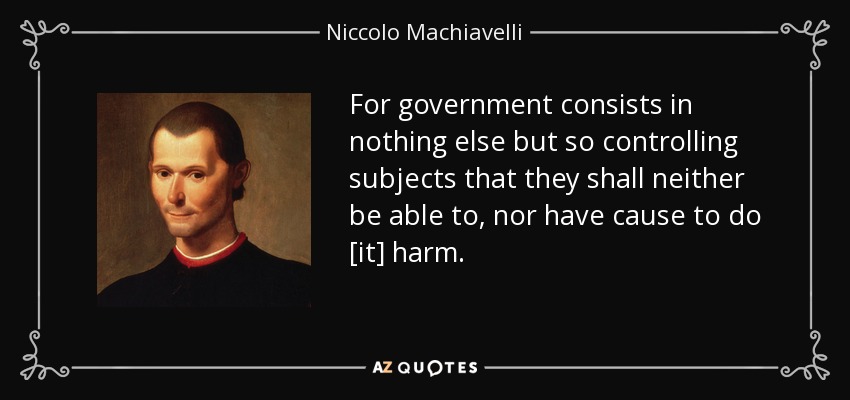
For government consists in nothing else but so controlling subjects that they shall neither be able to, nor have cause to do [it] harm.
One can generally say this about men: that they are ungrateful, fickle, simulators and deceivers, avoiders of danger, greedy for gain; and while you work for their good they are completely yours, offering you their blood, their property, their lives, and their sons when danger is far away; but when it comes nearer to you, they turn away.
Occasionally words must serve to veil the facts. But let this happen in such a way that no one become aware of it; or, if it should be noticed, excuses must be at hand to be produced immediately.
And here one must not that hatred is acquired just as much by means of good actions as by bad ones; and so, as I said above, if a prince wishes to maintain the state, he is often obliged not to be good; because whenever that group which you believe you need to support you is corrupted, whether it be the common people, the soldiers, or the nobles, it is to your advantage to follow their inclinations in order to satisfy them; and then good actions are your enemy.
The princes who have done great things are the ones who have taken little account of their promises.
He who would foresee what is to happen should look to what has happened: for all that is has its counterpart in time past.
Whoever is the cause of another becoming powerful, is ruined himself; for that power is produced by him either through craft or force; and both of these are suspected by the one who has been raised to power.
Well used are those cruelties (if it is permitted to speak well of evil) that are carried out in a single stroke, done out of necessity to protect oneself, and are not continued but are instead converted into the greatest possible benefits for the subjects. Badly used are those cruelties which. although being few at the outset, grow with the passing time instead of disappearing. Those who follow the first method can remedy their condition with God and with men; the others cannot possibly survive.
To know well the nature of the people one must be a prince, and to know well the nature of princes one must be of the people.
The one who adapts his policy to the times prospers, and likewise that the one whose policy clashes with the demands of the times does not.
Although deceit is detestable in all other things, yet in the conduct of war it is laudable and honorable; and a commander who vanquishes an enemy by stratagem is equally praised with one who gains victory by force.
Men as a whole judge more with their eyes than with their hands.
And it will always happen that he who is not your friend will request your neutrality and he who is your friend will ask you to declare yourself by taking up arms. And irresolute princes, in order to avoid present dangers, follow the neutral road most of the time, and most of the time they are ruined.
For, besides what has been said, it should be borne in mind that the temper of the multitude is fickle, and that while it is easy to persuade them of a thing, it is hard to fix them in that persuasion
They have not any difficulties on the way up because they fly, but they have many when they reach the summit.
Men ought either to be indulged or utterly destroyed, for if you merely offend them they take vengeance, but if you injure them greatly they are unable to retaliate, so that the injury done to a man ought to be such that vengeance cannot be feared.
He who becomes a Prince through the favour of the people should always keep on good terms with them; which it is easy for him to do, since all they ask is not to be oppressed
And if such malignity is hidden for a time, it proceeds from the unknown reason that would not be known because the experience of the contrary had not been seen, but time, which is said to be the father of every truth, will cause it to be discovered.
In order not to annul our free will, I judge it true that Fortune may be mistress of one half our actions but then even she leaves the other half, or almost, under our control.
The prince must consider, as has been in part said before, how to avoid those things which will make him hated or contemptible; and as often as he shall have succeeded he will have fulfilled his part, and he need not fear any danger in other reproaches.
Follow AzQuotes on Facebook, Twitter and Google+. Every day we present the best quotes! Improve yourself, find your inspiration, share with friends
or simply: