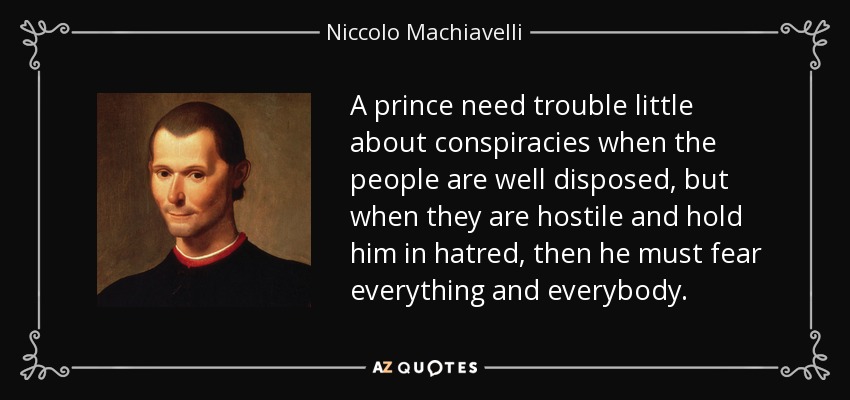


Thus it is well to seem merciful, faithful, humane, sincere, religious, and also to be so; but you must have the mind so disposed that when it is needful to be otherwise you may be able to change to the opposite qualities.
A son can bear with equanimity the loss of his father, but the loss of his inheritance may drive him to despair.
In truth, there never was any remarkable lawgiver amongst any people who did not resort to divine authority, as otherwise his laws would not have been accepted by the people; for there are many good laws, the importance of which is known to be the sagacious lawgiver, but the reasons for which are not sufficiently evident to enable him to persuade others to submit to them; and therefore do wise men, for the purpose of removing this difficulty, resort to divine authority.
Wisdom consists of knowing how to distinguish the nature of trouble, and in choosing the lesser evil.
He who neglects what is done for what ought to be done, sooner effects his ruin than his preservation.
A blast in the human breast is nothing to boast of.
I say that every prince must desire to be considered merciful and not cruel. He must, however, take care not to misuse this mercifulness.
No one should therefore fear that he cannot accomplish what others have accomplished, for, men are born, live, and die in quite the same way they always have.
Men in general judge more by the sense of sight than by the sense of touch, because everyone can see but few can test by feeling. Everyone sees what you seem to be, few know what you really are; and those few do not dare take a stand against the general opinion.
Nature creates few men brave, industry and training makes many.
A wise prince then...should never be idle in times of peace but should industriously lay up stores of which to avail himself in times of adversity so that when fortune abandons him he may be prepared to resist her blows.
it is much safer to be feared than loved because ...love is preserved by the link of obligation which, owing to the baseness of men, is broken at every opportunity for their advantage; but fear preserves you by a dread of punishment which never fails.
Men are less hesitant about harming someone who makes himself loved than one who makes himself feared because love is held together by a chain of obligation which, since men are wretched creatures, is broken on every occasion in which their own interests are concerned; but fear is sustained by dread of punishment which will never abandon you.
My view is that it is desirable to be both loved and feared; but it is difficult to achieve both and, if one of them has to be lacking, it is much safer to be feared than loved.
It is much better to tempt fortune where it can favor you than to see your certain ruin by not tempting it.
One should never permit a disorder to persist in order to avoid a war, for wars cannot be avoided and can only be deferred to the advantage of others.
You do not know the unfathomable cowardice of humanity...servile in the face of force, pitiless in the face of weakness, implacable before blunders, indulgent before crimes...and patient to the point of martyrdom before all the violences of bold despotism.
Princes and governments are far more dangerous than other elements within society.
The world has always been the same; and there is always as much good fortune as bad in it.
The nature of man is such that people consider themselves put under an obligation as much by the benefits they confer as by those they receive.
A wise man will see to it that his acts always seem voluntary and not done by compulsion, however much he may be compelled by necessity.
Conquered states that have been accustomed to liberty and the government of their own laws can be held by the conqueror in three different ways. The first is to ruin them; the second, for the conqueror to go and reside there in person; and the third is to allow them to continue to live under their own laws, subject to a regular tribute, and to create in them a government of a few, who will keep the country friendly to the conqueror
Never do your enemy a minor injury.
Speaking generally, men are ungrateful, fickle, hypocritical, fearful odanger and covetous ogain.
And above all you ought to guard against leading an army to fight which is afraid or which is not confident of victory. For the greatest sign of an impending loss is when one does not believe one can win.
Follow AzQuotes on Facebook, Twitter and Google+. Every day we present the best quotes! Improve yourself, find your inspiration, share with friends
or simply: