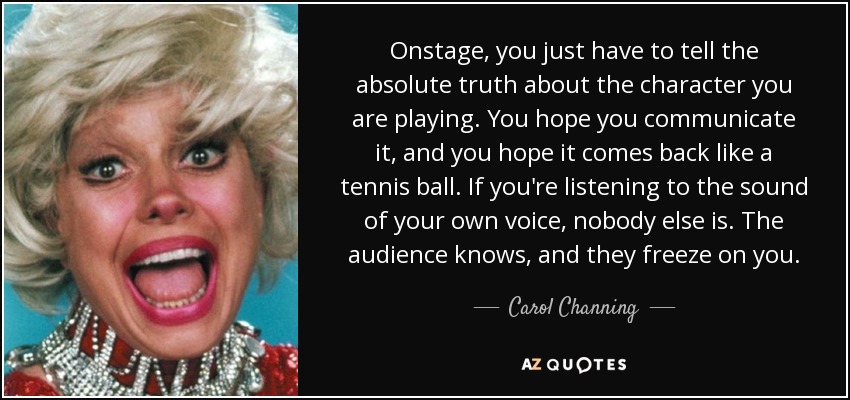
Onstage, you just have to tell the absolute truth about the character you are playing. You hope you communicate it, and you hope it comes back like a tennis ball. If you're listening to the sound of your own voice, nobody else is. The audience knows, and they freeze on you.
How do I create something out of nothing? And how do I create my own life? I think it is by questioning, and saying to myself that there are no absolute truths.
There can be no absolute reality, there can be no absolute truth.
AN ARTISTIC DISCOVERY OCCURS EACH TIME AS A NEW AND UNIQUE IMAGE OF THE WORLD, A HIEROGLYPHIC OF ABSOLUTE TRUTH. IT APPEARS AS A REVELATION, AS A MOMENTARY, PASSIONATE WISH TO GRASP INTUITIVELY AND AT A STROKE ALL THE LAWS OF THIS WORLD-ITS BEAUTY AND UGLINESS, ITS COMPASSION AND CRUELTY, ITS INFINITY AND ITS LIMITATIONS.
God is the absolute truth...
There is no such thing as an absolute truth to be discovered.
Words are but symbols for the relations of things to one another and to us; nowhere do they touch upon absolute truth.
Once war becomes a clash of absolutes, there is no breathing room for mercy. Absolute truth is blind truth.
The study of Nature is intercourse with the highest mind. You should never trifle with Nature. At her lowest her works are the works of the highest powers, the highest something in the universe, in whichever way we look at it... This is the charm of Study from Nature itself; she brings us back to absolute truth wherever we wander.
Reality is, after all, too big for our frail understanding to fully comprehend. Nevertheless, we have to build our life on the theory which contains the maximum truth.We cannot sit still because we cannot, or do not , know the Absolute Truth.
Woe to the suicides! I believe that there can be none more miserable than they. Oh, there are some who remain proud and fierce even in hell, in spite of their certain knowledge and contemplation of the absolute truth; there are some fearful ones who have given themselves over to Satan and his proud spirit entirely. For such, hell is voluntary and ever consuming; they are tortured by their own choice. For they have cursed themselves, cursing God and life. And they will burn in the fire of their own wrath forever and yearn for death and annihilation. But they will not attain to death.
Add a few drops of venom to a half truth and you have an absolute truth.
There is nothing more necessary than truth, and in comparison with it everything else has only secondary value. This absolute will to truth: what is it? Is it the will to not allow ourselves to be deceived? Is it the will not to deceive? One does not want to be deceived, under the supposition that it is injurious, dangerous, or fatal to be deceived.
The absolute truth is that the 'I' is perfect and complete; the real 'I' is spiritual and can therefor never be less than perfect; it can never have any lack, limitation, or disease.
There is no such thing as absolute truth and absolute falsehood. The scientific mind should never recognise the perfect truth or the perfect falsehood of any supposed theory or observation. It should carefully weigh the chances of truth and error and grade each in its proper position along the line joining absolute truth and absolute error.
It is necessary for the Bible, in order to be accommodated to the understanding of every man, to speak many things which appear to differ from the absolute truth so far as the bare meaning of the words is concerned.
Today's devices blurt out the absolute truth as they know it. A smart device in the future might know when NOT to blurt out the truth.
The purpose of scientific method is to select a single truth from among many hypothetical truths. That, more than anything else, is what science is all about. But historically science has done exactly the opposite. Through multiplication upon multiplication of facts, information, theories and hypotheses, it is science itself that is leading mankind from single absolute truths to multiple indeterminate, relative ones.
The beginning of religion, more precisely its content, is the concept of religion itself, that God is the absolute truth, the truth of all things, and subjectively that religion alone is the absolutely true knoweldge.
To think out a problem is not unlike drawing a caricature. You have to exaggerate the salient point and leave out that which is not typical. "To illustrate a principle ," says Bagehot , "you must exaggerate much and you must omit much." As to the quantity of absolute truth in a thought : it seems to me the more comprehensive and unobjectionable a thought becomes, the more clumsy and unexciting it gets. I like half-truths of a certain kind they are interesting and they stimulate.
Truth indeed is sacred; but, as Pilate said, "What is truth?" Show us the undoubted infallible criterion of absolute truth, and we will hold it as a sacred inviolable thing. But in the absence of that infallible criterion, we have all an equal right to grope about in our search of it, and no body and no school nor clique must be allowed to set up a standard of orthodoxy which shall bar the freedom of scientific inquiry.
(Because) the notion of absolute truth is difficult to sustain outside the context of religion, ethical conduct is not something we engage in because it is somehow right in itself but because, like ourselves, all others desire to be happy and to avoid suffering. Given that this is a natural disposition, shared by all, it follows that each individual has a right to pursue this goal. Accordingly, I suggest that one of the things which determines whether an act is ethical or not is its effect on others' experience or expectation of happiness.
Truth is always unfolding. It's not an absolute.
Religion claims to be in possession of an absolute truth; but its history is a history of errors and heresies. It gives us the promise and prospect of a transcendent world - far beyond the limits of our human experience - and it remains human, all too human.
An ideology is a complex of ideas or notions which represents itself to the thinker as an absolute truth for the interpretation of the world and his situation within it; it leads the thinker to accomplish an act of self-deception for the purpose of justification, obfuscation and evasion in some sense or other to his advantage.
Follow AzQuotes on Facebook, Twitter and Google+. Every day we present the best quotes! Improve yourself, find your inspiration, share with friends
or simply: