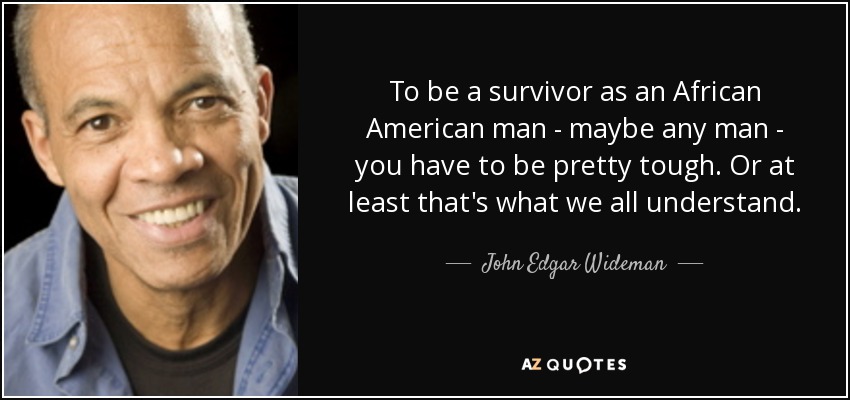
To be a survivor as an African American man - maybe any man - you have to be pretty tough. Or at least that's what we all understand.
And thus goes segregation which is the most far-reaching development in the history of the Negro since the enslavement of the race.
I have 90 percent or 95 percent support in the African American community and it's not sort of "Well, he's black, so it's okay. We're not going to say anything even though we're seething." And I hang out with a lot of middle-aged black women, and they're not casual in their support of me. There's a lot of love forthcoming. Partly because they understand the constraints of this society. They know that this is hard.
I deeply understand the history of civil rights and the horrendous impact that relentless and systemic discrimination and the denial of voting rights has had on our African-American brothers and sisters. I have witnessed it.
When I think of the Harlem Renaissance, I think of bright colors, and bold, dynamic art. African American artists of the period were, in large measure, breaking out of the constrictions white society had set for them. They were claiming and remaking their own images, and doing so in bold and striking ways.
This is, for an accomplished Latino, an accomplished African American, an accomplished anyone who disproves stereotypes, it's a constant battle in your life.
The designation is useful and necessary and sometimes limiting but it is only limiting to people who think, for example, that African-American literature couldn't possibly be something they could be interested in or relate to. They have limited imaginations, which is sad.
You make real progress when somebody is honest enough to say something that's really uncomfortable. Of course when you're a candidate's wife and when you're first lady and the first African-American first lady to boot, that is very, very hard to do.
I don't regret the fervor, because I do believe, in the African American community but also for other communities, and I know from talking to people, for communities around the world, the election of an African American to the most powerful office on Earth meant things had changed, and not just in superficial ways. That in some irreversible way the world was different.
My writing is definitely influenced by and speaks to African-Americans because that is who I am. I'm black. I'm a black woman. I'm a black mother, wife, churchgoer, etc. I am the legacy of slavery.
There are some dark days when I do receive some racist mail or emails. But overall the response to me has been very positive. Readers relate to me not just as an African-American, but as an American trying to make sense of her personal finance, just like them.
People who are overweight face discrimination. African-Americans face discrimination. Women face discrimination and sexism. So I don't have the luxury of not being tolerant of anyone.
Higher minimum wages, full-employment programs, early-childhood education: Those kinds of programs are, by design, universal, but by definition, because they are helping folks who are in the worst economic situations, are most likely to disproportionately impact and benefit African Americans. They also have the benefit of being sellable to a majority of the body politic.
We all remember that [Donald] Trump was one of the leaders of the so-called birther movement trying to delegitimize the presidency of our first African-American president Barack Obama, which is an outrage.
If you want to get at African American poverty, the income gap, wealth gap, achievement gap, that the most important thing is to make sure that the society as a whole does right by people who are poor, are working class, are aspiring to a better life for their kids.
The same would be true for something like Social Security, where historically, if you just read the law and the fact that it excluded domestic workers or agricultural workers, you might not see race in it, unless you knew that that covered a huge chunk of African Americans, particularly in the South.
Reinvigorating the Civil Rights Division of the Justice Department, making sure that in our Department of Education, where we see evidence of black boys being suspended at substantially higher rates than white boys for the same behavior, in the absence of that kind of rigorous enforcement of the nondiscrimination principle, then the long-standing biases that I believe have weakened, but are still clearly present in our society, assert themselves in ways that usually disadvantage African Americans.
How do we in the African American community build a culture in which we are saying to our kids, "Here's what it takes to succeed. Here's the sacrifices you need to make to be able to get ahead. Here's how we support each other. Here's how we look out for each other."
So how do Latinos feel if there's a big investment just in the African American community, and they're looking around and saying, "We're poor as well. What kind of help are we getting?" Or Asian Americans who say, "Look, I'm a first-generation immigrant, and clearly I didn't have anything to do with what was taking place."
I have much more confidence in my ability, or any president or any leader's ability, to mobilize the American people around a multiyear, multibillion-dollar investment to help every child in poverty in this country than I am in being able to mobilize the country around providing a benefit specific to African Americans as a consequence of slavery and Jim Crow.
Let's also say that the Justice Department and the courts are making sure, as I've said in a speech before, that when Jamal sends his résumé in, he's getting treated the same as when Johnny sends his résumé in.Now, are we going to have suddenly the same number of CEOs, billionaires, etc., as the white community? In 10 years? Probably not, maybe not even in 20 years. But I guarantee you that we would be thriving, we would be succeeding. We wouldn't have huge numbers of young African American men in jail.
It requires enormous energy for us to cut the African American uninsured rate by a third. A lot of scars.
Bernie Sanders would say, "You still have millions of African Americans who aren't insured, and if we had a single-payer system, that wouldn't be the case." And that's true.
Let's say hypothetically, knowing what we know now about public policy, that we could close the education gap so that it was only a couple percentage points, and we could make sure that hiring barriers and educational barriers had been leveled down, and unemployment among African Americans right now instead of being double was only 10 percent higher than white unemployment - if we got to that point , America as a whole would be a lot richer.
I actually believe that some residue of discrimination would lessen, because it's my view that there is a certain percentage of the white population that stereotypes and makes assumptions about African Americans because they don't inject the history of slavery and Jim Crow into current incarceration rates, or crime rates, or poverty rates, or what have you.
Follow AzQuotes on Facebook, Twitter and Google+. Every day we present the best quotes! Improve yourself, find your inspiration, share with friends
or simply: