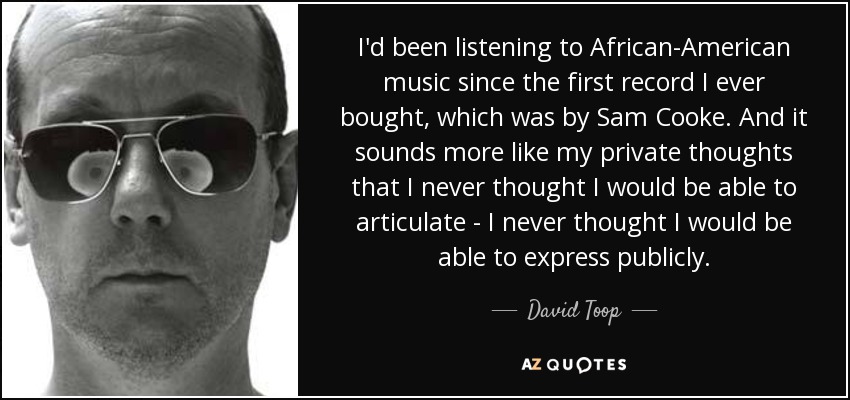
I'd been listening to African-American music since the first record I ever bought, which was by Sam Cooke. And it sounds more like my private thoughts that I never thought I would be able to articulate - I never thought I would be able to express publicly.
Ray Gomez is truly an unsung hero in American music.
Grammys, American Music Awards, successful albums, I'd pick my kids any day over any of it.
Paste may be the last great American music magazine left.
Above all else, [Benny Goodman] was a great player, one of the greatest American music has produced. He brought his absolute talent and his invincible love of music to the fore every time he played. There are many other things connected to society and ethnicity that are often mentioned in a discussion of Benny Goodman but all of them are connected to his overwhelming affection for the art of the music and the fairness it should be allowed to express.
The biggest problem with American music right now, is that kids don't listen. They come by it honestly, Americans don't listen anyway. When people go to concerts, they say I'm going to see... not, I'm going to hear.
I quite like American music, like The Fray - I'm a massive fan of them - and The Killers. I also like more acoustic stuff like Ed Sheeran; I like this English songwriter James Morrison and another singer called Ben Howard.
The whole path of American music has been so much about the recognition of stylistic diversity, and the recognition of the importance of music which was from one of the vernacular traditions.
I was into playing American music, especially the blues.
The standardization of world culture, with local popular or traditional forms driven out or dumbed down to make way for American television, American music, food, clothes and films, has been seen by many as the very heart of globalization.
There is a definite Chinese pop sound developing, but I was shocked at how influenced it is by American music.
I love that there's this tradition of being able to discuss the heaviest topics and the gnarliest stuff that goes down in people's lives in traditional Southern American music.
The '60s were a time of great change in American music.
Society wants to categorize everything, but to me it's all African-American music.
New Orleans is of such key importance to American music because historical factors combined to make it the strongest center of African musical practice in the United States, and, cliches aside, that practice really did travel up the Mississippi and did spread overland.
American music culture is black culture.
I wanted a trumpet concerto that reflected Native American music because, well, there aren't any. I looked around for one but couldn't find anything. So it's a wide-open field.
I call this my church house trilogy. Souls' Chapel really was music from the Mississippi Delta, which to me is a church within itself. The Delta is the church of American Roots music. The Badlands is a cathedral without a top on it. And the Ryman has been called the Mother Church of Country Music, but to me it's the Mother Church of American Music. If you can think it up, it's been done there. In my mind, this is kind of a spiritual odyssey as much as anything else, and I had the settings of three churches to make it in.
I don't think there is much American music.
Irving Berlin has no place in American music -- he is American music.
I think the women - Lauryn Hill, Mary J. Blige, Erykah Badu - are doing new conceptual things and using their voices to create new American music.
I've hosted the Soul Train awards, the American Music Awards... and I had my own talk show. So if I can't host by now, what the hell can I do?
I did a little bit to raise the dignity and recognition of the greatness of African-American music.
I enjoy writing songs that could have been written before [my time]. When I feel like I'm tapping into a deep vein in the body of American music, it gives me strength as a writer, like I'm dipping my pen into a deep ink well. That's the folk music tradition. Like Pete Seeger said, 'Everyone's a link in the chain.' It's a strong chain, so rely on it. ... I believe it takes all those great songs in the past to make your song even a little bit good.
I visited New York in '63, intending to move there, but I noticed that what I valued about jazz was being discarded. I ran into `out-to-lunch' free jazz, and the notion that groove was old-fashioned. All around the United States, I could see jazz becoming linear, a horn-player's world. It made me realize that we were not jazz musicians; we were territory musicians in love with all forms of African-American music. All of the musicians I loved were territory musicians, deeply into blues and gospel as well as jazz.
Follow AzQuotes on Facebook, Twitter and Google+. Every day we present the best quotes! Improve yourself, find your inspiration, share with friends
or simply: