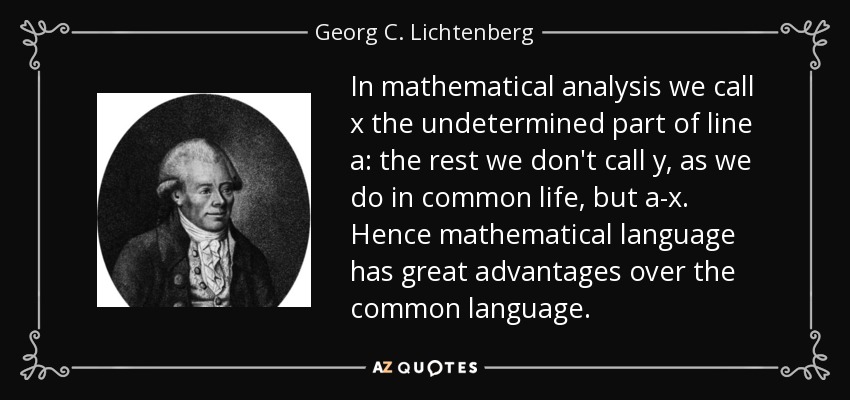
In mathematical analysis we call x the undetermined part of line a: the rest we don't call y, as we do in common life, but a-x. Hence mathematical language has great advantages over the common language.
In engineering, as in other creative arts, we must learn to do analysis to support our efforts in synthesis. One cannot build a beautiful and functional bridge without a knowledge of steel and dirt, and a considerable mathematical technique for using this knowledge to compute the properties of structures. Similarly, one cannot build a beautiful computer system without a deep understanding of how to "previsualize" the process generated by the code one writes.
When a truth is necessary, the reason for it can be found by analysis, that is, by resolving it into simpler ideas and truths until the primary ones are reached. It is this way that in mathematics speculative theorems and practical canons are reduced by analysis to definitions, axioms and postulates.
The task of physiological psychology remains the same in the analysis of ideas that it was in the investigation of sensations: to act as mediator between the neighbouring sciences of physiology and psychology.
Whether or not you agree that trimming and cooking are likely to lead on to downright forgery, there is little to support the argument that trimming and cooking are less reprehensible and more forgivable. Whatever the rationalization is, in the last analysis one can no more than be a bit dishonest than one can be a little bit pregnant. Commit any of these three sins and your scientific career is in jeopardy and deserves to be.
In the last analysis, what the Marine Corps becomes is what we make of it during our respective watches. And that watch of each Marine is not confined to the time he spends on active duty. It last as long as he is "proud to bear the title of United States Marine."
When I started writing a business column 15 years ago, I knew I'd found the perfect job for myself. As a columnist I could pick my own topic, do my own analysis, say what I wanted to say and attribute it to myself. Best of all, I could write in my own voice.
Sometimes during the two-year curriculum, every MBA student ought to hear it clearly stated that numbers, techniques, and analysis are all side matters. What is central to business is the joy of creating.
Just as the pianist practices the most complicated pieces to improve the technique of his fingers, so too a grandmaster must keep his vision in trim by daily analysis of positions with sharp possibilities, and this applies whether he prefers such positions in his play or not.
It's a very special generation, because during our careers the computer entered chess. So we know how to play without computers, which is also important. We can analyse without computers. I am not saying that younger players cannot do this, but we are more in the habit of doing this. That's important to improve your chess understanding.
Sometimes it happens that the computer's assessment is very abstract. It's correct, but it's not useful for a practical game. You have to prove the assessment with very strong moves and if you don't find all of these strong moves you may lose very quickly. For a computer this is not a problem, but for humans it is not so easy.
In analysing complicated variations one must examine each branch of the tree once and once only.
Like Dvoretsky, I think that (all other things being equal), the analytical method of studying chess must give you a colossal advantage over the chess pragmatist, and that there can be no certainty in chess without analysis. I personally acquired these views from my sessions with Mikhail Botvinnik, and they laid the foundations of my chess-playing life.
By strictly observing Botvinnik's rule regarding the thorough analysis of one's own games, with the years I have come to realize that this provides the foundation for the continuous development of chess mastery.
Analysis is a glittering opportunity for training: it is just here that capacity for work, perseverence and stamina are cultivated, and these qualities are, in truth, as necessary to a chess player as a marathon runner.
Our job is not to amuse our readers. Our mission is to stir them, inform and inflame them. Our task is to continually hold up our government and our leaders to clear-eyed analysis, unaffected by professional spinmeisters and agenda-pushers.
It is not possible to become a great player without having learned how to analyse deeply and accurately.
It is hardly useful if you trustingly play through variation after variation from a book. It is a great deal more useful and more interesting if you take part actively in the analysis, find something yourself, and try to refute some of the author's conclusions.
Training in analysis (like any other form of chess training) should be treated very seriously.
Along with my retirement from chess analytical work seems to have gone too.
I claim that nothing else is so effective in encouraging the growth of chess strength as such independent analysis, both of the games of the great players and your own.
The triumph of the analytical movement, which formed in the '30's and '40's, was precisely what earned the Soviet masters the acclaim of chessplayers the world over. Unfortunately, it must also be noted that, for today's chessmasters, the watchword is practicality.
Like the alchemist of old, for ever searching for the philosopher's stone, the analyst to-day never stops looking for stronger moves to prevent the defender from establishing equality.
To my surprise I found that when other top players in the precomputer age (before 1995, roughly) wrote about games in magazines and newspaper columns, they often made more mistakes in their annotations than the players had made at the board.
He who analyses blitz is stupid.
Follow AzQuotes on Facebook, Twitter and Google+. Every day we present the best quotes! Improve yourself, find your inspiration, share with friends
or simply: