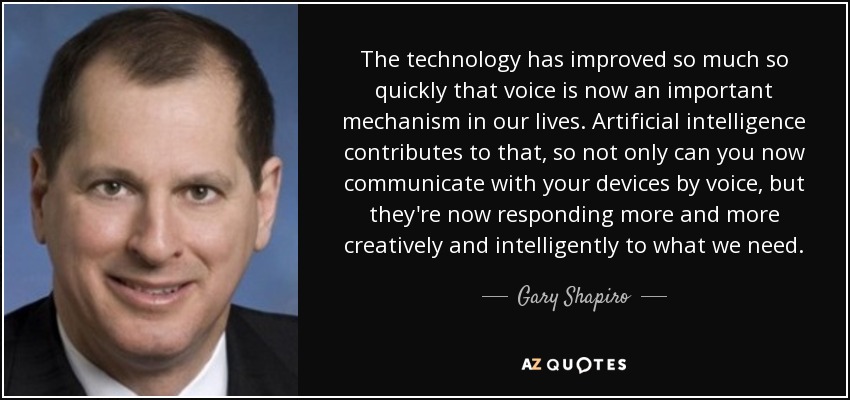
The technology has improved so much so quickly that voice is now an important mechanism in our lives. Artificial intelligence contributes to that, so not only can you now communicate with your devices by voice, but they're now responding more and more creatively and intelligently to what we need.
Artificial intelligence uses a complex set of rules - algorithms - to get to a conclusion. A computer has to calculate its way through all those rules, and that takes a lot of processing. So AI works best when a small computer is using it on a small problem - your car's anti-lock brakes are based on AI. Or you need to use a giant computer on a big problem - like IBM using a room-size machine to compete against humans on Jeopardy in 2011.
I advocate as a futurist and also as a member of the Transhumanist Party, that we never let artificial intelligence completely go on its own. I just don't see why the human species needs an artificial entity, an artificial intelligence entity, that's 10,000 times smarter than us. I just don't see why that could ever be a good thing.
What I advocate for is that, as soon as we get to the point when artificial intelligence can take off and be as smart, or even 10 times more intelligent than us, we stop that research and we have the research of cranial implant technology or the brainwave. And we make that so good so that, when artificial intelligence actually decides - when we actually decide to switch the on-button - human beings will also be a part of that intelligence. We will be merged, basically directly.
Right up till the 1980s, SF envisioned giant mainframe computers that ran everything remotely, that ingested huge amounts of information and regurgitated it in startling ways, and that behaved (or were programmed to behave) very much like human beings... Now we have 14-year-olds with more computing power on their desktops than existed in the entire world in 1960. But computers in fiction are still behaving in much the same way as they did in the Sixties. That's because in fiction [artificial intelligence] has to follow the laws of dramatic logic, just like human characters.
Futurists are already predicting the day mankind builds its replacement, Artificial Intelligence. Daniel Wilson shows what might happen when that computer realizes its creators are no longer needed. Lean prose, great characters, and almost unbearable tension ensure that Robopocalypse is going to be a blockbuster. Once started I defy anyone to put it down.
With artificial intelligence, we are summoning the demon. In all those stories where there's the guy with the pentagram and the holy water, it's like, yeah, he's sure he can control the demon. Didn't work out.
With the increasingly important role of intelligent machines in all phases of our lives--military, medical, economic and financial, political--it is odd to keep reading articles with titles such as Whatever Happened to Artificial Intelligence? This is a phenomenon that Turing had predicted: that machine intelligence would become so pervasive, so comfortable, and so well integrated into our information-based economy that people would fail even to notice it.
I'm hoping the reader can see that artificial intelligence is better understood as a belief system instead of a technology.
Computer science really involves the same mindset, particularly artificial intelligence.
There are lots of examples of routine, middle-skilled jobs that involve relatively structured tasks, and those are the jobs that are being eliminated the fastest. Those kinds of jobs are easier for our friends in the artificial intelligence community to design robots to handle them. They could be software robots; they could be physical robots.
My colleagues, they study artificial intelligence; me, I study natural stupidity.
Robots equipped with software can be designed to do repetitive jobs. All that you need in a factory is a set of dials, an expert, and a dog to keep the expert awake. We will be moving shortly to the next stage to robots with artificial intelligence who can "think."
I'm a fan of the simulation theory. I tend to think that most of our existence, if not all of it, is part of a hologram created by some type of other life form, or some type of other artificial intelligence. Now, it may be impossible for us to ever know that, but a bunch of recent studies in string theory physics have proved that.
Robots want to love us because the field of artificial intelligence has programmed robots to say they want to love us.
I've found that in life, and certainly in music, it's all just a series of occurrences in which you are constantly assessing the potential outcome of your decisions based on past precedence. As an aside, this is apparently the defining factor in science that separates artificial intelligence from human consciousness. One thing that our brains are really good at is taking a bunch of answers and extrapolating the question, whereas in computing, you input a question and it will provide an answer.
I think that the artificial-intelligence people are making a lot of noise recently, claiming that artificial intelligence is making huge progress and we're going to be outstripped by the machines. But, in my view, this whole field is based on a misconception. I think the brain is analog, whereas the machines are digital. They really are different. So I think that what the machines can do, of course, is wonderful, but it's not the same as what the brain can do.
The chances of human beings being the only intelligent form of life in the universe are so minuscule that it's really kind of crazy to actually - no scientist could ever argue that we would be alone. It's much more likely that there are hundreds of thousands of other intelligences and other life forms out there in the universe just based on a strictly mathematical formula. And what that means is that artificial intelligence has probably already occurred in the universe.
We call ourselves Homo sapiens--man the wise--because our intelligence is so important to us. For thousands of years, we have tried to understand how we think: that is, how a mere handful of matter can perceive, understand, predict, and manipulate a world far larger and more complicated than itself. The field of artificial intelligence, or AI, goes further still: it attempts not just to understand but also to build intelligent entities.
Maybe we want to keep A.I. to the level of a 16-year-old or a 17-year-old adolescent, rather than some fully maxed-out artificial intelligence that becomes 10,000 times smarter than us in just a matter of years. Who knows what could happen? It could be a very dangerous scenario.
I'm working on artificial intelligence. Actually, natural language understanding, which is to get computers to understand the meaning of documents.
Could Artificial Intelligence End the Electronic Medical Record Nightmare?
I envision some years from now that the majority of search queries will be answered without you actually asking. It'll just know this is something that you're going to want to see.
In the field of Artificial Intelligence there is no more iconic and controversial milestone than the Turing Test, when a computer convinces a sufficient number of interrogators into believing that it is not a machine but rather is a human. It is fitting that such an important landmark has been reached at the Royal Society in London, the home of British Science and the scene of many great advances in human understanding over the centuries. This milestone will go down in history as one of the most exciting.
We know have the power of God in many ways: the atomic bomb, the ability to create life in a test tube, cloning, artificial intelligence.
Follow AzQuotes on Facebook, Twitter and Google+. Every day we present the best quotes! Improve yourself, find your inspiration, share with friends
or simply: