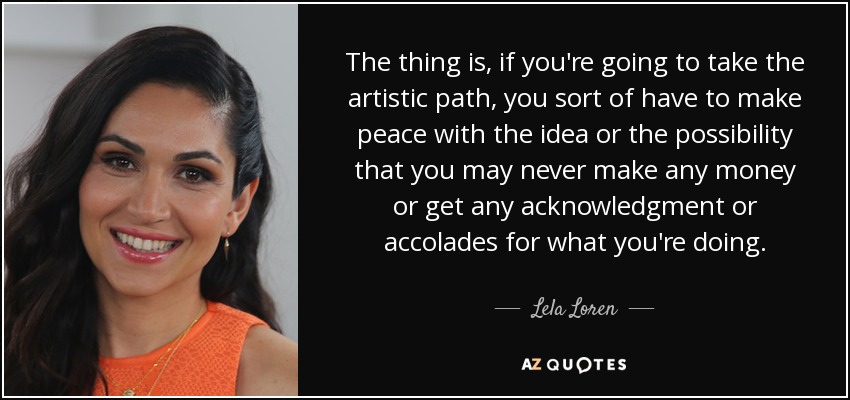
The thing is, if you're going to take the artistic path, you sort of have to make peace with the idea or the possibility that you may never make any money or get any acknowledgment or accolades for what you're doing.
I am seeing strength in the ability of artistic expression to change our future.
I grew up as an only child, and my mother was a single mom. It's always been "us." If it weren't for her nurturing and guiding my artistic talents at a young age, I don't think I'd be a professional actress and performer today.
I was always known as that stocky, muscular, powerful, short, athlete. People always wondered if I was on steroids, and it was because I wasn't that long and lean, flexible, artistic gymnast. It didn't affect me too much but it got to the point where I tried to be that long and lean gymnast, and it just wasn't possible.
We are not saying that all women should be thin like these very thin and young girls. We are creating a show, with its artistic codes and rules, and we have to try not to mix up all the codes together.
When the doors to television were opened to me, that was quite a surprise. It's been such a gift that there was so much TV and independent film happening in New York that I could be a part of. There was something to satiate my desire to be artistic and creative, especially when it wasn't in the way I originally thought it was going to be.
The young of human beings compare so poorly in original efficiency with the young of many of the lower animals, that even the powers needed for physical sustentation have to be acquired under tuition. How much more, then, is this the case with respect to all the technological, artistic, scientific, and moral achievements of humanity!
There's always the danger that there are so damn many things that a playwright can examine in this society of ours - things that have less to do with his artistic work than have to do with the critical and aesthetic environment - that perhaps he does have to worry about whether or not he is writing too fast. But then also, perhaps he should worry about getting as many plays on as possible before the inevitable ax falls.
The ultimate judgment of a work of art, whether it be a masterpiece or a lesser event, must be solely in terms of its artistic success and not on Freudian guesswork.
You may dislike the intention enormously but your judgment of the artistic merit of the work must not be based on your view of what it's about. The work of art must be judged by how well it succeeds in its intention.
One can be a technical master - full of craftsmanship, but not in most senses an artistic master.
I feel like my dad was the more artistic one, creating his own thing, loving to be around people, and all this stuff, doing exciting things, and my mom was more of the performer.
My mom is one, but there have been performers in my family since as long as we can trace them back, so I think it was kind of inevitable to be artistic and to have a force. We're leaders; we're a family of leaders, so I think it's just part of my genes.
Attempts are found in domains of human performance, such as sports, games, artistic domains, professional domains like medicine and the law, and so on. These feature distinctive aims, and corresponding competences. Archery, with its distinctive arrows and targets, divides into subdomains. Thus, competitive archery differs importantly from archery hunting.
I think the world that I grew up in was like being in this sort of magical artistic garden.
It wasn't until I was in college that I even realized how much I loved film and started to appreciate acting, this beautiful medium of artistic expression. All I wanted to do was go to college, and I thought I wanted to be a teacher.
The push and pull of representing your world responsibly and your artistic license is a tricky balance.
We don't have a lot of power in the world, right? We can only control so many things. It allows you to curate your own emotional and artistic intake of life.
When you're playing festivals, you only get a half-hour. It's like a meat market. You don't get to be artistic. You don't get to play music. It's called a showcase for a reason.
I kind of started with this foundation, and tried to do all the research I could do for Alice [Cullen], and then every time a [new] director would come in, they have their own artistic take on things and add in new elements. And a lot of times they would ask, "What did you love that you portrayed, and what do you wish that you could show?" So I felt, with each installment, I got the opportunity to add on something. I think she was very - you know, really sweet, [laughs] a little odd in the first installment.
My family was not an artistic family, but somewhere in my head, I thought I might be good at it. I don't know why I thought it. I had no evidence to think I might be good at it.
The cliché of that sort of wasted, renegade, drugged-out musician of the '70s is kind of dead and gone now. And I suppose that a lot of people still keep relying on that, or some kind of image to perpetuate something that they think they're supposed to sound like. But that kind of takes you away from real inspiration and, you know, real artistic discovery of the individual.
I remember somebody saying something to me about Frost/Nixon, when Anthony Hopkins does his famous speech, and the difference in the way Anthony did it was to dramatize, essentially, what was a documentary-style version of that speech. I remember someone saying to me, "There is artistic liberty."
For people who make inventions, whether they make scientific inventions or artistic inventions, they're driven by pretty much the same thing. It's some mistrust from somebody saying it couldn't be a certain way, and overthrowing that. But that can happen at any point in history, at any time you come along. It doesn't get better or worse because you're born in this era or that era - I think it's more individualistic. It comes from within, you know, it's an internal thing.
My parents weren't in the arts, but we grew up in Balmain, which at that time was an artistic, bohemian suburb of Sydney. It's a lot more gentrified now. It was very working class, pubs on every corner because it's right by the water so a lot of the guys on the ships and the boats used to go and drink there. It's very posh now.
Follow AzQuotes on Facebook, Twitter and Google+. Every day we present the best quotes! Improve yourself, find your inspiration, share with friends
or simply: