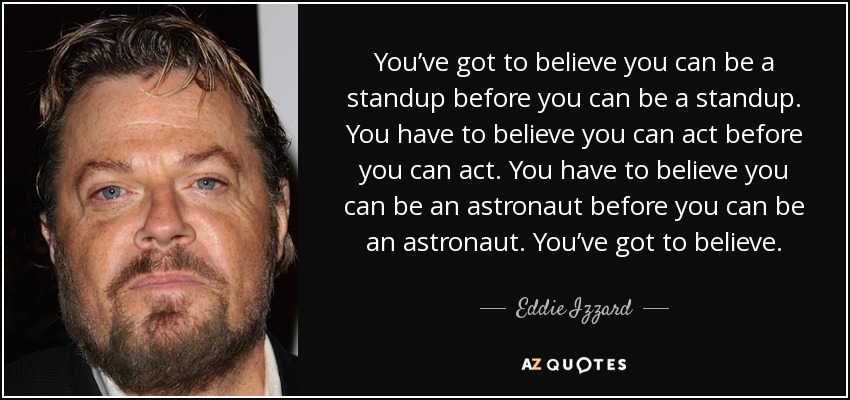
You’ve got to believe you can be a standup before you can be a standup. You have to believe you can act before you can act. You have to believe you can be an astronaut before you can be an astronaut. You’ve got to believe.
Constantly working outward, putting system after system inside the known universe, they were the bright hungry wave of mankind reaching out to gather in the stars.
Audiences of critical thinkers are my favorite kinds of audiences. There are jokes I tell in the show that don't get laughs unless I am in front of an audience of critical thinkers. Put me in front of a crowd of science teachers or astronauts! The guileless aren't our audience - it's the critical thinkers we love.
When you talk to astronauts, the most profound thing when you finally go into space is the view - looking back at the planet - so I absolutely know for sure that that's going to change my perspective on our planet, and it's going to change my perspective on life, I think.
Modern neuroimaging is like asking an astronaut in the space shuttle to look out the window and judge how America is doing.
I can only wonder what astronauts must feel like or something like that when you're really in the space of silence and you are feeling and breathing in a way that you're really aware of your muscle and bone and the breath and the body and the movement and all of those things that just you take for granted in the urban landscape.
I grew up in California. I was outside of the city, not directly in it. So I did have an experience of the sky, but for me, it was the idea of space exploration that fueled my interest. I grew up in that age of the astronauts, and I was fascinated that we could leave the Earth.
To become an astronaut is not a question of being the best at something or things coming easy to you, but it's being a person that can work with others and not give up. And, for me, that was part of it too.
Growing up in the shadow of Johnson Space Center and moving to Texas to welcome our last moon mission home, I wanted to be an astronaut. Combined with my love for Navy history and World War II flight ops, and unsatisfying degrees in college and law school, I joined the Navy and became a naval aviator.
I applied to be an astronaut four times. I was rejected three times before I was accepted. So, it's about that, not - following your dream and not giving up.
The space station mission was kind of the culmination of all of my experience of being a NASA Astronaut, so it had brought all of my previous experience into play. I had to learn the Russian language to a fluent level so that I could function as the co-pilot of the Soyuz Spacecraft that we flew up and back from the space station. And then the challenge of being the Commander of the whole expedition, a six and a-half month flight aboard the international space station. I felt the burden of the whole mission on my shoulders, which was fine, and fortunately everything did go well.
As far as Russia goes, they've been our partner for a long time now, since the early '90's. So you know, what's that, that's more than 15 years. And there have been times where things were a little tense, a little testy, but by and large, the partnership has been very successful. To give you two examples of that, when the Columbia accident occurred, the Russians supported us with their spacecraft faring our astronauts, including me, to the space station and also supplies.
My advice for an aspiring astronaut is to really follow your passion. I mean, study something that interests you, but also qualifies you to apply. NASA recruits from a wide variety of backgrounds. I know people who have applied to be an astronaut who ask me, well should I do this or should I do that. And I said, you know, it doesn't matter. The basic requirements are you have to be in good health, and you have to have a good heart, I mean in a technical way, not to be a kind person, well that helps. Study something that you like and do well in it.
One peculiarity of an astronaut's job is that we do everything in public. Also, you don't want to make a mistake. In the best case, it's an embarrassment, in the worst, death. That's also part of the training. They teach you to think like an astronaut, like they do with a pilot, a military man, a fireman. You dissociate in your mind the gravity of the consequences of your mistake.
Canada needs individuals to whom educators can point, and of whom we can be proud, whether athletes or astronauts or anything else. I think the role each of Canadian plays is not so much "Look at me," but rather, "Look at our country".
Most astronauts are very down-to-earth people. Many of us, three-quarters, have an engineering degree, and we have a very Cartesian, rational approach to things. You don't go and get swept off your feet. That's not your job and that's not why you're hired. So if you get so mesmerized that you forget to do what you're supposed to do, whether it's to open the cargo door of the space shuttle or configure something inside, then you should not be there as a professional operator.
I think pirates, like astronauts, particularly for a boy, are always kind of worth thinking about.
I saw this film Moon, it's directed by Duncan Jones, David Bowie's son. Sam Rockwell plays this astronaut that is stuck in a space station on the moon. You just have to see it. It's easy to do something really cheesy with sci-fi, and to do something that's already been done, but I think the story was something I hadn't heard before, so it was really great.
The prerequisite that people have a scientific or engineering degree or a medical degree limits the number of female astronauts. Right now, still, we have about 20 per cent of people who have that prerequisite who are female. So hey, girls: Embrace the very fun career of science and technology. Look at computer science. That's what I did.
Most people here don't have a wide emotional range. It's just the type of people astronauts are, they're required to be level.
I've never had a musical career. So I think it's been unaffected. I play the accordion. In terms of thinking of it as a musical career, I think it's sort of like calling yourself an astronaut because you have a shiny suit.
Spacemen die if they stay in one place.
Astronauts were not the impulsive daredevils so dear to the stereopticonloving public. They couldn't afford to be. The hazards of the profession required an infinite capacity for cautious, contemplative thought.
Spacemen - men who work in space, pilots and jetmen and astrogators and such - are men who like a few million miles of elbow room.
David will never go to space again. I'm glad.What did it gain the McQuarries? What has it ever gained men? Have men ever brought back more happiness from the stars? Will they ever?
Follow AzQuotes on Facebook, Twitter and Google+. Every day we present the best quotes! Improve yourself, find your inspiration, share with friends
or simply: